
Can I measure my yard myself? Yes, you absolutely can measure your yard yourself with the right tools and a little patience. This guide will walk you through the process of how to measure a yard accurately, whether it’s a simple rectangle or a more complex shape. Knowing your yard’s dimensions is crucial for many tasks, from landscaping and gardening to installing fences or calculating the amount of seed or fertilizer you’ll need. We’ll cover everything from how to calculate yard size to determining property lines and finding the square footage of a yard.
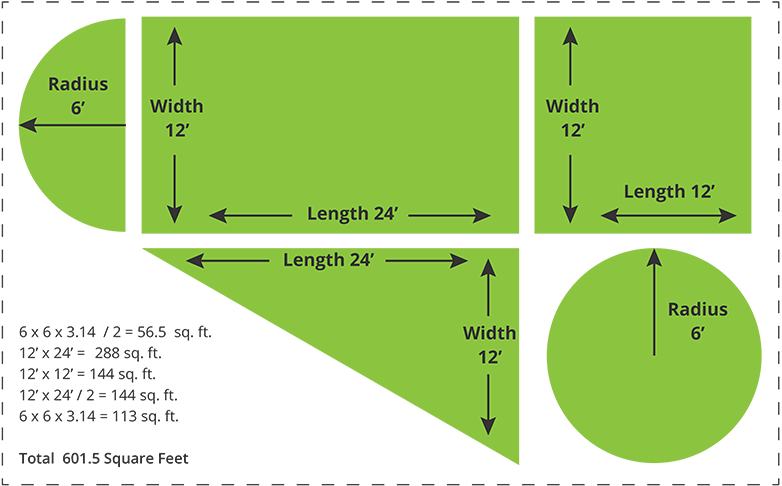
Image Source: gvt.net
Gathering Your Measuring Tools
Before you start, ensure you have the right tools for measuring land. Having these on hand will make the process much smoother and more accurate.
Essential Tools
- Measuring Tape: A long tape measure is your primary tool. For larger yards, a 100-foot or 200-foot tape measure is ideal. A digital laser measuring device can also be very helpful for longer distances.
- Stakes or Markers: These can be anything from wooden stakes to brightly colored flags or even spray paint. You’ll use these to mark corners and points along your property lines.
- Pencils and Paper or a Digital Device: To record your measurements.
- Calculator: To help with calculations.
- Work Gloves: For protection while handling stakes or navigating rough terrain.
- Helper (Optional but Recommended): Having a second person can make measuring long distances much easier and more accurate.
Advanced Tools (Optional)
- GPS Device or App: For very large properties or if you need precise coordinates, a GPS device can be useful. Many smartphone apps also offer basic GPS measuring capabilities.
- Surveying Equipment: For official boundary determinations or complex projects, professional surveying equipment might be necessary. However, for most homeowner needs, a good tape measure will suffice.
Measuring a Rectangular Yard
Most yards are not perfectly rectangular, but many have at least one section that is. Measuring a rectangular yard is the simplest scenario.
Step-by-Step Guide
- Identify the Corners: Locate the four main corners of your rectangular yard section. These are often marked by fences, property markers, or significant landscaping features.
- Measure Length: Have your helper hold the end of the tape measure at one corner. Walk in a straight line to the adjacent corner, keeping the tape taut. Record this measurement. This is the length.
- Measure Width: Repeat the process for the other two sides. Measure from a corner to the next adjacent corner. This is the width.
- Record Measurements: Write down both the length and width measurements clearly. For example, Length = 150 feet, Width = 75 feet.
Calculating Square Footage
Once you have the length and width, calculating the square footage of a yard is straightforward.
- Formula: Square Footage = Length × Width
- Example: If your yard is 150 feet long and 75 feet wide, the square footage is 150 ft × 75 ft = 11,250 square feet.
This calculated number represents the plot size measurement of that specific rectangular section.
Measuring an Irregular Yard
Most yards have curves, angles, and non-straight boundaries, making them irregular shapes. Measuring an irregular yard requires breaking it down into simpler geometric shapes.
Breaking Down Complex Shapes
The key to accurately measuring an irregular yard is to divide it into smaller, manageable sections that you can measure easily. Common shapes to consider are rectangles, squares, triangles, and semicircles.
1. Rectangular and Square Sections
- Many irregular yards can be broken down into several rectangular or square areas.
- Measure the length and width of each rectangular section as described above.
- Calculate the square footage for each section individually.
2. Triangular Sections
- If you have a triangular area, you’ll need to measure its base and height.
- Base: Measure the longest side of the triangle.
- Height: The height is the perpendicular distance from the base to the opposite vertex (corner). You might need to use a plumb bob or a laser measuring device to find this perpendicular line if the corner isn’t directly across from the base.
- Formula: Area of Triangle = 0.5 × Base × Height
- Example: If a triangular section has a base of 50 feet and a height of 30 feet, its area is 0.5 × 50 ft × 30 ft = 750 square feet.
3. Circular or Semicircular Sections
- If your yard has a circular feature, like a patio or a round garden bed, measure its diameter (the distance across the circle through the center).
- Radius: The radius is half of the diameter.
- Formula: Area of Circle = π × Radius² (where π is approximately 3.14159)
- Example: If a circular garden bed has a diameter of 20 feet, its radius is 10 feet. The area is approximately 3.14159 × (10 ft)² = 3.14159 × 100 sq ft = 314.16 square feet.
- For semicircles, calculate the area of the full circle and divide by two.
Putting it All Together
Once you have calculated the area of each individual shape within your yard, you simply add them up to find the total square footage of a yard. This is how you effectively calculate your total plot size measurement. This method of dividing and conquering is key to measuring land area accurately.
Determining Property Lines
Accurately determining property lines is crucial, especially if you plan to build, fence, or make significant changes to your yard.
Locating Boundary Markers
- Property Survey: The most accurate way to determine your property lines is to consult your property survey. This document, usually provided when you purchased your home, shows the official boundaries and any markers.
- Physical Markers: Look for physical markers such as:
- Metal Stakes or Pipes: Often found at property corners, these are usually sunk into the ground.
- Concrete Monuments: Larger, more permanent markers.
- Wooden Stakes: May have been placed by surveyors.
- Natural Features: Sometimes, property lines are defined by fences, walls, mature trees, or waterways. However, these can shift or be ambiguous.
- County Records: Your local county recorder’s office or assessor’s office will have records of property boundaries and surveys.
Measuring Between Markers
Once you’ve identified your property corner markers:
- Measure Distances: Use your tape measure to find the distances between these markers.
- Record Angles (If Necessary): For complex boundaries, you might need to measure angles. This is where a protractor or more advanced tools might be helpful, but for most home use, straight-line measurements are sufficient.
- Document Everything: Keep detailed notes and sketches of where the markers are located and the measurements between them.
If the markers are missing or unclear, it’s best to contact a licensed surveyor to officially determine property lines. Attempting to guess can lead to disputes with neighbors.
Estimating Yard Dimensions for Specific Tasks
Sometimes, you don’t need the exact square footage of a yard but rather a good estimate for calculating lawn size or planning a project.
Quick Estimation Techniques
- Pacing: You can estimate distances by counting your steps. Know the average length of your stride (e.g., if your stride is 3 feet, 100 strides is about 300 feet). This is a quick way to get a rough idea, but it’s less accurate than using a tape measure.
- Using Known Objects: If you know the length of a standard garden hose, a car, or a common paving stone, you can use these as visual aids to estimate yard dimensions.
Practical Applications of Yard Measurement
- Landscaping and Gardening: Knowing your yard’s size helps you determine how much soil, mulch, plants, or sod you’ll need.
- Fencing: Accurate measurements are essential for calculating the amount of fencing material and the number of posts required.
- Sprinkler Systems: You can map out your yard and calculate the area to design an efficient irrigation system.
- Lawn Care: Calculating your lawn size helps determine how much fertilizer, grass seed, or weed killer to purchase.
Tips for Accurate Measurement
Accuracy is key when measuring land area. Follow these tips to ensure your results are as precise as possible.
Best Practices for Measuring
- Go Slow and Steady: Rushing can lead to mistakes. Take your time with each measurement.
- Keep the Tape Measure Taut: A slack tape measure will result in shorter, inaccurate readings.
- Measure in Straight Lines: Avoid measuring around curves unless you are specifically calculating the length of a curved boundary. For measuring land area, straight lines are usually preferred for the initial breakdown.
- Account for Obstacles: Try to measure from point A to point B directly. If there’s an obstacle like a shed or a large tree, you might need to measure around it and then account for that detour, or break the measurement into segments.
- Double-Check Your Work: Measure each section twice, or have your helper measure it and compare.
- Record Units: Always note whether you are measuring in feet, meters, inches, etc., and be consistent.
- Consider Elevation Changes: For precise landscaping or construction, significant elevation changes can affect area calculations or material needs. While standard yard measuring usually focuses on horizontal distances, be mindful of slopes.
Dealing with Common Challenges
- Sloping Ground: For slopes, you are usually interested in the horizontal distance, not the distance along the slope. If using a tape measure on a slope, try to keep it as level as possible. Laser measures are often better at providing horizontal distances automatically.
- Obstructions: If a property line is marked by a fence that isn’t perfectly straight or is on the boundary itself, measure from the official corner markers rather than relying solely on the fence line.
- Lost Markers: If you cannot find a boundary marker, it’s a good indication that you may need professional help to re-establish the property lines.
Calculating Lawn Size and Beyond
Understanding your calculating lawn size is just one aspect of measuring land area. Your entire yard might include patios, driveways, garden beds, and structures. When you need the total plot size measurement of your property, you’ll need to account for all these elements.
Incorporating All Yard Features
- Map Your Yard: Draw a rough sketch of your yard.
- Outline Different Areas: Draw lines to represent different types of surfaces or zones (lawn, patio, driveway, flower beds, etc.).
- Measure Each Zone: Use the techniques described above to measure the area of each individual zone.
- Sum Total Area: Add up the areas of all the zones to get the total plot size measurement of your property.
This detailed breakdown is essential for comprehensive planning, especially for larger projects. For example, when determining property lines for a new fence, you’ll want to know the exact dimensions of the area you intend to fence.
Frequently Asked Questions (FAQ)
Here are some common questions people have when measuring their yards:
What is the best way to measure a very large yard?
For very large yards, a 100-foot or 200-foot tape measure is essential. Alternatively, a laser measuring device can significantly speed up the process, especially if you have a helper to hold the target end. For extremely large or irregularly shaped properties, considering a professional survey might be more efficient and accurate.
Can I use my phone to measure my yard?
Yes, there are many smartphone apps that use augmented reality (AR) and GPS to help you measure distances and areas. While these can be convenient for quick estimates, they are generally not as accurate as using a physical tape measure or laser device, especially for precise projects.
How do I account for a curved fence when measuring my yard?
If a fence defines a boundary but is curved, you’ll need to measure the straight-line distance between the endpoints of the curve (this is the chord). If you need the exact length of the curved fence itself, you can approximate it by measuring short, straight segments along the curve and adding their lengths together. For measuring land area, you would typically use the straight-line measurements to define the boundaries of your shapes.
What is the difference between measuring area and perimeter?
Area is the measurement of the surface within a boundary (e.g., square feet or square meters). Perimeter is the measurement of the total length of the boundary around an area (e.g., feet or meters). For calculating lawn size, you’re typically interested in the area. For fencing, you’ll need both the perimeter (for the length of fence) and the area (to determine how much land the fence encloses).
Do I need a survey to measure my yard?
You do not need a survey to measure the dimensions of your yard for general purposes like gardening or buying plants. However, if you need to accurately determine property lines, resolve boundary disputes, or are planning significant construction, a professional survey is highly recommended.
By following these guidelines, you can confidently measure your yard, whether you’re simply estimating yard dimensions for a small garden or mapping out your entire property. Accurate measurements are the foundation of successful projects and informed decisions about your outdoor space.