
A common question for anyone tackling a landscaping project is: How many square feet in a yard of mulch? To answer this directly, a single cubic yard of mulch will cover approximately 100 square feet when spread at a depth of 3 inches. This is a crucial piece of information for effective planning and budgeting for your garden beds and landscaping projects.
Many homeowners and garden enthusiasts wonder about the conversion between cubic yards and square feet when it comes to mulch. This is a fundamental aspect of landscape material estimation, impacting both cost and the overall success of your gardening endeavors. Let’s delve into the details to ensure you’re never left guessing about your mulch needs.
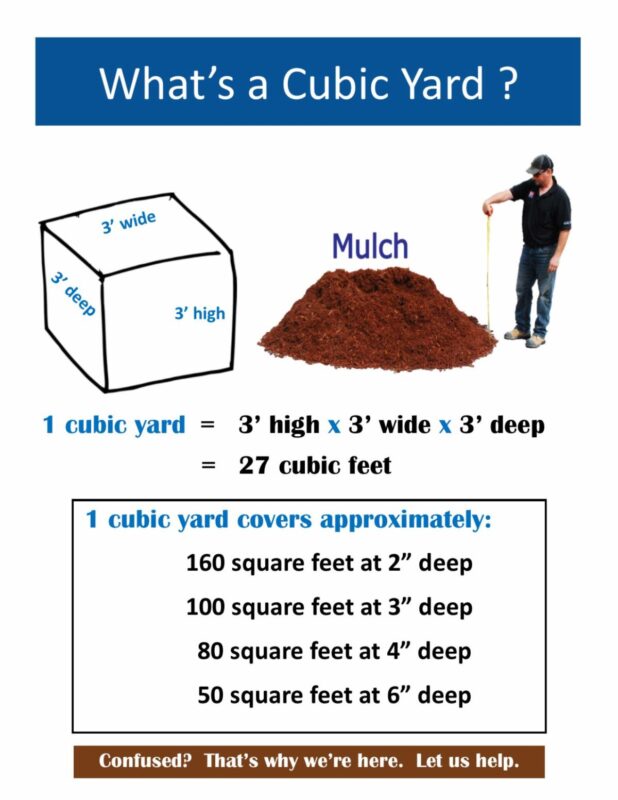
Image Source: stonegarden-nc.com
Deciphering Mulch Coverage: From Volume to Area
The process of converting mulch volume to area coverage might seem a bit confusing at first. It’s not a simple one-to-one conversion because mulch is sold by volume (cubic yards) but applied over an area (square feet) at a specific depth. Think of it like filling a box (volume) and then spreading its contents thinly over a floor (area).
The Core Calculation: Volume to Area Mulch
At its heart, the calculation involves determining how much area a given volume of material can cover when spread to a uniform depth. The standard depth recommended for most mulching applications is 3 inches. This depth is ideal for suppressing weeds, retaining moisture, and regulating soil temperature.
The formula used to determine coverage is:
Coverage (sq ft) = (Volume in cubic feet * 12) / (Depth in inches)
However, since mulch is typically sold in cubic yards, we need to convert that first.
- 1 cubic yard = 27 cubic feet
So, for one cubic yard of mulch:
- Coverage (sq ft) = (27 cubic feet * 12) / 3 inches
- Coverage (sq ft) = 324 / 3
- Coverage (sq ft) = 108 sq ft
This calculation is often rounded to 100 square feet per cubic yard for simplicity and to account for slight variations in mulch density and settling. This is the figure most landscaping professionals and mulch suppliers use.
Understanding Cubic Feet to Square Feet Mulch
When you see “cubic feet to square feet mulch,” it refers to this conversion process. You have a material measured in three dimensions (length, width, and depth, hence cubic feet) and you want to know how much flat surface area it can cover. The depth of application is the key factor that bridges this volume-to-area gap.
- Cubic feet tells you the total amount of space the mulch occupies.
- Square feet tells you the surface area you can cover.
- Depth is the crucial link between the two.
Factors Affecting Mulch Coverage
While 100 square feet per cubic yard is a good rule of thumb, several factors can influence the actual coverage:
- Desired Depth: The most significant factor. If you spread mulch thinner, you’ll cover more area. If you spread it thicker, you’ll cover less.
- Mulch Type: Different types of mulch have varying densities. Finer mulches might compact more easily, potentially covering a slightly larger area than coarser mulches if spread to the same apparent depth.
- Settling: Over time, mulch settles and compacts, especially after rain. A slightly thicker initial application can help maintain the desired depth for longer.
- Application Method: Careful, even spreading ensures you get the most coverage. Shoveling and raking evenly are key.
Planning Your Mulch Project: Backyard Mulch Calculation
When planning your backyard mulch calculation, it’s essential to measure your garden beds accurately. This will prevent you from buying too much or too little mulch.
Steps for Backyard Mulch Calculation:
-
Measure Your Area:
- For rectangular or square beds, measure the length and width in feet.
- For irregularly shaped beds, break them down into smaller, manageable geometric shapes (rectangles, squares, circles, triangles) and measure each part.
- Formula for Rectangles/Squares: Area = Length × Width
- Formula for Circles: Area = π × (radius)² (where radius is half the diameter)
-
Calculate Total Square Footage: Add up the areas of all the individual sections you measured.
-
Determine Desired Mulch Depth: As mentioned, 3 inches is standard. If you want to use a different depth, adjust your calculations accordingly. For example, 2 inches will cover more area, and 4 inches will cover less.
-
Calculate Cubic Yards Needed:
- Convert your total square footage to square inches: Total sq ft × 144 (since 1 sq ft = 144 sq in)
- Convert your desired depth from inches to square feet: Desired Depth (inches) / 12 (inches per foot)
- Formula for Cubic Yards: (Total Square Footage × Desired Depth in Inches) / 36
Let’s break down the formula’s logic:
* You need to find the total volume in cubic feet.
* Volume (cubic feet) = Area (square feet) × Depth (feet).
* To get depth in feet, you divide the desired depth in inches by 12.
* So, Volume (cubic feet) = Total Square Footage × (Desired Depth in Inches / 12).
* Since 1 cubic yard = 27 cubic feet, you divide the volume in cubic feet by 27 to get cubic yards.
* Cubic Yards = [Total Square Footage × (Desired Depth in Inches / 12)] / 27
* Cubic Yards = (Total Square Footage × Desired Depth in Inches) / (12 × 27)
* Cubic Yards = (Total Square Footage × Desired Depth in Inches) / 324A simpler approach using the 3-inch rule:
If you’re using the standard 3-inch depth, one cubic yard covers 100 sq ft.
Cubic Yards Needed = Total Square Footage / 100
Example Calculation:
Let’s say you have a garden bed that is 10 feet long and 5 feet wide. You want to mulch it to a depth of 3 inches.
- Area: 10 ft × 5 ft = 50 sq ft
- Desired Depth: 3 inches
- Cubic Yards Needed (using the 100 sq ft rule): 50 sq ft / 100 sq ft/yard = 0.5 cubic yards.
You would need half a cubic yard of mulch. It’s often wise to round up to the nearest half or full cubic yard to account for settling and ensure you have enough.
Mulch Bag Coverage vs. Bulk Mulch
Mulch is available in both bags and bulk. Understanding mulch bag coverage is essential when deciding which option is best for your project.
Mulch Bags: Convenience for Smaller Jobs
Mulch is commonly sold in bags, typically containing 2 or 3 cubic feet of material. This is perfect for smaller flower beds, accent areas, or containers.
- 2 cubic foot bag: At a 3-inch depth, this bag will cover approximately 6 to 8 square feet. (2 cubic feet × 1728 cubic inches/cubic foot = 3456 cubic inches. 3456 cubic inches / (12 inches/foot × 12 inches/foot × 3 inches depth) = 3456 / 432 = 8 sq ft).
- 3 cubic foot bag: At a 3-inch depth, this bag will cover approximately 9 to 12 square feet. (3 cubic feet × 1728 cubic inches/cubic foot = 5184 cubic inches. 5184 cubic inches / 432 cubic inches/sq ft = 12 sq ft).
Pros of Mulch Bags:
* Easy to transport and handle for small areas.
* Convenient for precise application in specific spots.
* Often come in decorative colors and types.
Cons of Mulch Bags:
* Can be more expensive per cubic yard than bulk mulch.
* More plastic waste.
* Requires many bags for larger projects, making it time-consuming.
Bulk Mulch: Efficiency for Larger Landscapes
For larger landscaping projects, like covering an entire backyard mulch calculation, purchasing mulch in bulk is often more cost-effective and efficient. Bulk mulch is typically sold by the cubic yard.
Pros of Bulk Mulch:
* Generally cheaper per cubic yard.
* Faster to spread large quantities.
* Less waste.
Cons of Bulk Mulch:
* Requires a truck or trailer for transport, or delivery service.
* Can be harder to estimate precise amounts for very small areas.
Using a Mulch Estimator Tool
To simplify the process, many garden centers and landscaping supply websites offer a mulch estimator tool or mulch coverage calculator. These online tools are incredibly helpful for determining exactly how much mulch you need.
Typically, you’ll input:
- The dimensions of your garden beds (length, width, or specific shapes).
- The desired depth of mulch (usually in inches).
The tool then crunches the numbers and tells you the total square footage you need to cover and the estimated number of cubic yards (or bags) required. This takes the guesswork out of the mulch calculation guide.
How a Mulch Coverage Calculator Works
These calculators are based on the same principles we’ve discussed. They use the volume to area mulch conversion formulas. You input your area dimensions, and the calculator determines the total square footage. Then, using your desired depth, it calculates the volume needed.
- Example: You input a 20 ft x 15 ft area and a 3-inch depth.
- The calculator first finds the area: 20 ft × 15 ft = 300 sq ft.
- Then, it calculates the cubic yards needed for a 3-inch depth: 300 sq ft / 100 sq ft/yard = 3 cubic yards.
Using a mulch estimator tool is a great way to ensure accuracy and avoid over or under-ordering.
Achieving Optimal Mulch Depth: The Mulch Depth Calculator
The depth at which you apply mulch is crucial for its effectiveness. Too thin, and it won’t suppress weeds or retain moisture well. Too thick, and it can suffocate plant roots or prevent water from reaching the soil. A mulch depth calculator helps ensure you get it just right.
While not a separate tool from the coverage calculator, the depth input is a key parameter in any mulch calculation guide.
Recommended Mulch Depths:
- General Garden Beds: 2-3 inches. This provides good weed suppression and moisture retention without hindering plant growth.
- Around Trees: 3-4 inches in a wide circle extending to the drip line, but keep mulch a few inches away from the trunk to prevent rot.
- Steep Slopes: 4 inches or more, possibly combined with a landscape fabric, to prevent erosion.
- New Plantings: Sometimes a slightly thicker layer (3-4 inches) is recommended initially to help establish the plant.
When using a mulch coverage calculator, remember to select the depth that best suits your plants and landscape needs.
How Much Mulch Per Square Foot?
This is the inverse of our main question. If you want to know how much mulch per square foot, it relates to the depth.
- At a 1-inch depth, you need approximately 0.003 cubic yards per square foot.
- At a 2-inch depth, you need approximately 0.006 cubic yards per square foot.
- At a 3-inch depth, you need approximately 0.009 cubic yards per square foot (or 1 cubic yard covers 100 sq ft).
- At a 4-inch depth, you need approximately 0.012 cubic yards per square foot.
These figures are useful if you’re calculating very small areas or have precise depth requirements.
Types of Mulch and Their Coverage
While the basic volume to area mulch conversion remains the same, the type of mulch can subtly affect how easily it spreads and how it looks after settling.
Organic Mulches:
- Wood Chips/Bark Mulch: Common and durable. Different sizes (shredded, nuggets) can affect appearance and how tightly they pack.
- Shredded Bark: Often lighter and can spread easily.
- Pine Straw: Popular in certain regions. It’s lightweight and interlocks, making it good for erosion control.
- Compost: Improves soil as it breaks down. Can be finer and may settle more.
Inorganic Mulches:
- Gravel/Stone: Used for paths, around succulents, or for a modern look. Coverage is generally consistent by volume.
- Rubber Mulch: Made from recycled tires. Durable but can have an odor and may not be ideal for vegetable gardens.
Regardless of the type, the fundamental principle of mulch coverage remains tied to its volume and your chosen depth.
Tips for Accurate Mulch Estimation
- Measure Twice, Order Once: Always double-check your measurements.
- Use an Online Calculator: Leverage mulch estimator tool resources.
- Account for Irregular Shapes: Break down complex areas into simpler geometric shapes.
- Consider Extra: It’s better to have a little extra mulch than to run short, especially if you have a delivery or need to make a second trip to the store.
- Factor in Settling: Plan for mulch to settle by about 10-20% over time, especially after rain. Applying slightly more than the minimum calculated amount can be beneficial.
- Visualize the Depth: Before you start, take a ruler and measure 3 inches on your shovel or rake to get a feel for the correct depth.
Frequently Asked Questions (FAQ)
Q1: How many square feet does one cubic yard of mulch cover?
A: One cubic yard of mulch typically covers about 100 square feet when spread at the standard depth of 3 inches.
Q2: If I spread mulch at 2 inches instead of 3 inches, how much more area will I cover with a cubic yard?
A: If you spread mulch at 2 inches deep, one cubic yard will cover approximately 150 square feet (27 cubic feet / (12 inches/ft × 12 inches/ft × 2 inches / 12 inches/ft) = 27 / 2 = 13.5 sq ft… wait, let’s recalculate: Volume in cubic feet = 27. Area = Volume / Depth. Depth in feet = 2 inches / 12 inches/foot = 0.1667 feet. Area = 27 cu ft / 0.1667 ft = 162 sq ft. So, approximately 162 square feet. This is a significant increase in coverage!
Q3: How many square feet does a bag of mulch cover?
A: This depends on the bag size. A typical 2 cubic foot bag covers about 6-8 square feet at a 3-inch depth, and a 3 cubic foot bag covers about 9-12 square feet. Always check the bag for specific coverage information.
Q4: What is the best depth for mulch?
A: The best depth is generally 2-3 inches for most garden beds. This provides optimal weed suppression and moisture retention without harming plant roots.
Q5: Can I use a mulch coverage calculator online?
A: Yes, absolutely! There are many free mulch coverage calculator tools available online that can help you estimate your needs accurately based on your garden dimensions and desired depth.
Q6: What’s the difference between cubic feet and square feet for mulch?
A: Cubic feet measures the volume (three dimensions: length, width, depth) of the mulch, which is how it’s sold. Square feet measures the area (two dimensions: length, width) of your garden beds that you want to cover. The depth of application bridges the volume to area mulch conversion.
Q7: How much mulch do I need for a circular garden bed?
A: You’ll need to calculate the area of the circle. Measure the diameter, divide by two to get the radius, and then use the formula: Area = π × (radius)². Once you have the square footage, use the mulch estimator tool or divide by 100 (for 3-inch depth) to find your cubic yardage.
By focusing on accurate measurements and using reliable tools like a mulch coverage calculator or a mulch estimator tool, you can confidently plan your landscaping projects and ensure your garden beds look their best with the right amount of mulch. Happy gardening!