
Image Source: i.ytimg.com
How Many Bags Of Concrete For A Cubic Yard?
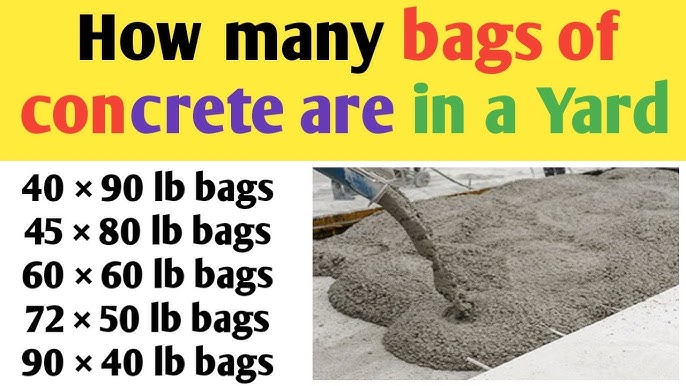
To determine how many bags of concrete are needed for a cubic yard, you’ll generally need four to five 80-pound bags or six to seven 60-pound bags. This is a crucial piece of information when planning any DIY project involving concrete.
Deciphering Bagged Concrete Quantities
When you’re embarking on a concrete project, whether it’s a small patio, a new sidewalk, or a sturdy foundation, one of the most fundamental questions you’ll face is: “How much concrete do I actually need?” More specifically, you’ll be asking yourself, “How many bags of concrete for a cubic yard?” This isn’t just about avoiding a trip back to the hardware store; it’s about efficient budgeting, minimizing waste, and ensuring your project has the structural integrity it requires. Fathoming these quantities accurately is key to a successful outcome.
The Cubic Yard: A Unit of Measurement
Before we dive into the specifics of bagged concrete, it’s essential to grasp what a cubic yard is. A cubic yard is a unit of volume in the Imperial and US customary systems. It’s the volume of a cube that measures one yard on each side. Think of it as a cube that’s 3 feet long, 3 feet wide, and 3 feet high.
- 1 cubic yard = 27 cubic feet
- 1 cubic yard = 46,656 cubic inches
This measurement is the standard for ordering ready-mix concrete, and it’s the benchmark against which we calculate our bagged concrete needs.
How Much Concrete Is In A Bag?
Bagged concrete is convenient for smaller jobs because it’s pre-mixed and readily available. However, these bags come in different weights, which directly impacts how much concrete you get from each one. The most common bag sizes you’ll encounter are:
- 40-pound bags: These are typically for very small repairs or anchoring posts.
- 60-pound bags: A common size for general-purpose concrete work like small patios, steps, or repairs.
- 80-pound bags: The most popular choice for larger DIY projects, offering more volume per bag.
The amount of concrete you get from a bag depends on the specific product and its density when mixed with water. Manufacturers provide an estimated yield for each bag. For instance:
- A 40-pound bag typically yields about 0.3 cubic feet of concrete.
- A 60-pound bag usually yields about 0.45 cubic feet of concrete.
- An 80-pound bag generally yields about 0.6 cubic feet of concrete.
It’s vital to check the packaging of the specific concrete mix you purchase, as yields can vary slightly between brands and formulations.
Estimating Concrete Bags: The Calculation
Now, let’s get to the core of the matter: the concrete bag calculation. To figure out how many bags of concrete you need for a cubic yard, you need to convert the volume of a cubic yard into the volume provided by each bag.
The Formula:
Number of Bags = Total Volume Needed (in cubic feet) / Volume Per Bag (in cubic feet)
Let’s break this down using the common bag sizes:
For 80-pound Bags:
We know 1 cubic yard = 27 cubic feet.
An 80-pound bag yields approximately 0.6 cubic feet.
Number of 80-lb Bags = 27 cubic feet / 0.6 cubic feet/bag
Number of 80-lb Bags = 45 bags
Wait, that doesn’t seem right! Let’s recheck the typical yields. Ah, yes, the common estimations are often simplified. A more precise yield for an 80-pound bag is often closer to 0.65 cubic feet, or even slightly higher depending on the specific mix and water added. Let’s recalculate with a commonly accepted average yield for an 80-pound bag, which is around 0.65 cubic feet.
Number of 80-lb Bags = 27 cubic feet / 0.65 cubic feet/bag
Number of 80-lb Bags ≈ 41.5 bags
This is why you’ll often hear that you need about 4 to 5 bags of 80-pound concrete per cubic yard. It’s always wise to round up to ensure you have enough. So, for a full cubic yard, aim for 42-45 bags.
For 60-pound Bags:
A 60-pound bag yields approximately 0.45 cubic feet.
Number of 60-lb Bags = 27 cubic feet / 0.45 cubic feet/bag
Number of 60-lb Bags = 60 bags
Again, checking manufacturer data is key. Many 60lb bags yield closer to 0.45 – 0.50 cubic feet. Let’s use 0.48 cubic feet as a slightly more generous average yield.
Number of 60-lb Bags = 27 cubic feet / 0.48 cubic feet/bag
Number of 60-lb Bags = 56.25 bags
So, for a cubic yard using 60-pound bags, you’re looking at 56-60 bags. This is why the common estimate is 6 to 7 bags per cubic yard.
For 40-pound Bags:
A 40-pound bag yields approximately 0.3 cubic feet.
Number of 40-lb Bags = 27 cubic feet / 0.3 cubic feet/bag
Number of 40-lb Bags = 90 bags
This clearly illustrates that 40-pound bags are only practical for very small projects.
A Handy Comparison Table
To make things even clearer, here’s a table summarizing the approximate number of bags needed for one cubic yard of concrete based on common bag sizes:
| Bag Size (Weight) | Approximate Yield Per Bag (Cubic Feet) | Bags Per Cubic Yard |
|---|---|---|
| 40 pounds | 0.30 | 90 |
| 60 pounds | 0.45 – 0.50 (use 0.48 for estimate) | 56 – 60 |
| 80 pounds | 0.60 – 0.70 (use 0.65 for estimate) | 42 – 45 |
Important Note: Always verify the yield listed on the specific product packaging you are purchasing. These figures are averages.
Project Planning: Beyond the Cubic Yard
While knowing how many bags of concrete for a cubic yard is essential, effective project planning involves more than just this single calculation. You need to consider the dimensions of your project accurately.
Calculating Your Project’s Volume
Most concrete projects involve slabs or forms of a specific length, width, and depth (or thickness). The formula for volume is straightforward:
Volume = Length × Width × Depth
Make sure all your measurements are in the same units, preferably feet, so you can easily convert to cubic yards.
Example:
Let’s say you want to pour a patio that is 10 feet long, 8 feet wide, and 4 inches thick.
- Convert thickness to feet: 4 inches = 4/12 feet = 0.333 feet.
- Calculate volume in cubic feet: 10 ft × 8 ft × 0.333 ft = 26.64 cubic feet.
- Convert cubic feet to cubic yards: 26.64 cubic feet / 27 cubic feet/cubic yard ≈ 0.987 cubic yards.
In this case, you would need just under one cubic yard of concrete.
Factor in Waste and Spillage
It’s a common and wise practice to add 5-10% to your concrete estimate to account for waste, spillage, and slight variations in formwork. This extra amount can save you from a frustrating trip to the store mid-pour.
Using our patio example: 0.987 cubic yards × 1.05 (for 5% extra) = 1.036 cubic yards.
So, you would round up to 1.1 cubic yards. Based on our earlier calculations:
- If using 80-pound bags (approx. 0.65 cu ft yield): 1.1 cubic yards × 41.5 bags/cubic yard ≈ 45.65 bags. You’d need to buy 46 bags.
- If using 60-pound bags (approx. 0.48 cu ft yield): 1.1 cubic yards × 56.25 bags/cubic yard ≈ 61.875 bags. You’d need to buy 62 bags.
This demonstrates why estimating concrete bags accurately, with a buffer, is so important.
Concrete Mix Ratios: The Foundation of Strength
The strength and durability of your concrete depend heavily on the concrete mix ratios of cement, sand, gravel (aggregate), and water. While pre-bagged concrete has these ratios pre-determined for you (which is a major advantage), it’s good to have a basic awareness.
A common mix ratio for general-purpose concrete is 1:2:3 (cement:sand:gravel). However, the exact ratio is specified by the manufacturer on the bag to achieve the desired strength, often rated in pounds per square inch (psi). For instance, a standard sidewalk might require 3000 psi concrete, while a structural foundation might need 4000 psi or more.
The amount of water added is also critical. Too much water weakens the concrete, while too little makes it difficult to work with. Always follow the water recommendations on the bag precisely.
Buying Bagged Concrete: Key Considerations
When you’re buying bagged concrete, keep these points in mind:
- Bag Weight: Choose the bag size that best suits your project’s scale. Larger bags are generally more economical per volume.
- Product Type: There are different types of concrete mixes:
- All-purpose concrete: Good for general use like sidewalks, patios, and foundations.
- Mortar: Used for laying bricks and stones.
- Quikrete, Sakrete, etc.: These are brand names for pre-mixed concrete products.
- Sand mix: Contains only cement and sand, for patching or thin layers.
- Concrete patching compound: For small repairs.
- Project Requirements: Consider the strength (psi) needed for your application.
- Storage: Keep bags of concrete dry until you’re ready to use them. Moisture will cause them to harden prematurely.
The Benefits of Bagged Concrete
For DIY enthusiasts, bagged concrete quantities offer several advantages:
- Convenience: No need to rent a mixer if your project is small. You can mix smaller batches in a wheelbarrow or mixing tub.
- Accuracy: The proportions of cement, sand, and aggregate are already optimized by the manufacturer.
- Availability: Readily available at most home improvement and hardware stores.
- Cost-Effective for Small Jobs: For projects under a cubic yard, buying bags is usually more economical than ordering ready-mix concrete, which often has a minimum order quantity and delivery fee.
When Ready-Mix Concrete Might Be Better
While bagged concrete is fantastic for smaller tasks, for larger projects (typically over 1-2 cubic yards), ordering ready-mix concrete from a supplier becomes a more practical and often more economical choice.
- Volume: Ready-mix trucks deliver large volumes directly to your site.
- Time Savings: You don’t spend hours mixing bags. The concrete is delivered ready to pour.
- Consistency: Large batch mixing ensures a uniform consistency throughout the entire pour.
- Cost: For significant volumes, the per-cubic-yard cost of ready-mix is often lower than buying individual bags.
If you’re estimating a need for more than 50-60 bags of 80-pound concrete, it’s definitely time to start looking into ready-mix options.
Frequently Asked Questions (FAQ)
Q1: How many 50-pound bags of concrete make a cubic yard?
A: A 50-pound bag typically yields about 0.375 cubic feet. To make a cubic yard (27 cubic feet), you would need approximately 27 / 0.375 = 72 bags.
Q2: Can I just buy enough bags for my project without calculating?
A: While you might get lucky, it’s highly recommended to calculate your needs. Underestimating can lead to delays and color inconsistencies if you have to add more concrete later. Overestimating leads to wasted product and money.
Q3: How much water should I add to a bag of concrete?
A: Always follow the manufacturer’s instructions on the specific bag of concrete you purchased. The amount of water needed can vary slightly between products and brands. Adding too much water will significantly weaken the final concrete.
Q4: What is the difference between concrete and mortar?
A: Concrete is a mixture of cement, sand, gravel, and water, used for structural elements like slabs, walls, and foundations. Mortar is a mixture of cement, sand, and water (no gravel), used as a bonding agent for bricks, stones, and concrete blocks.
Q5: How do I calculate the volume of a circular concrete pad?
A: For a circular pad, you’ll need the radius (half the diameter). The formula for the volume of a cylinder (which a concrete pad is) is: Volume = π × radius² × depth. Ensure all measurements are in the same units (e.g., feet) before calculating and converting to cubic yards.
By carefully calculating your needs and choosing the right product, you can ensure your concrete projects are successful, strong, and visually appealing. Knowing how many bags of concrete for a cubic yard is the first step in that process.