
What is the best way to measure a lawn? The best way to measure your lawn is by breaking it into simple shapes and calculating the area of each. For most homeowners, this involves basic geometry. Can I measure my lawn without special tools? Yes, you can measure your lawn with common household items, though a lawn measurement tool can make it easier. Who needs to measure their lawn? Anyone planning lawn care projects like fertilizing, seeding, or sodding, or those looking to estimate material needs for landscaping will benefit from knowing their lawn’s dimensions.
Why Knowing Your Lawn’s Square Footage Matters
Accurately measuring your lawn’s square footage is a foundational step for any successful lawn care project. Whether you’re planning to overseed, fertilize, apply pest control, or even install a new sprinkler system, knowing the precise area you’re working with prevents waste and ensures you buy the right amount of product. This avoids the common pitfalls of buying too much or too little, both of which can be costly and time-consuming. Estimating lawn size without proper measurement can lead to incorrect application rates for fertilizers, herbicides, and pesticides, potentially damaging your grass or failing to achieve the desired results. For instance, applying too much fertilizer can burn your lawn, while applying too little will have no effect. Similarly, if you’re looking to lay sod or spread grass seed, having the exact lawn area calculation ensures you purchase the correct quantity, saving you trips to the store and unnecessary expenses. This detailed guide will walk you through simple steps to measure your lawn, calculate its area, and get you on the right track for a healthier, more beautiful yard. We will cover various methods, from using basic tools to employing more advanced techniques, ensuring you can accurately determine your lawn dimensions for any project.
Gathering Your Tools: What You’ll Need
Before you begin measuring, it’s helpful to have a few basic tools on hand. While you can often get by with what’s in your home, having the right tools can significantly speed up the process and improve accuracy.
- Lawn Measuring Tape: This is a specialized tool, often a long, durable tape measure (50-100 feet or more) designed for outdoor use. They are typically made of fiberglass or reinforced nylon to withstand weather and wear.
- Measuring Wheel: Also known as a rolling measuring tool or surveyor’s wheel, this is excellent for measuring long, straight distances and curves. You simply walk the perimeter of your lawn, and the wheel records the distance as you go.
- Stakes or Markers: You’ll need these to mark corners or key points of your lawn’s shape. Paint, flags, or even sturdy sticks can work.
- Notebook and Pen/Pencil: Essential for recording your measurements.
- Calculator or Smartphone: To perform the calculations for your lawn area calculation.
- Graph Paper (Optional): Helpful for sketching your lawn and plotting measurements.
- Measuring Tape (Standard): A regular household measuring tape can be used for shorter distances or for measuring features within the lawn.
Having these items ready will make the process of measuring your lawn size much more efficient.
Step-by-Step Guide to Measuring Your Lawn
Measuring your lawn can seem daunting, especially if it’s an irregular shape. However, by breaking it down into manageable steps, you can achieve an accurate lawn area calculation.
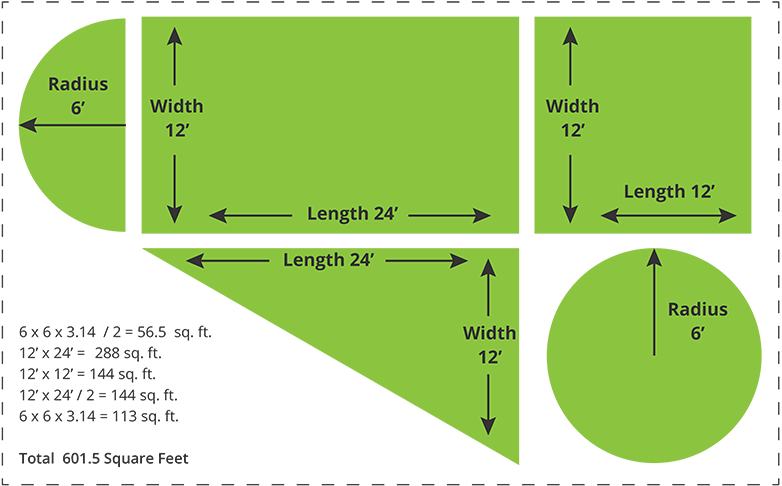
Image Source: gvt.net
Step 1: Visualize and Sketch Your Lawn
The first step in measuring your lawn is to get a clear picture of its shape. Don’t worry about perfection; a rough sketch is all you need.
- Identify the Main Shape: Look at your lawn from a bird’s-eye view, perhaps from a window or by walking around its perimeter. Is it a simple rectangle or square? Does it have curves, odd angles, or attached sections?
- Draw a Basic Outline: On your notebook or graph paper, draw a rough sketch of your entire lawn area. Include any significant features like trees, patios, sheds, or flower beds. These might affect your measurement or be areas you don’t need to include in your lawn area calculation.
- Mark Key Points: Identify the corners of your lawn or the points where the shape changes significantly. Mark these on your sketch.
This sketch will serve as your roadmap as you take your measurements. It helps in visualizing the lawn dimensions and planning how to tackle the measurement process.
Step 2: Measure the Perimeter and Dimensions
Once you have your sketch, you can start taking physical measurements. The goal here is to determine the length and width of the different sections of your lawn.
Measuring Rectangular and Square Lawns
For simple rectangular or square lawns, this is straightforward.
- Measure Length: Use your lawn measuring tape or measuring wheel to measure the longest side of the lawn. Record this measurement.
- Measure Width: Measure the shortest side, perpendicular to the length. Record this measurement.
- Check for Consistency: If your lawn is a perfect rectangle or square, the opposite sides should be equal. Measure all four sides to ensure accuracy.
Measuring Irregularly Shaped Lawns
Most lawns aren’t perfect squares. For irregular shapes, you’ll need to break them down into simpler geometric shapes.
- Divide into Sections: Look at your sketch. Can you divide the lawn into rectangles, squares, triangles, or even semi-circles?
- Measure Each Section:
- Rectangles/Squares: Measure the length and width of each rectangular or square section.
- Triangles: If you have triangular sections, you’ll need to measure the base and the height. The height is the perpendicular distance from the base to the opposite vertex.
- Circles/Semi-circles: If you have circular or semi-circular areas, measure the diameter (the distance across the widest part, passing through the center) or the radius (the distance from the center to the edge).
Using a Measuring Wheel for Curves
A measuring wheel is particularly useful for measuring curved edges.
- Align the Wheel: Place the wheel at the starting point of the curve.
- Walk the Curve: Slowly walk along the edge of the lawn, keeping the wheel on the ground. Try to follow the curve as closely as possible.
- Record the Distance: The wheel will show the total distance traveled along the curve. Record this measurement.
When measuring the perimeter of your lawn, especially if it has curves, ensure you are consistently following the edge.
Step 3: Calculate the Area of Each Section
Now that you have your measurements, it’s time to calculate the area of each shape you identified.
Area Formulas for Common Shapes
Here are the basic formulas you’ll need for your lawn area calculation:
- Square: Area = side × side (or side²)
- Rectangle: Area = length × width
- Triangle: Area = ½ × base × height
- Circle: Area = π × radius² (where π is approximately 3.14159)
- Semi-circle: Area = ½ × π × radius²
Table: Common Area Formulas
| Shape | Formula |
|---|---|
| Square | side × side |
| Rectangle | length × width |
| Triangle | ½ × base × height |
| Circle | π × radius² |
| Semi-circle | ½ × π × radius² |
Note: Remember to use consistent units (e.g., all feet or all meters) for all your measurements before calculating the area.
Examples of Lawn Area Calculation
Let’s illustrate with some examples:
Example 1: Rectangular Lawn
Your lawn measures 50 feet long and 30 feet wide.
Area = 50 ft × 30 ft = 1500 square feet.
Example 2: L-Shaped Lawn
Imagine an L-shaped lawn. You can divide it into two rectangles.
* Rectangle A: 20 ft long × 40 ft wide = 800 sq ft
* Rectangle B: 30 ft long × 20 ft wide = 600 sq ft
Total Area = 800 sq ft + 600 sq ft = 1400 sq ft.
Tip for L-Shapes: If the L-shape is formed by a larger rectangle with a smaller rectangle cut out, measure the outer dimensions, then measure the dimensions of the cutout and subtract its area.
Example 3: Lawn with a Circular Patio
Your lawn is rectangular, 60 ft x 40 ft, with a circular patio in the center that has a diameter of 10 ft. You want to calculate the grass area.
- Lawn Area: 60 ft × 40 ft = 2400 sq ft.
- Patio Radius: Diameter is 10 ft, so radius = 10 ft / 2 = 5 ft.
- Patio Area: π × (5 ft)² = 3.14159 × 25 sq ft ≈ 78.5 sq ft.
- Grass Area: Lawn Area – Patio Area = 2400 sq ft – 78.5 sq ft ≈ 2321.5 sq ft.
This helps you calculate the grass area specifically.
Step 4: Sum Up the Areas for Total Lawn Size
If your lawn was divided into multiple sections, you need to add up the areas of all those individual shapes to get your total lawn area calculation.
- Add all calculated areas: If you measured a rectangle and a triangle, add the area of the rectangle to the area of the triangle.
- Subtract non-lawn areas: If your measurements included patios, driveways, or garden beds that are not part of the grass area you need to treat, subtract their areas from the total.
This final sum gives you the total square footage of your lawn, which is crucial for estimating lawn size accurately.
Advanced Techniques for Complex Shapes
For extremely complex or unusually shaped lawns, there are more advanced methods to achieve an accurate lawn measurement tool equivalent.
Using a Measuring Wheel for Complex Curves
As mentioned earlier, a measuring wheel is excellent for irregular shapes. For very intricate curves, it’s invaluable.
- Trace the Perimeter: Start at a point and slowly move the wheel along the entire outer edge of your lawn.
- Record the Total Distance: The wheel’s counter will give you the total perimeter length. While this doesn’t directly give you area, it’s a useful measurement for understanding the boundary.
- Combining with Straight Measurements: For a complex shape, you might measure some straight sections with a tape measure and the curved sections with the wheel, then add them up for the total perimeter.
Utilizing Online Mapping Tools
Many online tools can help you measure lawn area without physically stepping onto your property with a tape measure.
- Google Earth Pro: This free desktop application allows you to draw polygons over aerial imagery of your property. It automatically calculates the area of the shape you draw.
- Download and install Google Earth Pro.
- Search for your address.
- Use the “Add Polygon” tool to trace the outline of your lawn.
- The tool will display the area of the polygon you drew.
- Other Online Measurement Tools: Several websites offer similar functionality, allowing you to input an address and use drawing tools on satellite imagery to measure distances and areas. Search for “online lawn measurement tool” or “satellite area calculator.”
These digital tools can provide a quick estimate, but physical measurements are often more precise, especially if the satellite imagery isn’t perfectly up-to-date or if your lawn has many features not clearly visible from above.
Professional Surveyors
For extremely large properties or when the highest level of accuracy is required for professional landscaping or construction, hiring a land surveyor is an option. They use specialized equipment to provide precise measurements of your property boundaries and features, including the exact square footage of your lawn.
Common Pitfalls to Avoid When Measuring Your Lawn
Even with simple steps, homeowners can make mistakes when measuring their lawn. Being aware of these common errors can help you achieve a more accurate lawn area calculation.
- Inconsistent Units: Mixing feet and inches, or feet and yards, during your measurements without proper conversion can lead to significant errors in the final square footage. Always ensure you are working with a single unit (e.g., feet) for all your measurements before calculation.
- Not Accounting for Obstacles: Forgetting to subtract the area of driveways, patios, sheds, or large garden beds within your lawn can overestimate the grass area. This leads to buying too much product. Double-check your sketch to ensure all non-lawn areas are accounted for.
- Ignoring Slopes or Uneven Terrain: Most basic measurements assume a flat surface. If your lawn has significant slopes, the actual ground area might be different from the projected flat area. For most homeowner projects, this difference is negligible, but for precise applications like grading, it’s a factor.
- Measuring to the Wrong Boundary: Make sure you are measuring to the actual edge of the grass, not to a fence, a walkway edge, or a different type of landscaping.
- Inaccurate Curve Measurement: When using a standard measuring tape for curves, you might have to approximate. A measuring wheel is better for this. If using a tape measure, try to lay it down in as straight a line as possible along the curve, taking multiple small measurements if necessary.
- Calculation Errors: Simple math mistakes can happen. Double-check your calculations, especially when adding multiple areas or performing multiplications. Using a calculator app on your phone is a good safeguard.
Calculating Total Lawn Area: Putting It All Together
Let’s put everything into practice. Imagine you’ve measured your lawn, and it’s comprised of the following sections:
- Main Rectangular Area: Length = 80 feet, Width = 50 feet.
- Side Strip (Rectangular): Length = 30 feet, Width = 10 feet.
- Corner Garden Bed (Square): Side = 8 feet.
- Curved Flower Bed Edge: Measured with a wheel as 25 feet. (This isn’t an area, but a perimeter).
First, we calculate the area of each section that contributes to the total grass area.
- Area of Main Rectangular Area: 80 ft × 50 ft = 4000 sq ft.
- Area of Side Strip: 30 ft × 10 ft = 300 sq ft.
- Area of Corner Garden Bed: 8 ft × 8 ft = 64 sq ft. (This is not grass, so we will subtract it).
Now, we calculate the total potential area and then subtract the non-grass areas.
- Total Area (before subtracting garden bed): 4000 sq ft + 300 sq ft = 4300 sq ft.
- Grass Area Calculation: Total Area – Garden Bed Area = 4300 sq ft – 64 sq ft = 4236 sq ft.
So, your estimated lawn size is 4236 square feet. This is your lawn area calculation. This number is what you’ll use for all your lawn care product calculations.
Why Accurate Measurements Improve Lawn Care
Having precise lawn dimensions is more than just a number; it’s the key to effective and efficient lawn maintenance.
- Fertilizer and Seed Application: Products like fertilizer, grass seed, and weed control are typically sold with application rates specified per 1,000 square feet. Applying too much can harm your lawn and waste money. Applying too little means the product won’t work as intended. Knowing your exact square footage ensures you buy the right amount. For example, if a bag of fertilizer covers 5,000 sq ft and your lawn is 4,236 sq ft, you know one bag is sufficient.
- Pest and Disease Control: Similarly, pesticides and fungicides have specific dosage instructions based on the area treated. Accurate measurements prevent over-application, which can be harmful to beneficial insects and the environment, and under-application, which fails to solve the problem.
- Watering Needs: While not directly tied to square footage for most residential systems, knowing your lawn’s size helps in understanding water usage and setting up irrigation schedules that adequately cover the entire area without excessive waste.
- Sod and Mulch: If you’re planning to lay sod or add mulch to flower beds bordering your lawn, accurate measurements are critical for ordering the correct quantities. Too much sod is expensive and wasteful; too little means incomplete coverage.
- Cost-Effectiveness: Ultimately, accurate measurements lead to cost savings. You buy only what you need, reduce waste, and avoid repeat purchases due to miscalculation.
Frequently Asked Questions (FAQ)
Q1: How do I measure a circular lawn?
A1: To measure a circular lawn, find the diameter (the distance across the widest part, passing through the center). Then, calculate the area using the formula: Area = π × radius², where the radius is half of the diameter. For example, if your lawn has a diameter of 40 feet, the radius is 20 feet. The area would be approximately 3.14159 × (20 ft)² = 1256.6 sq ft.
Q2: What is the best tool for measuring a large, complex lawn?
A2: For large and complex lawns, a measuring wheel is often the most efficient tool for tracing perimeters and curves. For precise measurements, especially for irregular shapes, dividing the lawn into simpler geometric shapes and measuring each with a durable lawn measuring tape is recommended. Online mapping tools like Google Earth Pro can also provide a quick estimate.
Q3: Do I need to measure the perimeter of my lawn?
A3: While measuring the perimeter helps you understand the boundaries of your lawn, it is the area that is most important for most lawn care calculations (like fertilizing or seeding). You will measure dimensions (lengths and widths) to calculate the area.
Q4: How do I account for slopes when estimating lawn size?
A4: For most standard lawn care tasks, slight slopes don’t significantly alter the required product amount. However, if your lawn has very steep slopes or uneven terrain, the actual surface area might be slightly larger than the flat area measurement. For typical homeowner needs, the flat measurement is usually sufficient. If extreme accuracy is needed for large-scale projects like grading, consult a professional surveyor.
Q5: My lawn has many trees and flower beds. How do I calculate just the grass area?
A5: When sketching your lawn, mark the locations of trees, flower beds, patios, and other non-grass areas. Measure these areas separately using the appropriate geometric formulas and subtract their total area from the overall lawn area to find the pure grass area for your lawn area calculation.
By following these steps, you can confidently measure your lawn and ensure your lawn care projects are successful and cost-effective. Happy measuring!