
To determine how many bags of concrete are in a cubic yard, you’ll typically need between 50 and 75 bags, depending on the bag size and the specific concrete mix. This guide will help you accurately estimate your concrete needs for any project, ensuring you don’t end up with too much or too little material.
Planning a concrete project, whether it’s a small patio, a sturdy foundation, or a decorative pathway, requires careful calculation. The most common question homeowners and DIYers ask is: how many bags of concrete do I need for a cubic yard? Getting this right is crucial for staying on budget and avoiding frustrating trips back to the store. This comprehensive guide will break down everything you need to know about calculating concrete volumes, understanding bag sizes, and ensuring you have the right amount of concrete mix for your job.
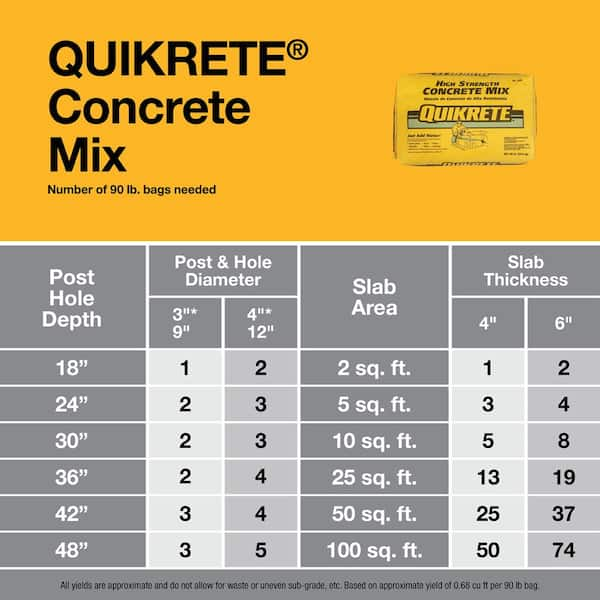
Image Source: images.thdstatic.com
Deciphering Cubic Yards of Concrete
Before we dive into bag counts, let’s clarify what a “cubic yard of concrete” actually is. A cubic yard is a unit of volume. Imagine a cube that is 3 feet wide, 3 feet long, and 3 feet high. That’s one cubic yard.
- Length: 3 feet
- Width: 3 feet
- Height: 3 feet
- Total Volume: 3 ft x 3 ft x 3 ft = 27 cubic feet
This is the standard measurement for ordering ready-mix concrete, and it’s also the basis for calculating how much bagged concrete you’ll need.
Why Accurate Measurement Matters
Accurate concrete volume calculation is vital for several reasons:
- Cost Savings: Buying too much concrete means wasted money. Buying too little means delays, extra trips for more bags, and potentially inconsistent results if you can’t match the mix.
- Project Completion: Having the right amount ensures you can finish your pour without interruption, which is important for achieving a smooth, even finish.
- Material Consistency: For larger projects, buying all your bagged concrete at once helps ensure consistency in the mix and color.
Fathoming Bagged Concrete Quantities
Bagged concrete is a convenient option for smaller to medium-sized projects. It comes in pre-measured bags, typically containing a specific amount of dry mix that, when combined with water, yields a certain volume of concrete.
Standard Bag Sizes and Yields
Bagged concrete commonly comes in two main sizes:
- 40-pound bags: These typically yield about 0.3 cubic feet of concrete.
- 60-pound bags: These typically yield about 0.45 cubic feet of concrete.
- 80-pound bags: These are the most common and generally yield about 0.6 cubic feet of concrete.
It’s essential to check the packaging of the specific brand you are using, as yields can vary slightly due to different concrete mix ratios and densities.
Calculating Concrete Bags Per Cubic Yard
Now, let’s do the math to determine how many bags of concrete you need per cubic yard. We know that 1 cubic yard equals 27 cubic feet.
Using 80-pound bags (0.6 cubic feet per bag):
- Total cubic feet needed: 27 cubic feet
- Cubic feet per bag: 0.6 cubic feet
- Number of bags = Total cubic feet / Cubic feet per bag
- Number of bags = 27 / 0.6 = 45 bags
So, you’ll need approximately 45 bags of 80-pound concrete mix to create one cubic yard.
Using 60-pound bags (0.45 cubic feet per bag):
- Number of bags = 27 / 0.45 = 60 bags
You’ll need approximately 60 bags of 60-pound concrete mix for one cubic yard.
Using 40-pound bags (0.3 cubic feet per bag):
- Number of bags = 27 / 0.3 = 90 bags
You’ll need approximately 90 bags of 40-pound concrete mix for one cubic yard.
Table: Concrete Bags per Cubic Yard (Approximate Yields)
| Bag Size (Weight) | Approximate Yield per Bag (Cubic Feet) | Number of Bags per Cubic Yard (27 cu ft) |
|---|---|---|
| 40 lbs | 0.3 | 90 |
| 60 lbs | 0.45 | 60 |
| 80 lbs | 0.6 | 45 |
Important Note: Always add a buffer of 5-10% to your total bag count to account for spillage, uneven subgrade, or slight variations in mix consistency.
Estimating Concrete for Your Project
Most concrete projects involve more than just a single cubic yard. You’ll need to calculate the volume of the specific shape you’re filling. Here’s how to approach estimating concrete for various common applications.
Calculating Volume for Slabs and Footings
The most common use for bagged concrete is creating slabs and footings. The volume is calculated by multiplying the length, width, and thickness of the area you need to fill.
Formula for Volume:
Volume = Length x Width x Thickness
Units are Key!
It’s crucial to ensure all your measurements are in the same units before calculating volume. Most plans use feet. If you measure in inches, remember to convert to feet by dividing by 12.
- Example: If you need a slab that is 10 feet long, 10 feet wide, and 4 inches thick:
- Convert thickness to feet: 4 inches / 12 inches/foot = 0.333 feet
- Calculate volume in cubic feet: 10 ft x 10 ft x 0.333 ft = 33.3 cubic feet
Now, you need to convert this to cubic yards. Since 1 cubic yard = 27 cubic feet:
- Volume in cubic yards = Volume in cubic feet / 27
- Volume in cubic yards = 33.3 / 27 = 1.23 cubic yards
Using a Concrete Slab Calculation Tool
To simplify these calculations, many online resources offer a concrete volume calculator or a bagged concrete calculator. These tools allow you to input your project dimensions (length, width, thickness) and will automatically provide the total volume needed in cubic yards and the estimated number of bags.
How to use a DIY concrete calculator:
- Measure your project area: Determine the length and width in feet.
- Determine the desired depth: Measure this in inches.
- Convert depth to feet: Divide the depth in inches by 12.
- Input dimensions into the calculator: Enter the length (ft), width (ft), and depth (ft).
- Select bag size: Choose the weight of the bags you plan to purchase (e.g., 80 lbs).
- Get your estimate: The calculator will tell you the total cubic yards and the number of bags required.
Estimating Concrete for Other Shapes
While slabs are common, you might also need concrete for:
- Cubic Footings: These are essentially small rectangular prisms. Calculate volume as Length x Width x Height.
- Cylindrical Columns or Piers: The formula is π * r² * h, where ‘r’ is the radius (half the diameter) and ‘h’ is the height. Remember to convert your measurements to feet and then divide by 27 for cubic yards.
- Steps: Each step can be broken down into rectangular volumes (riser height x tread width x step width) and tread volumes (tread depth x tread width x step width). Sum these volumes.
For any irregular shapes, it’s often best to break them down into simpler geometric forms and sum their volumes.
Comprehending Concrete Mix Ratio
The concrete mix ratio refers to the proportions of cement, sand, and gravel used in the mix, along with water. While bagged concrete has these proportions pre-mixed, understanding the concept helps in appreciating why different bags yield different amounts and why consistency is important.
A typical concrete mix ratio might be expressed as 1:2:3 (cement:sand:gravel). The amount of water added is critical; too much makes the concrete weak, and too little makes it difficult to work with.
- Cement: The binder that reacts with water to harden.
- Sand (Fine Aggregate): Fills the gaps between larger stones.
- Gravel (Coarse Aggregate): Provides bulk and strength.
- Water: Activates the cement.
The water-to-cement ratio (w/c ratio) is a key factor in concrete strength. Lower w/c ratios generally lead to stronger concrete, but can make it harder to place.
How Mix Ratios Affect Bag Yield
Different manufacturers might use slightly different concrete mix ratios or aggregate densities, which can subtly affect the yield of their bagged concrete. This is why checking the bag’s stated yield is always the best practice.
When to Use Bagged Concrete vs. Ready-Mix
Choosing between bagged concrete and ready-mix concrete depends on the scale and complexity of your project.
Bagged Concrete Advantages:
- Convenience for Small Jobs: Perfect for DIYers tackling smaller projects like steps, small patios, fence posts, or repairs.
- No Minimum Order: You can buy just a few bags.
- Portability: Easy to transport from the store to your site.
- Controlled Mixing: You control the amount of water and ensure thorough mixing.
Bagged Concrete Disadvantages:
- Labor Intensive: Mixing many bags by hand or with a small mixer is time-consuming and physically demanding.
- Inconsistent Batches: It can be challenging to achieve perfectly consistent mixes across many bags, potentially leading to variations in color and strength.
- Cost for Large Projects: For large volumes, buying hundreds of bags is often more expensive and far more work than ordering ready-mix.
Ready-Mix Concrete:
- Ideal for Larger Projects: Foundations, large slabs, driveways, and commercial projects.
- Delivered to Site: Mixed at a plant and delivered by a truck.
- Consistent Quality: Factory-controlled mixes ensure uniformity.
- Cost-Effective for Volume: Generally cheaper per cubic yard for large quantities.
Practical Tips for Your Concrete Project
Once you’ve calculated how much concrete do I need, here are some tips for a successful pour:
Preparation is Key
- Formwork: Build strong, well-braced forms that are accurately measured.
- Subgrade: Ensure the ground beneath the concrete is compacted and level. For slabs, a layer of gravel or crushed stone is often recommended for drainage and stability.
- Reinforcement: For structural projects, use rebar or wire mesh to strengthen the concrete and prevent cracking.
Mixing Concrete
- Use a Mixer: For more than a few bags, renting a power concrete mixer is highly recommended. It ensures a more consistent mix and saves significant labor.
- Follow Bag Instructions: Always read and follow the manufacturer’s instructions for water addition. Start with less water than suggested and add more gradually until you reach the desired consistency.
- Add Cement to Water (Not Vice Versa): Typically, you add the dry mix to the water in the mixer.
- Mix Thoroughly: Mix until the color is uniform and there are no dry pockets. The consistency should be workable but not soupy.
Pouring and Finishing
- Work Quickly: Once mixed, concrete starts to set. Have your tools and helpers ready.
- Place and Consolidate: Fill the forms, ensuring the concrete reaches all corners. Use a shovel or vibrator to remove air pockets.
- Screed: Use a straight board to level the concrete surface.
- Float: Use a float to smooth the surface and bring the cream (finer particles) to the top.
- Trowel: For a smoother finish, trowel the surface once the concrete has started to set slightly.
- Broom Finish: For a non-slip surface, brush the concrete with a stiff broom after troweling.
Curing Concrete
Curing is the process of keeping the concrete moist and at a favorable temperature for a specific period, allowing it to gain strength and durability.
- Keep it Moist: Cover the concrete with plastic sheeting, wet burlap, or use a curing compound.
- Duration: Cure for at least 3-7 days, depending on the conditions and the type of concrete.
Frequently Asked Questions (FAQ)
Q1: How many 80 lb bags of concrete make a cubic yard?
A1: Approximately 45 bags of 80 lb concrete mix are needed to make one cubic yard.
Q2: What is the conversion for cubic feet to cubic yards?
A2: There are 27 cubic feet in one cubic yard.
Q3: Can I mix concrete in a wheelbarrow?
A3: Yes, you can mix concrete in a wheelbarrow for very small jobs, but it is labor-intensive and can lead to inconsistent mixes if not done carefully.
Q4: How do I calculate the concrete needed for a circular patio?
A4: Calculate the area of the circle (π * radius²) and then multiply by the desired thickness (converted to feet). Then divide the total cubic feet by 27 to get cubic yards.
Q5: What happens if I add too much water to my concrete mix?
A5: Adding too much water reduces the strength and durability of the concrete, making it more prone to cracking and damage over time.
Q6: Do I need to add rebar to a small concrete slab?
A6: For small patios or walkways that are 4 inches thick, rebar or wire mesh might not be strictly necessary, but it can significantly improve crack resistance and overall durability, especially if the ground is not perfectly stable. For any structural applications or larger slabs, reinforcement is highly recommended.
Q7: What is the average cost of a bag of concrete?
A7: The price varies by brand and location, but expect to pay anywhere from $5 to $10 for a standard 80 lb bag.
Q8: How do I convert inches to feet for concrete thickness?
A8: Divide the number of inches by 12. For example, 4 inches divided by 12 is 0.333 feet.
By using a concrete volume calculator and following these guidelines, you can confidently estimate how many bags of concrete in a yard and ensure your DIY projects are a success. Remember to always factor in a little extra material to avoid any last-minute surprises.