
So, you’re wondering, how many bags of concrete to a yard? A typical 80-pound bag of concrete mix yields about 0.6 cubic feet of concrete. To figure out how many bags you need for a cubic yard, you first need to know that a cubic yard is equal to 27 cubic feet. This means you’ll need approximately 4.5 bags of concrete for every cubic foot of space you want to fill. When calculating the total number of bags, it’s always wise to add a little extra to account for any spillage or unevenness in your project area.
This guide will help you determine exactly how much concrete do I need for your projects, covering everything from small repairs to larger jobs like patios and walkways. We’ll break down the calculations, discuss different bag sizes, and even touch on when it might be more practical to order ready-mix concrete.
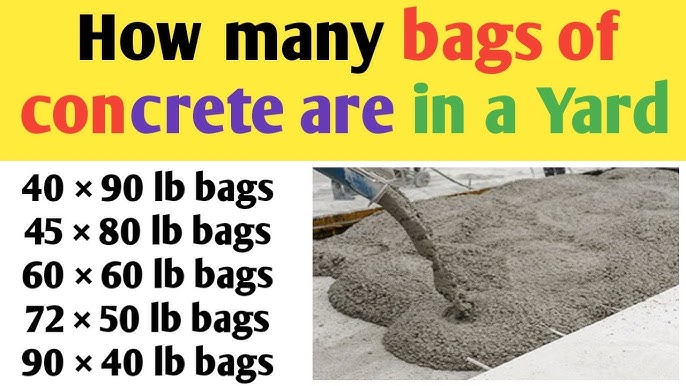
Image Source: i.ytimg.com
Figuring Out Your Concrete Needs
Before you start counting bags, the most crucial step is to accurately measure the area you need to cover and the desired depth of the concrete. This is where a concrete volume calculator or a simple concrete calculator becomes your best friend.
Measuring Your Project Area
Let’s say you’re building a small patio. You’ll need to measure its length and width in feet. For example, a patio that is 10 feet long and 10 feet wide has an area of 100 square feet (10 ft x 10 ft).
Determining Depth
The depth of the concrete is also vital. For most standard applications like patios, walkways, or even a small slab, a depth of 4 inches is common. However, for areas that will bear heavier loads, like a driveway, you might opt for 6 inches or more.
It’s important to convert your depth measurement from inches to feet. To do this, divide the number of inches by 12. So, 4 inches becomes 4/12 = 0.33 feet, and 6 inches becomes 6/12 = 0.5 feet.
Calculating Cubic Feet
Once you have the area in square feet and the depth in feet, you can calculate the total volume in cubic feet.
- Volume (cubic feet) = Area (square feet) × Depth (feet)
Using our patio example:
- Volume = 100 sq ft × 0.33 ft = 33 cubic feet
Converting Cubic Feet to Cubic Yards
Most ready-mix concrete is sold by the cubic yard, and it’s often easier to think in terms of cubic yards of concrete when ordering larger quantities. To convert your calculated cubic feet into cubic yards, you need to divide by 27, as there are 27 cubic feet in one cubic yard.
- Volume (cubic yards) = Volume (cubic feet) / 27
For our patio example:
- Volume = 33 cubic feet / 27 = 1.22 cubic yards
This means you need approximately 1.22 cubic yards of concrete for your 10×10 foot patio with a 4-inch depth.
How Many Bags of Concrete Per Cubic Yard?
Now, let’s get back to the main question: how many bags of concrete to a yard. This depends on the size of the concrete bags you are using. The most common sizes are 40-pound and 80-pound bags.
Standard Bag Yields
- 40-pound bag: Typically yields about 0.3 cubic feet of concrete.
- 60-pound bag: Typically yields about 0.45 cubic feet of concrete.
- 80-pound bag: Typically yields about 0.6 cubic feet of concrete.
Calculating Bags for a Cubic Yard
To determine how many bags of concrete to fill a cubic yard (27 cubic feet), we can use the following formula:
- Bags per cubic yard = 27 cubic feet / Yield per bag (cubic feet)
Let’s calculate for each common bag size:
- For 40-pound bags: 27 cubic feet / 0.3 cubic feet per bag = 90 bags per cubic yard.
- For 60-pound bags: 27 cubic feet / 0.45 cubic feet per bag = 60 bags per cubic yard.
- For 80-pound bags: 27 cubic feet / 0.6 cubic feet per bag = 45 bags per cubic yard.
So, to directly answer the question, if you’re using the common 80-pound bags, you’ll need about 45 bags of concrete to a yard.
Example Calculation: How Many Bags of Concrete for Patio?
Let’s use our 10×10 foot patio example, which required 1.22 cubic yards of concrete.
-
Using 80-pound bags (45 bags per cubic yard):
- Total bags = 1.22 cubic yards × 45 bags/cubic yard = 54.9 bags.
- Always round up to the nearest whole bag, so you’d need 55 bags.
-
Using 60-pound bags (60 bags per cubic yard):
- Total bags = 1.22 cubic yards × 60 bags/cubic yard = 73.2 bags.
- Round up to 74 bags.
-
Using 40-pound bags (90 bags per cubic yard):
- Total bags = 1.22 cubic yards × 90 bags/cubic yard = 109.8 bags.
- Round up to 110 bags.
It’s a good idea to purchase an extra bag or two to be safe, especially for larger projects. This covers any potential errors in measurement, uneven subgrade, or minor spills during the pouring process.
Using a Concrete Bag Calculator
Many online tools can simplify these calculations. A concrete bag calculator or a concrete calculator can take your project dimensions (length, width, depth) and tell you precisely how many bags of a specific weight you’ll need. These are incredibly helpful to avoid under or over-ordering.
When using an online calculator, ensure you input your measurements correctly (e.g., feet for length and width, inches for depth, which the calculator will then convert to feet). You’ll also need to select the weight of the concrete bag you intend to purchase.
Inputting Data for a Concrete Volume Calculator
Let’s imagine you need to pour a small concrete footing for a fence post.
- Length: 2 feet
- Width: 2 feet
- Depth: 12 inches (which is 1 foot)
Using the formula:
- Volume (cubic feet) = 2 ft × 2 ft × 1 ft = 4 cubic feet
- Volume (cubic yards) = 4 cubic feet / 27 = 0.15 cubic yards
Now, let’s calculate the number of 80-pound bags needed:
- Bags needed = 0.15 cubic yards × 45 bags/cubic yard = 6.75 bags.
- You would round this up to 7 bags of 80-pound concrete mix.
Table: Estimated Bags Needed Per Cubic Yard
| Bag Weight | Yield (Cubic Feet) | Bags Per Cubic Yard (27 cu ft) |
|---|---|---|
| 40 lbs | 0.3 | 90 |
| 60 lbs | 0.45 | 60 |
| 80 lbs | 0.6 | 45 |
This table provides a quick reference for how many bags of concrete to a yard you can expect based on bag weight.
Factors Affecting Concrete Volume and Bag Count
While the standard calculations are a great starting point, several factors can influence the actual amount of concrete you’ll need.
1. Compaction and Spreading
When you mix and pour concrete, it’s not perfectly uniform. Some slight variations in density and how it spreads can occur. This is why ordering a little extra is always recommended.
2. The Mix Ratio
The concrete mix ratio is the proportion of cement, sand, and gravel (aggregate) used to make concrete. Pre-packaged concrete mixes have these ratios pre-determined for various applications. The yield stated on the bag is based on the manufacturer’s specific mix ratio. While you generally don’t alter this when using pre-packaged bags, understanding that the ratio affects strength and yield is helpful.
- A common DIY mix ratio might be 1 part cement, 2 parts sand, and 3 parts gravel.
- The cement bag calculator is more relevant if you are mixing from scratch. For example, if you’re using 94-pound bags of cement, and your desired mix ratio requires a certain amount of cement per cubic yard, a cement bag calculator helps determine how many bags of cement you need. However, for pre-bagged concrete, you rely on the stated yield per bag.
3. Subgrade Preparation
The ground or base on which you pour concrete is called the subgrade. If your subgrade is uneven, has soft spots, or is not properly compacted, you might end up using more concrete than initially calculated to achieve a level surface.
4. Waste and Spillage
Some concrete will inevitably be lost due to spillage during mixing, transport (wheelbarrowing), and placement. It’s often estimated that 5-10% of your concrete will be lost to waste.
When to Consider Ready-Mix Concrete
For larger projects, such as significant patios, driveways, or foundations, buying bags of concrete can become incredibly labor-intensive and expensive. This is where ordering ready-mix concrete from a supplier becomes a more practical solution.
Benefits of Ready-Mix Concrete
- Efficiency: It’s mixed at a plant and delivered directly to your site in a truck, saving you a tremendous amount of time and effort.
- Consistency: Ready-mix concrete is produced under controlled conditions, ensuring a consistent quality and strength.
- Cost-Effectiveness for Large Jobs: While there’s a minimum order quantity (often 1 cubic yard), the cost per cubic yard can be lower than buying numerous bags for large projects.
Ordering Ready-Mix
When you order ready-mix, you’ll provide your cubic yards of concrete measurement to the supplier. They have their own calculators and expertise to ensure you get the right amount. It’s still wise to have your own calculations from a concrete calculator as a reference.
For example, if your calculations showed you needed 1.22 cubic yards for your patio, you would likely order 1.5 cubic yards to ensure you have enough and account for the minimum order sizes and potential waste.
Project-Specific Considerations
Let’s look at how the number of bags might change depending on the type of project.
1. Sidewalks and Walkways
These typically require a 4-inch depth. The calculations remain the same as our patio example. A standard 4-foot wide sidewalk, 4 inches deep, would require approximately 0.15 cubic yards per 10 linear feet.
-
For 50 linear feet of sidewalk (4 ft wide x 50 ft long x 4 in deep):
- Area = 4 ft x 50 ft = 200 sq ft
- Depth = 4 inches = 0.33 ft
- Volume = 200 sq ft x 0.33 ft = 66 cubic feet
- Volume (cubic yards) = 66 cu ft / 27 = 2.44 cubic yards
-
Using 80-pound bags (45 bags/yard):
- Total bags = 2.44 cubic yards x 45 bags/cubic yard = 109.8 bags.
- Round up to 110 bags.
2. Patios
As we’ve seen, patios also commonly use a 4-inch depth. The main difference is the area you need to cover. A larger patio will naturally require more bags.
3. Driveways
Driveways bear more weight and require a greater depth, usually 6 inches, sometimes even 8 inches for heavier vehicles.
-
Consider a small driveway apron, 10 feet long, 8 feet wide, and 6 inches deep:
- Length = 10 ft
- Width = 8 ft
- Depth = 6 inches = 0.5 ft
- Area = 10 ft x 8 ft = 80 sq ft
- Volume = 80 sq ft x 0.5 ft = 40 cubic feet
- Volume (cubic yards) = 40 cu ft / 27 = 1.48 cubic yards
-
Using 80-pound bags (45 bags/yard):
- Total bags = 1.48 cubic yards x 45 bags/cubic yard = 66.6 bags.
- Round up to 67 bags.
This illustrates how increasing the depth significantly increases the number of bags needed.
4. Small Repairs and Footings
For smaller tasks, like patching a hole in a driveway or setting a fence post, you might only need a few bags. The calculations still apply, but the quantities are much smaller. Using a concrete calculator is essential even for small jobs to avoid buying far too much.
Tips for Buying and Using Concrete Bags
- Check the Bag: Always look at the yield information printed on the concrete bag itself. Manufacturers might have slight variations.
- Buy a Little Extra: As mentioned, always add 5-10% extra to your calculated amount.
- Storage: Store bags of concrete in a dry place, off the ground. Damp concrete can set up prematurely, rendering it useless.
- Mixing: Follow the water-to-mix ratio recommended on the bag precisely. Too much water weakens the concrete, while too little makes it unworkable.
- Working Time: Once mixed, concrete has a limited working time (usually around 30-60 minutes), depending on temperature and humidity. Plan your work accordingly.
Frequently Asked Questions (FAQs)
Q1: How many bags of concrete do I need for a 4×8 foot slab that is 4 inches thick?
A: First, calculate the volume:
* Area = 4 ft x 8 ft = 32 sq ft
* Depth = 4 inches = 0.33 ft
* Volume = 32 sq ft x 0.33 ft = 10.56 cubic feet
* Volume in cubic yards = 10.56 cu ft / 27 = 0.39 cubic yards
Using 80-pound bags (0.6 cu ft yield, approximately 45 bags per cubic yard):
* Bags needed = 0.39 cubic yards * 45 bags/cubic yard = 17.55 bags.
* You should purchase 18-19 bags to be safe.
Q2: Can I mix concrete in a wheelbarrow?
A: Yes, for small batches, a wheelbarrow works well. However, for larger projects requiring multiple bags, a power concrete mixer is highly recommended to ensure proper mixing and save your back!
Q3: What is the best type of concrete mix to use for a patio?
A: For most patios and walkways, a standard all-purpose concrete mix (often labeled as “Concrete Mix” or “All-Purpose Concrete”) is suitable. These typically have a strength of around 3000-4000 PSI, which is adequate for foot traffic and moderate weather exposure.
Q4: How much water should I add to a bag of concrete?
A: The exact amount of water will be specified on the concrete bag. Generally, for an 80-pound bag, you might add around 2.5 to 3 quarts of water. Always start with the lower amount and add more only if needed to achieve a workable consistency. Adding too much water significantly reduces the strength of the concrete.
Q5: What is the difference between cement and concrete?
A: Cement is a binder, a powder that, when mixed with water, hardens and binds other materials together. Concrete is a composite material made from cement, aggregate (like sand and gravel), and water. Cement is just one component of concrete.
Q6: Do I need to add anything to concrete mix other than water?
A: Generally, no. Pre-packaged concrete mixes contain cement, sand, and gravel in the correct proportions. You only need to add water according to the manufacturer’s instructions. If you are mixing concrete from scratch using individual components (cement, sand, gravel), then you are responsible for achieving the correct concrete mix ratio.
By following these guidelines and using the available tools, you can confidently determine how many bags of concrete to a yard and ensure your DIY projects are a success.