
What is the best way to measure my lawn? The best way to measure your lawn depends on its shape. For simple rectangular or square lawns, it’s a matter of measuring length and width and multiplying them. For more complex shapes, breaking the lawn down into smaller, manageable geometric figures and adding their areas together is the most accurate approach.
Knowing your lawn’s size is crucial for many tasks, from buying the right amount of grass seed or fertilizer to planning landscaping projects or getting accurate quotes for lawn care services. This guide will walk you through the process of measuring your lawn size accurately, ensuring you have the right data for any endeavor. We’ll cover simple shapes and more complex scenarios, providing you with the tools and techniques for precise yard measurement.
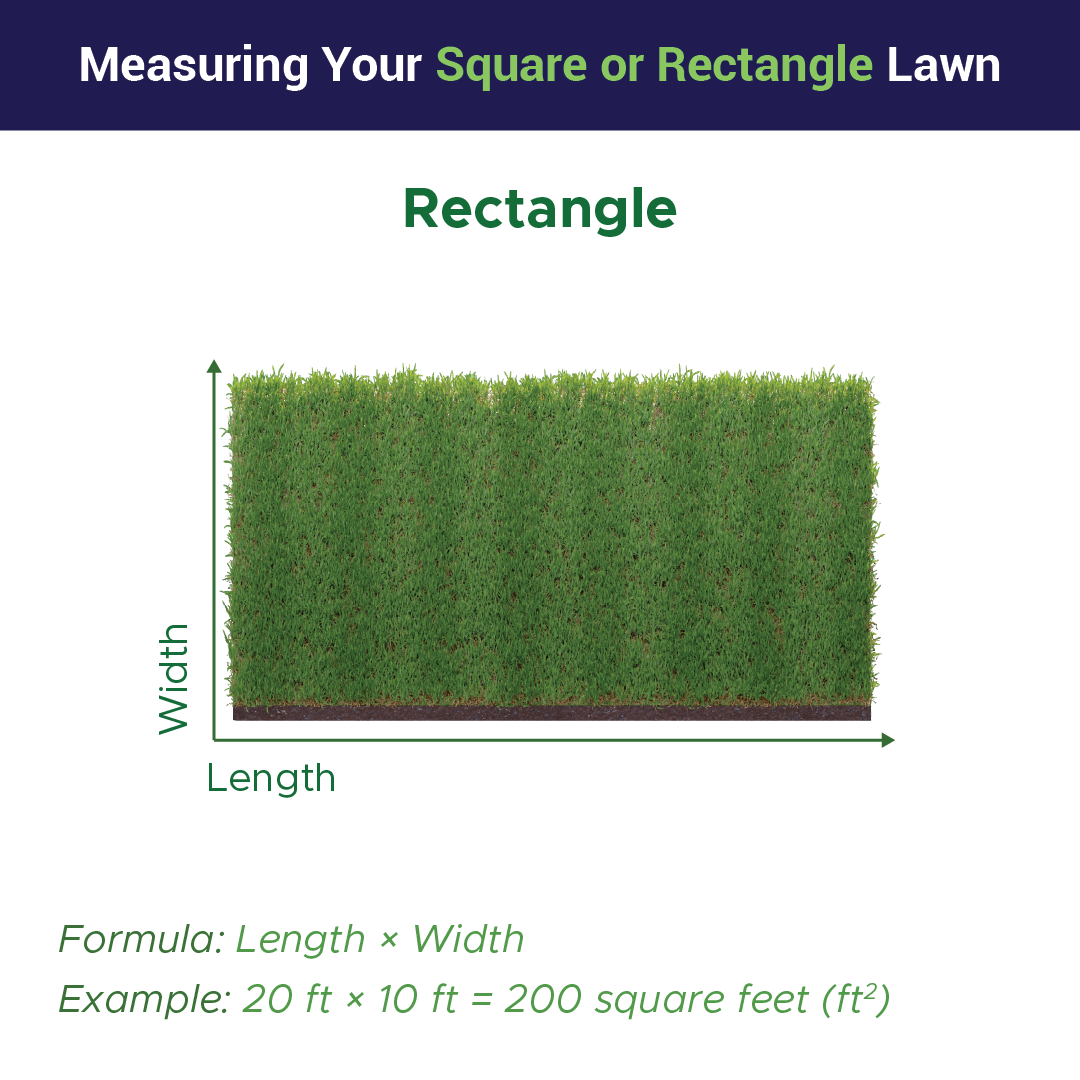
Image Source: lawntolakemidwest.org
Why Accurate Lawn Measurement Matters
Before diving into the “how,” let’s briefly touch on the “why.” Having precise measurements for your yard measurement can save you time, money, and frustration.
- Purchasing Supplies: Whether it’s grass seed, fertilizer, mulch, or sod, knowing your square footage of yard ensures you buy the correct quantity. Overbuying leads to waste and extra cost, while underbuying means incomplete coverage and potentially repeated trips to the store.
- Landscaping Projects: Planning new garden beds, patios, or walkways requires accurate dimensions to determine material needs and visualize the final layout.
- Pest and Weed Control: Applying treatments for pests or weeds often depends on the area being treated. Incorrect measurements can lead to under-application (ineffective) or over-application (wasteful and potentially harmful).
- Sprinkler System Design: Installing or adjusting a sprinkler system requires precise knowledge of the lawn area to ensure proper water distribution.
- Professional Services: When obtaining quotes from lawn care companies, providing accurate measurements helps them give you a more precise estimate.
Tools You’ll Need for Yard Measurement
Gathering the right tools before you start will make the process smoother.
- Measuring Tape: A long, retractable measuring tape (50-100 feet or more) is essential for larger lawns. A digital measuring wheel can also be very useful for covering long distances quickly.
- Pencil and Paper (or a Digital Device): To sketch your lawn and record your measurements.
- Stake or Marker: To mark points if needed, especially for irregular shapes.
- Calculator (or Smartphone): To perform the calculating lawn area for you.
Measuring Simple Lawn Shapes
Most lawns can be broken down into basic geometric shapes. Let’s start with the easiest ones.
Rectangular or Square Lawns
This is the most straightforward scenario.
- Identify the Shape: If your lawn is a perfect rectangle or square, you only need two measurements.
- Measure Length: Place your measuring tape at one end of the lawn and extend it to the other end along the longest side. Record this measurement.
- Measure Width: Now, measure the distance across the lawn, perpendicular to the length, along the shortest side. Record this measurement.
-
Calculate Area: To find the square footage of yard, multiply the length by the width.
- Formula: Area = Length × Width
Example:
If your lawn is 50 feet long and 30 feet wide:
Area = 50 ft × 30 ft = 1500 sq ft.
Circular Lawns
Circular areas are less common for entire lawns but might be part of a larger design.
- Measure Diameter: Find the longest straight line across the circle that passes through the center. This is the diameter. You can do this by stretching your tape measure across the widest part of the circular area.
- Calculate Radius: The radius is half the diameter.
- Formula: Radius (r) = Diameter / 2
-
Calculate Area: The area of a circle is calculated using pi (approximately 3.14159).
- Formula: Area = π × r²
Example:
If the diameter of your circular lawn is 20 feet:
Radius = 20 ft / 2 = 10 ft
Area = 3.14159 × (10 ft)² = 3.14159 × 100 sq ft = 314.16 sq ft.
Triangular Lawns
Triangular sections can occur at corners or as standalone features.
- Measure Base: Identify one side of the triangle as the base. Measure its length.
- Measure Height: Measure the perpendicular distance from the base to the opposite vertex (the highest point). This is the height.
-
Calculate Area:
- Formula: Area = 0.5 × Base × Height
Example:
If the base of a triangular section of your lawn is 20 feet and its height is 15 feet:
Area = 0.5 × 20 ft × 15 ft = 10 ft × 15 ft = 150 sq ft.
Measuring Irregular Lawn Shapes: Strategies for Success
Most lawns are not perfect geometric shapes. They often have curves, angles, and odd protrusions. Here’s how to tackle them:
Breaking Down Complex Shapes
The most effective method for irregular lawns is to divide the entire area into smaller, recognizable geometric shapes like rectangles, squares, triangles, and even semi-circles.
- Sketch Your Lawn: On your paper or device, draw a rough outline of your entire lawn. Don’t worry about perfect accuracy at this stage; just get the general shape.
- Identify Geometric Sections: Look at your sketch and try to divide the irregular shape into simpler geometric forms. Imagine drawing lines to create these sections. For example, a curved corner might be approximated by a triangle or a sector of a circle.
- Measure Each Section: Go out to your lawn and carefully measure the dimensions of each of the smaller shapes you’ve identified.
- For rectangles/squares: Measure length and width.
- For triangles: Measure base and height.
- For curves: This is where it gets tricky, and approximations are often necessary.
Approximating Curves and Sectors
Measuring curved areas accurately requires a bit more finesse.
- Segmenting Curves: If you have a large curve, you can try to approximate it with a series of straight lines. Measure the length of each straight line segment and the perpendicular distance from each segment to a central point or baseline. This can be complex.
- Using a Measuring Wheel for Curves: A measuring wheel can sometimes be rolled along a curve, but this is rarely perfectly accurate.
- Approximating with Triangles: A common method is to treat a curved section as a series of small triangles. Pick a point outside the curve as a vertex and draw lines to points along the curve. Measure the length of each line and the angle between them. Then, use the formula for the area of a triangle (0.5 * a * b * sin(C), where a and b are two sides and C is the angle between them), or approximate with simple base x height triangles.
The “Offset” Method for Irregular Boundaries
This is a practical way to handle curves or irregular edges:
- Establish a Baseline: Imagine a straight line that runs along one edge of your lawn or a nearby straight feature like a fence or sidewalk. Measure the total length of this baseline that corresponds to your lawn’s edge.
- Measure Perpendicular Offsets: At regular intervals along this baseline (e.g., every 5 or 10 feet), measure the perpendicular distance from the baseline out to the edge of your lawn. Record these “offset” measurements.
-
Divide into Trapezoids: Each section between two offsets on the baseline, along with the corresponding curve on the lawn’s edge, can be approximated as a trapezoid. The parallel sides of the trapezoid are the two offset measurements, and the height of the trapezoid is the distance between the two offsets on the baseline.
- Formula for Trapezoid Area: Area = 0.5 × (base1 + base2) × height
Example:
Let’s say your baseline is 50 feet long. You measure offsets every 10 feet:
* Offset 1: 5 ft
* Offset 2: 8 ft
* Offset 3: 12 ft
* Offset 4: 15 ft
* Offset 5: 10 ft
* Offset 6: 6 ftNow, calculate the area of each trapezoidal section:
* Section 1 (Offsets 1 & 2, distance 10 ft): 0.5 × (5 + 8) × 10 = 0.5 × 13 × 10 = 65 sq ft
* Section 2 (Offsets 2 & 3, distance 10 ft): 0.5 × (8 + 12) × 10 = 0.5 × 20 × 10 = 100 sq ft
* Section 3 (Offsets 3 & 4, distance 10 ft): 0.5 × (12 + 15) × 10 = 0.5 × 27 × 10 = 135 sq ft
* Section 4 (Offsets 4 & 5, distance 10 ft): 0.5 × (15 + 10) × 10 = 0.5 × 25 × 10 = 125 sq ft
* Section 5 (Offsets 5 & 6, distance 10 ft): 0.5 × (10 + 6) × 10 = 0.5 × 16 × 10 = 80 sq ftTotal Area = 65 + 100 + 135 + 125 + 80 = 505 sq ft.
This method, while an approximation, is often more accurate for irregular boundaries than trying to fit complex curves into simple shapes.
Using a Lawn Area Calculator or App
Modern technology offers convenient solutions. Many smartphone apps and online tools can help with calculating lawn area.
- GPS-Based Apps: Some apps use your phone’s GPS to trace the perimeter of your lawn. You walk the boundary, and the app calculates the area. Accuracy can vary depending on GPS signal strength and the app’s sophistication.
- Satellite Imagery Tools: Websites and apps allow you to draw on a satellite image of your property to outline your lawn and get an estimated area. These are often very convenient for quick estimates, especially if you don’t have physical access to the property.
While these tools are helpful for lawn size estimation, it’s always a good idea to cross-reference with manual measurements, especially for critical projects.
Measuring Non-Grassy Areas
It’s important to distinguish between your total backyard area calculation and your actual measure grass area. If you’re buying grass seed or fertilizer, you only need to account for the grassy portions.
- Identify Non-Grassy Zones: Note areas like driveways, patios, decks, garden beds, walkways, and structures.
-
Subtract Non-Grassy Areas: If you’ve calculated the total area of your property or a large section of it, you can subtract the areas of these non-grassy features to get a more accurate figure for the measure grass area.
Example:
Your entire backyard is 2000 sq ft. You have a patio that is 10 ft x 20 ft (200 sq ft) and a driveway that is 10 ft x 30 ft (300 sq ft).
Total non-grassy area = 200 sq ft + 300 sq ft = 500 sq ft.
Actual grassy area = 2000 sq ft – 500 sq ft = 1500 sq ft.
This ensures you’re purchasing materials only for the areas that need them.
Advanced Techniques and Considerations
For very large or complex properties, you might consider more advanced methods.
Breaking Down Large Properties
If your lawn is exceptionally large (e.g., several acres), breaking it down into manageable sections is essential.
- Map Property Boundaries: Start by noting the overall dimensions of your property.
- Divide into Quadrants or Rectangular Grids: Mentally or physically divide the large area into smaller, regular shapes.
- Measure Each Section: Measure each of these smaller sections individually, using the techniques described above.
- Sum All Areas: Add up the areas of all the sections to get the total measure grass area.
Using Survey Markers or Property Pins
If your property has been surveyed, you might have survey markers or pins at the corners of your property lines. These can be excellent starting points for your measurements.
Calibrating Your Measuring Tools
Ensure your measuring tape or wheel is accurate. Sometimes, older tapes can stretch or have worn markings. If using a measuring wheel, ensure it’s calibrated correctly before you begin.
Calculating Lawn Area: A Summary Table
Here’s a quick reference for calculating the area of common shapes:
| Shape | Formula | What You Need to Measure |
|---|---|---|
| Rectangle | Length × Width | Length, Width |
| Square | Side × Side (or Side²) | Length of one side |
| Circle | π × Radius² | Diameter (then calculate radius) |
| Triangle | 0.5 × Base × Height | Base, Perpendicular Height |
| Trapezoid | 0.5 × (Base1 + Base2) × Height | Two parallel bases, Perpendicular height |
Practical Tips for Accurate Measurement
- Be Patient: Rushing can lead to errors. Take your time and double-check your measurements.
- Measure Twice, Calculate Once: This old adage is particularly true for lawn measurements.
- Note Units: Always be consistent with your units (feet, meters) and ensure your final area is in the correct square units (square feet, square meters).
- Consider Slopes: While most calculations focus on horizontal area, significant slopes can affect coverage calculations for some products (like fertilizers). For most purposes, horizontal measurement is sufficient.
- Round Appropriately: For most DIY tasks, rounding to the nearest foot or even half-foot for initial measurements is fine. The final area calculation can be rounded as well.
Example Walkthrough: Measuring a Complex Lawn
Let’s say you have a backyard that looks something like this:
- A main rectangular section.
- A semi-circular patio along one side.
- A small triangular flower bed at one corner.
Step 1: Sketch Your Lawn
Draw an outline of your backyard, marking the different sections.
Step 2: Measure the Rectangular Section
Let’s say the main rectangular part of your lawn is 40 feet long and 30 feet wide.
Area (Rectangle) = 40 ft × 30 ft = 1200 sq ft.
Step 3: Measure the Semi-Circular Patio
The patio is attached to one of the 30-foot sides of the rectangle. Its diameter is 30 feet (meaning it spans the entire width of that side).
Radius = Diameter / 2 = 30 ft / 2 = 15 ft.
Area (Full Circle) = π × (15 ft)² = 3.14159 × 225 sq ft ≈ 706.86 sq ft.
Area (Semi-Circle) = Area (Full Circle) / 2 ≈ 706.86 sq ft / 2 ≈ 353.43 sq ft.
Step 4: Measure the Triangular Flower Bed
The triangular flower bed is at a corner. Let’s say its base along one edge of the lawn is 5 feet, and its perpendicular height is also 5 feet.
Area (Triangle) = 0.5 × 5 ft × 5 ft = 0.5 × 25 sq ft = 12.5 sq ft.
Step 5: Calculate Total Lawn Area
Now, add the areas of all the sections together to get your total yard measurement.
Total Area = Area (Rectangle) + Area (Semi-Circle) + Area (Triangle)
Total Area = 1200 sq ft + 353.43 sq ft + 12.5 sq ft = 1565.93 sq ft.
If you were buying grass seed, you’d need enough for approximately 1566 square feet (rounding up for safety). Remember to subtract any non-grassy parts within these areas if applicable.
Frequently Asked Questions (FAQ)
Q1: How do I measure a sloped lawn?
A1: For most purposes, you measure the horizontal distance, not the distance along the slope. If you’re using a measuring tape, keep it as horizontal as possible. If you need to account for the surface area of the slope itself (for specific tasks like spray coverage), you would need more advanced surveying techniques. However, for typical lawn care product calculations, the horizontal yard measurement is sufficient.
Q2: What if my lawn has many curves and odd shapes?
A2: The best approach is to break the lawn down into the simplest geometric shapes possible (rectangles, triangles, etc.) and sum their areas. The offset method is also very useful for approximating areas with irregular boundaries. Online tools or apps that use GPS or satellite imagery can also provide estimates, but manual measurement is often more reliable.
Q3: How accurate do my measurements need to be?
A3: This depends on the task. For buying a bag of fertilizer, a rough estimate might be okay. For laying sod or designing a complex irrigation system, accuracy is much more important. Aim for accuracy to within a few square feet for most typical lawn tasks.
Q4: Do I need to measure the area of my house or driveway when calculating lawn size?
A4: No, unless you are calculating the total property size. When you need to measure grass area, you should exclude any non-grassy surfaces like buildings, patios, decks, and paved areas.
Q5: Can I use my property deed for lawn measurements?
A5: Your property deed will give you the total acreage of your property, but it won’t typically provide the specific dimensions or layout of your lawn area versus other features on the land. You’ll still need to do your own measure grass area calculations.
Q6: What’s the easiest way to calculate yard size?
A6: For a simple rectangular or square yard, multiplying length by width is easiest. For more complex shapes, breaking them into simpler shapes and using a calculator or a dedicated lawn area calculator app is the most straightforward approach.
By following these detailed steps, you can confidently measure your lawn size accurately. Whether you’re planning a DIY project or seeking professional services, precise measurements are the foundation for successful outcomes.