
Can you measure a lawn yourself? Yes, you can absolutely measure a lawn yourself with simple tools and a few basic steps! This guide will walk you through how to accurately measure your lawn, whether you need the lawn area calculation for landscaping projects, estimating grass needs, or simply to know your grass square footage. We’ll cover how to tackle various shapes and sizes, from simple rectangles to more complex garden area measurement scenarios. Knowing your backyard dimensions is the first step to making informed decisions about your outdoor space.
Measuring your lawn accurately is crucial for many reasons. Whether you’re planning to reseed, fertilize, lay sod, install an irrigation system, or just get a general idea of your property’s size, having precise measurements is key. Incorrect measurements can lead to wasted materials, unnecessary costs, and disappointing results. This guide aims to demystify the process of measuring land and help you achieve precise results for your outdoor space measurement.
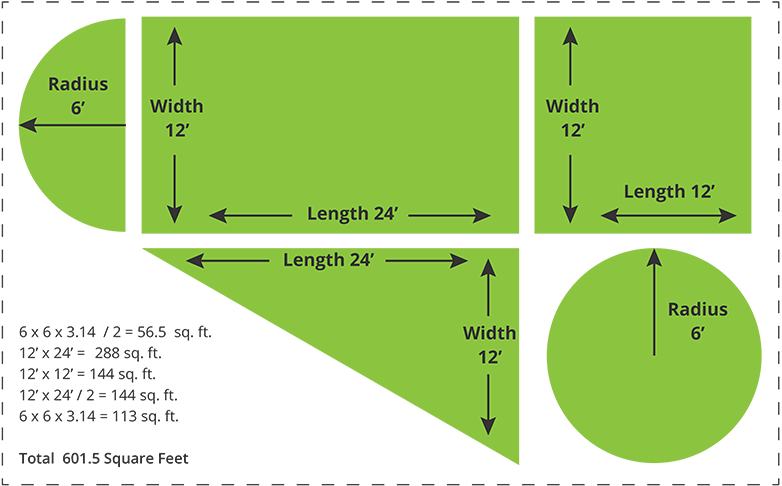
Image Source: gvt.net
Getting Started: What You’ll Need
Before you head outside, gather a few essential tools. These are readily available and will make the measuring process much smoother.
Essential Tools for Measuring Your Lawn
- Measuring Tape: A long, durable measuring tape is your primary tool. Aim for one that’s at least 50-100 feet long. Steel tape measures are generally more accurate than fabric ones.
- Stakes or Markers: You’ll need these to mark points as you measure, especially for longer distances or irregular shapes. Wooden stakes, spray paint, or even small flags will work.
- Paper and Pen/Pencil: To sketch your lawn’s shape and record your measurements.
- Calculator: For performing the lawn area calculation.
- Helper (Optional but Recommended): For longer stretches, a second person can hold the end of the tape measure and help keep it taut and accurate.
Measuring Simple Shapes: Rectangles and Squares
Most lawns can be broken down into simpler geometric shapes. Rectangles and squares are the easiest to measure.
Steps for Measuring Rectangular or Square Lawns
- Identify the Boundaries: Start by walking the perimeter of lawn. Clearly define the edges of the area you want to measure. This might be your fence line, sidewalks, or garden beds.
- Measure the Length: Place the end of your measuring tape at one corner of the rectangular area. Extend the tape along one side of the lawn until you reach the next corner. Record this measurement. This is the length.
- Measure the Width: From the same starting corner, extend the tape along the adjacent side of the lawn until you reach the third corner. Record this measurement. This is the width.
-
Calculate the Area: To find the grass square footage, multiply the length by the width.
Formula: Area = Length × Width
Example: If your lawn is 50 feet long and 30 feet wide, the area is 50 ft × 30 ft = 1500 sq ft.
This method is fundamental for calculating lawn size when your yard is a straightforward shape.
Measuring More Complex Shapes: Breaking it Down
Many yards aren’t perfect rectangles. They might have curves, L-shapes, or other irregular features. The key is to break down the complex shape into smaller, manageable geometric shapes like rectangles, squares, and triangles.
Strategies for Irregular Shapes
- Divide and Conquer: Mentally divide your lawn into smaller, easily measurable sections. Sketch these sections on your paper.
- Measure Each Section: Measure the length and width of each rectangular or square section as described above.
-
Measure Triangles: If you have triangular sections, you’ll need to measure the base and the height. The height is the perpendicular distance from the base to the opposite vertex (the highest point of the triangle).
Formula for Triangle Area: Area = (Base × Height) / 2
Example: If a triangular section of your lawn has a base of 20 feet and a height of 10 feet, its area is (20 ft × 10 ft) / 2 = 100 sq ft.
-
Measure Curves: For curved edges, you have a couple of options:
- Approximation with Straight Lines: Measure a series of short, straight lines that approximate the curve. The more lines you use, the more accurate your measurement will be. You can then calculate the area of the resulting polygons.
- Using Online Tools or Apps: Some advanced apps can help you trace curves and estimate areas, but for most DIYers, the straight-line approximation is sufficient.
Example: Measuring an L-Shaped Lawn
Imagine your lawn is shaped like an “L”.
- Sketch the Shape: Draw the L-shape on your paper.
- Divide into Rectangles: You can divide the L-shape into two rectangles in two ways.
- Option 1: Create a longer, narrower rectangle and a shorter, wider rectangle.
- Option 2: Create a wider, shorter rectangle and a longer, narrower rectangle.
-
Measure and Calculate:
- Measure the length and width of the first rectangle and calculate its area.
- Measure the length and width of the second rectangle and calculate its area.
- Add the areas of the two rectangles together for the total lawn area calculation.
Example L-Shape:
* Rectangle A: 40 ft long, 20 ft wide. Area = 40 x 20 = 800 sq ft.
* Rectangle B (the ‘arm’ of the L): 15 ft long, 10 ft wide. Area = 15 x 10 = 150 sq ft.
* Total Area = 800 sq ft + 150 sq ft = 950 sq ft.
This systematic approach is essential for accurate calculating lawn size for any backyard dimensions.
Measuring Circular or Oval Lawns
Circular or oval shapes require specific formulas.
Measuring a Circular Lawn
If you have a perfectly circular area of grass:
- Find the Diameter: Measure across the widest part of the circle, from one edge to the opposite edge, passing through the center. This is the diameter.
- Calculate the Radius: The radius is half of the diameter.
Formula: Radius (r) = Diameter / 2 -
Calculate the Area: Use the formula for the area of a circle.
Formula: Area = π × r² (where π is approximately 3.14159)
Example: If your circular lawn has a diameter of 30 feet, the radius is 15 feet. The area is 3.14159 × (15 ft)² = 3.14159 × 225 sq ft ≈ 706.86 sq ft.
Measuring an Oval Lawn
Oval shapes (ellipses) are a bit trickier.
- Find the Major Axis: Measure the longest diameter of the oval.
- Find the Minor Axis: Measure the shortest diameter of the oval.
- Calculate the Radii:
- Major Radius (R) = Longest Diameter / 2
- Minor Radius (r) = Shortest Diameter / 2
-
Calculate the Area: Use the formula for the area of an ellipse.
Formula: Area = π × R × r
Example: If your oval lawn’s longest diameter is 40 feet (Major Radius = 20 ft) and its shortest diameter is 20 feet (Minor Radius = 10 ft), the area is 3.14159 × 20 ft × 10 ft = 3.14159 × 200 sq ft ≈ 628.32 sq ft.
These calculations are vital for any precise garden area measurement.
Measuring with Property Boundaries in Mind
When measuring land, it’s important to consider your official property boundaries. Your lawn might not extend to the absolute edge of your property.
Key Considerations for Property Lines
- Fences and Walls: Often, fences or walls mark the edge of your usable yard space. Measure to these structures if they represent your desired lawn area.
- Easements and Setbacks: Be aware of any easements (rights for others to use a portion of your land, like for utilities) or setbacks (required distances from property lines for structures). These might affect the actual area you can maintain as lawn.
- Legal Descriptions: For very precise measurements, especially when dealing with property disputes or official records, refer to your property’s legal description or survey. This provides exact dimensions and boundary markers.
Accurate measurement ensures you’re working within your defined outdoor space measurement.
Advanced Techniques and Tools
For very large properties or more complex measuring land tasks, you might consider these advanced methods.
Using Technology for Accuracy
- GPS Devices: Dedicated GPS units can map out your lawn’s perimeter and calculate the area. Many smartphone apps also offer GPS area measurement features.
- Online Mapping Tools: Services like Google Maps or dedicated land measurement websites allow you to draw shapes on a satellite image and get area calculations. These are great for a quick estimate or for areas that are difficult to access directly.
Creating Detailed Sketches
When dealing with complex shapes, a detailed sketch is invaluable.
- Draw to Scale (Optional but helpful): If you have graph paper, you can draw your lawn’s shape to scale. This helps visualize proportions and identify sections.
- Label All Dimensions: Clearly label every measurement you take on your sketch.
- Note Irregularities: Mark any unusual features like trees, large flower beds, or slopes that might affect your measurements or future plans.
A good sketch aids significantly in calculating lawn size and visualizing your entire outdoor space measurement.
Converting Measurements
Sometimes you might need to convert measurements for different purposes.
Common Conversions
- Square Feet to Square Yards: If you need to buy sod or materials sold by the square yard, divide your total square footage by 9.
Formula: Square Yards = Square Feet / 9 - Feet to Inches: 1 foot = 12 inches.
- Square Feet to Acres: 1 acre = 43,560 square feet.
These conversions are useful for many lawn area calculation tasks.
Frequently Asked Questions (FAQ)
Here are some common questions people have about measuring their lawns:
How do I measure a sloped lawn?
For sloped lawns, it’s best to measure along the surface of the slope. A flexible measuring tape can be helpful. If you need the horizontal (flat) area, you would need to account for the angle of the slope using trigonometry, but for most purposes like estimating fertilizer or seed, measuring along the surface provides a more practical figure for estimating grass needs.
Can I use a garden hose to measure my lawn?
Yes, you can use a garden hose to help outline shapes, especially curves. Lay the hose down to mark your boundary, then measure the length of the hose you used. This is particularly helpful for measuring land with irregular borders.
What if my property has multiple levels or terraces?
If your yard has distinct terraces or levels, measure each level as a separate area and then add them together for your total lawn area calculation. Treat each terrace as its own unique shape.
How accurate do my measurements need to be?
The accuracy needed depends on your purpose. For general knowledge, a rough estimate might suffice. However, for purchasing materials like sod, seed, or fertilizer, strive for the most accurate measurements possible to avoid over or under-buying. Aim for at least within a few square feet for typical residential lawns when estimating grass needs.
What is the perimeter of a lawn?
The perimeter of a lawn is the total distance around its outer edge. It’s essentially the sum of all the lengths of its sides or the circumference if it’s a circle. Knowing the perimeter of lawn is useful for tasks like installing fencing or edging.
Conclusion: Mastering Your Lawn’s Measurements
Accurately measuring your lawn is a fundamental skill for any homeowner looking to manage their landscape effectively. By breaking down complex shapes into simpler geometric figures and using basic math, you can confidently determine your grass square footage, your backyard dimensions, and the overall size of your outdoor space measurement. Whether you’re tackling a small urban garden or a larger suburban plot, these techniques will help you in measuring land with precision. Knowing your lawn area calculation is the first step to successful gardening, landscaping, and property maintenance, ensuring you have a great handle on your garden area measurement and estimating grass needs. With a tape measure, some paper, and this guide, you’re well-equipped to master your lawn’s dimensions.