
Knowing your lawn size is essential for many tasks, like buying fertilizer, grass seed, or planning landscape projects. What is the easiest way to calculate lawn size? The simplest approach involves measuring your lawn’s dimensions and applying basic geometry formulas, which we’ll detail below. Can I calculate lawn size without special tools? Yes, you can often estimate your lawn size with just a measuring tape or even pacing, though more accurate methods yield better results. Who is this guide for? This guide is for anyone who wants to accurately determine the square footage of their yard for landscaping, gardening, or general maintenance.
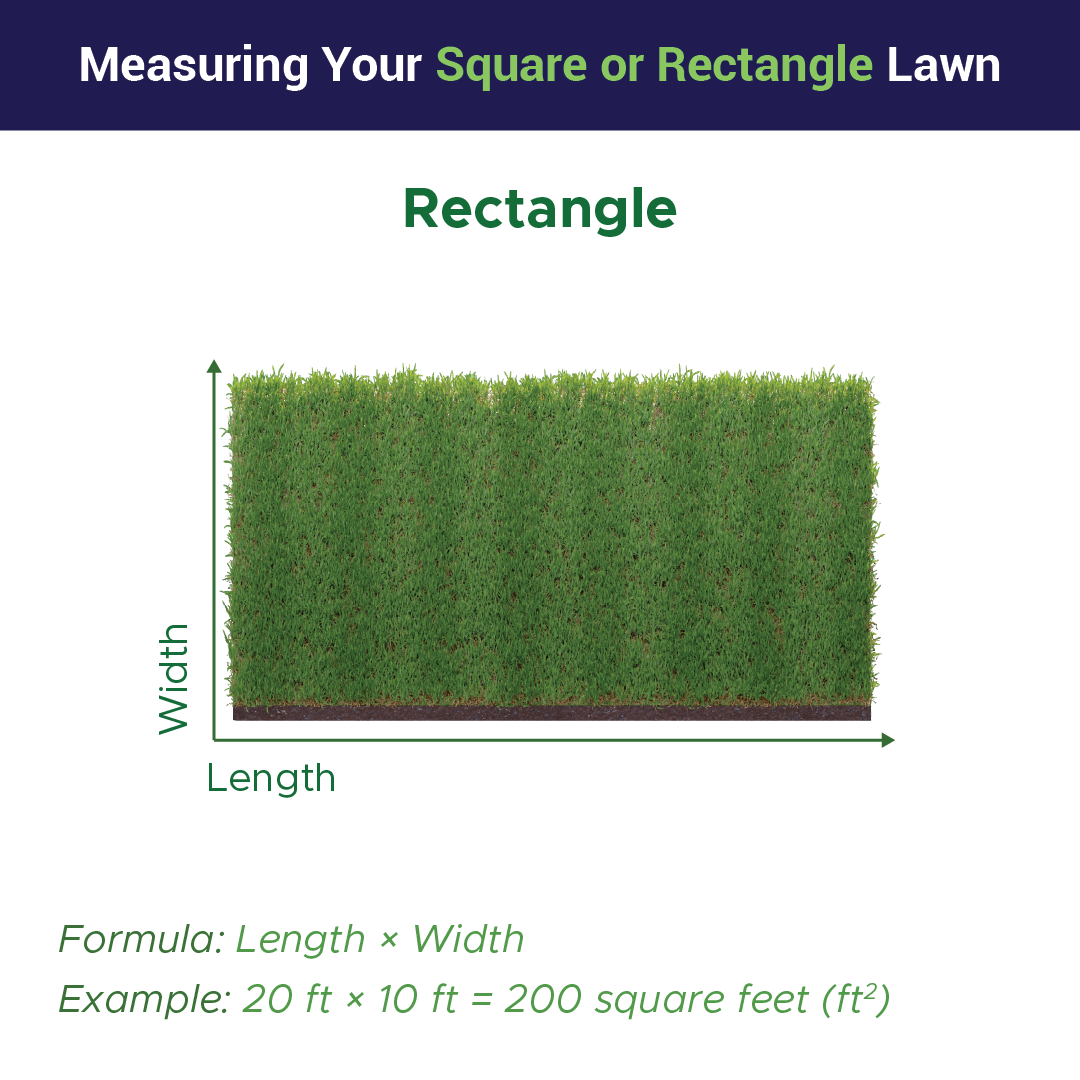
Image Source: lawntolakemidwest.org
Why Measuring Your Lawn Matters
Accurately calculating your lawn size, or lawn area calculation, is a foundational step for numerous homeowner activities. Whether you’re aiming to buy the right amount of grass seed, weed killer, fertilizer, or simply want to understand the scope of your backyard dimensions for a new patio or garden bed, having precise measurements is key. Overbuying can lead to wasted money and resources, while underbuying can result in incomplete projects and frustration. This guide will walk you through various lawn measurement techniques to ensure you get it right.
Key Benefits of Knowing Your Lawn Size
- Accurate Purchasing: Buy just enough seed, fertilizer, or mulch without overspending.
- Effective Weed and Pest Control: Apply treatments precisely where and in the amounts needed.
- Informed Landscaping: Plan for sprinklers, garden beds, or hardscaping with accurate area data.
- Budgeting: Get realistic cost estimates for lawn care services or DIY projects.
- Property Assessment: Understand the usable space on your property.
Tools for Measuring Your Lawn
Before you start, gather the necessary tools. While some methods require more precision than others, here are common items you might need:
- Measuring Tape: A long tape measure (50-100 feet or more) is ideal for most residential lawns.
- Stake or Marker: To mark corners or long measurement lines.
- Paper and Pen/Pencil: For recording measurements and sketching your lawn shape.
- Calculator: To perform the necessary calculations.
- Optional: Measuring Wheel: Useful for very large or irregularly shaped areas, offering a quicker way to measure distances.
- Optional: Smartphone Apps: Many apps use GPS or augmented reality to help with yard area calculation.
Basic Shapes and Their Lawn Area Formulas
Most lawns can be broken down into basic geometric shapes: rectangles, squares, triangles, and circles. Knowing the lawn area formula for each of these is the first step.
Rectangles and Squares
A rectangle has four sides, with opposite sides being equal and all angles being 90 degrees. A square is a special type of rectangle where all four sides are equal.
- Formula: Area = Length × Width
- How to Measure:
- Measure the length of one side of the rectangular section.
- Measure the width of an adjacent side (this will be perpendicular to the length).
- Multiply these two numbers together.
Example: If your lawn is a perfect rectangle measuring 50 feet long and 30 feet wide, its area is:
50 feet × 30 feet = 1500 square feet.
If your lawn is a square measuring 40 feet on each side:
40 feet × 40 feet = 1600 square feet.
Triangles
Triangles are three-sided shapes. For lawn measurement, you’ll often deal with right triangles (one 90-degree angle) or other triangles.
- Formula: Area = ½ × Base × Height
- How to Measure:
- Identify the base of the triangle (one of its sides).
- Measure the height, which is the perpendicular distance from the base to the opposite vertex (corner). For a right triangle, the two sides that form the right angle can be used as the base and height.
- Multiply the base by the height, then divide by 2 (or multiply by 0.5).
Example: If a triangular section of your lawn has a base of 20 feet and a perpendicular height of 15 feet:
Area = ½ × 20 feet × 15 feet = 150 square feet.
Circles
A circle is a perfectly round shape.
- Formula: Area = π × Radius² (where π is approximately 3.14159)
- How to Measure:
- Measure the diameter of the circle (the distance across the circle through its center).
- Calculate the radius by dividing the diameter by 2 (Radius = Diameter / 2).
- Square the radius (multiply it by itself).
- Multiply the result by π.
Example: If a circular garden bed has a diameter of 10 feet:
Radius = 10 feet / 2 = 5 feet.
Area = π × (5 feet)² = π × 25 square feet ≈ 78.54 square feet.
Calculating the Square Footage of Yard: Handling Irregular Shapes
Most lawns aren’t perfect squares or circles. They often have irregular shapes or are a combination of multiple simpler shapes. Here are effective techniques for estimating lawn size when things get a bit more complex.
Strategy 1: Breaking Down the Lawn into Simpler Shapes
This is the most common and effective method for irregular shapes.
- Sketch Your Lawn: Draw a rough outline of your lawn on paper. Don’t worry about perfection; just get the general shape and key features.
- Divide and Conquer: Mentally (or by drawing on your sketch) divide the irregular shape into smaller, manageable geometric shapes like rectangles, squares, and triangles. Try to make these shapes fit within the boundaries of your lawn as closely as possible.
- Measure Each Section: Use your measuring tape to carefully measure the necessary dimensions (length, width, base, height, radius) for each of the simpler shapes you’ve identified. Take your time to ensure accuracy.
- Calculate Each Area: Use the appropriate lawn area formula for each shape to calculate its individual area.
- Sum the Areas: Add up the areas of all the individual sections to get the total square footage of yard.
Example: Imagine a lawn that looks like an “L” shape.
- You can divide it into two rectangles.
- Rectangle 1: Measure its length and width. Calculate its area.
- Rectangle 2: Measure its length and width. Calculate its area.
- Total Lawn Area = Area of Rectangle 1 + Area of Rectangle 2.
Strategy 2: Measuring the Perimeter and Estimating Width
This method is less precise but can be useful for very long, narrow, or winding areas where breaking into small shapes is difficult. It’s also good for determining lawn perimeter.
- Measure the Perimeter: Carefully walk the edge of your lawn and measure the total distance around it. This gives you the lawn perimeter.
- Estimate an Average Width: This is where estimation comes in. Try to visually gauge an average width for your lawn along its entire length. If the width varies greatly, this method becomes less reliable.
- Calculate: Multiply the perimeter by your estimated average width. However, this is NOT a precise area calculation. It’s more like a rough estimate. A more refined version involves calculating the area of several strips.
Strategy 3: Using a Measuring Wheel for Long Distances
For large properties or long, straight runs, a measuring wheel can be faster than a tape measure.
- Mark Your Start and End Points: Place a stake or marker at the beginning of your measurement.
- Roll the Wheel: Walk in a straight line, keeping the measuring wheel’s wheel on the ground.
- Record the Distance: When you reach the end point, read the measurement on the wheel.
- Repeat for Dimensions: Use the wheel to measure all necessary lengths and widths for your shapes.
Calculating Lawn Acreage
Sometimes, you need to know your lawn size in acres, not just square feet. An acre is a larger unit of area.
- Conversion: 1 acre = 43,560 square feet
To convert your lawn size from square feet to acres:
- Formula: Lawn Acreage = Total Square Footage / 43,560
Example: If your lawn measures 15,000 square feet:
Lawn Acreage = 15,000 sq ft / 43,560 sq ft/acre ≈ 0.34 acres.
This conversion is crucial when dealing with larger quantities of lawn care products or when talking to landscaping professionals who often work with acreage. Calculating lawn acreage is a common requirement for property management.
Advanced Lawn Measurement Techniques
For those who need even greater precision or have very complex properties, consider these methods.
Using Trigonometry for Odd Angles
If your lawn has sections that form triangles with non-90-degree angles, you might need trigonometry. However, for most home lawns, breaking into right triangles or rectangles is usually sufficient. If you have a section that’s a triangle with sides a, b, and c, you can find its area using Heron’s formula if you know all three side lengths, but this is rarely necessary for typical lawn measurements.
Utilizing Technology: Smartphone Apps
Several apps can assist with yard area calculation.
- GPS-Based Apps: These apps use your phone’s GPS to map out the perimeter of your lawn. You walk the boundary, and the app records the path, calculating the area. Accuracy can vary based on GPS signal strength and the app’s sophistication.
- Augmented Reality (AR) Apps: Some newer apps use your phone’s camera to overlay virtual rulers and allow you to “draw” on your lawn to measure dimensions and areas. These can be quite intuitive and accurate if used carefully.
Pros of Apps:
* Convenient and quick for simple shapes.
* Can provide digital records of your measurements.
Cons of Apps:
* GPS accuracy can be an issue in areas with tall buildings or dense tree cover.
* May require a subscription or purchase.
* Still require careful boundary marking for best results.
Tips for Accurate Lawn Measurements
Accuracy is key to successful lawn care. Keep these tips in mind:
- Measure on Flat Ground: If your lawn has significant slopes, try to measure along the contours rather than a straight line up or down the slope, or measure the horizontal projection of the slope. If your lawn is very hilly, you might need to break it into smaller, flatter sections.
- Be Precise: Double-check your measurements. A small error can multiply significantly when calculating larger areas.
- Account for All Areas: Don’t forget to include all grassed areas, even small patches. Also, remember to subtract non-grass areas like patios, decks, driveways, and garden beds if you only want the grass area.
- Measure in Sections: For complex shapes, breaking the lawn into manageable geometric shapes (rectangles, squares, triangles) is the most reliable method.
- Use Consistent Units: Stick to feet for all measurements to avoid confusion.
Practical Application: Putting Your Measurements to Work
Once you have your lawn size, here’s how you can use it:
Estimating Grass Seed Needs
Most grass seed bags list the coverage area.
- Example: If a bag covers 5,000 sq ft and your lawn is 2,000 sq ft, you’ll need less than half a bag.
Calculating Fertilizer and Chemical Applications
Fertilizer bags and weed/pest control products specify application rates per 1,000 square feet.
- Example: If a fertilizer recommends 2 lbs per 1,000 sq ft, and your lawn is 5,000 sq ft:
- You need (5,000 sq ft / 1,000 sq ft) × 2 lbs = 10 lbs of fertilizer.
Planning Irrigation Systems
Knowing the square footage of yard helps determine the number of sprinkler heads needed and their placement for even coverage.
Ordering Mulch or Topsoil
Bulk materials like mulch or topsoil are often sold by the cubic yard. To calculate volume, you’ll need the area (in square feet) and the desired depth (in inches).
- Depth in Feet: Convert inches to feet (e.g., 3 inches = 0.25 feet).
- Volume (cubic feet): Area (sq ft) × Depth (ft)
- Volume (cubic yards): Volume (cubic feet) / 27 (since 1 cubic yard = 27 cubic feet).
Example: You want to add 3 inches of mulch to a 1,000 sq ft area.
Depth = 3 inches / 12 inches/foot = 0.25 feet
Volume = 1,000 sq ft × 0.25 ft = 250 cubic feet
Volume in cubic yards = 250 cu ft / 27 cu ft/yard ≈ 9.26 cubic yards.
Frequently Asked Questions About Calculating Lawn Size
Q1: How do I measure a very large lawn or property?
A1: For large areas, a measuring wheel is highly recommended. Alternatively, you can use a GPS-based smartphone app or, for very large plots, professional surveying or satellite imagery tools might be considered. Breaking the area into manageable sections, even with a measuring wheel, is still a good practice.
Q2: What if my lawn has a curved edge?
A2: A curved edge can be approximated by treating it as a series of short, straight lines. Measure several short segments along the curve and add them together to get the approximate length. For area calculation, try to fit a triangle or a segment of a circle that approximates the curve. The more segments you use, the more accurate your measurement will be.
Q3: How do I calculate the size of my front yard separately from my backyard?
A3: Treat your front yard and backyard as separate areas. Measure each one individually using the techniques described above (breaking into shapes, measuring dimensions, calculating area). Then, you can sum them if you need the total yard size, or keep them separate for specific landscaping plans.
Q4: Do I need to subtract trees or flower beds from my lawn size?
A4: This depends on your purpose. If you are buying grass seed, you generally only want the area where grass will be. If you are buying fertilizer or weed killer that applies to the entire property, you might include these areas or apply them separately based on product instructions. For most landscaping projects focused on the lawn itself, it’s best to measure the grassed areas and subtract non-grass features to get an accurate lawn area calculation.
Q5: Is pacing a reliable way to measure my lawn size?
A5: Pacing can give you a very rough estimate, especially if you know your average stride length. For example, if your stride is about 3 feet, you can pace out a length and multiply by 3. However, it’s not very accurate, as stride length can vary. It’s better suited for quick, rough estimations rather than precise calculations for purchasing materials.
By following these steps and utilizing the right tools, you can confidently calculate your lawn size, leading to more efficient and effective lawn care and landscaping projects. Accurately measuring lawn areas empowers you to make informed decisions and achieve the best results for your outdoor space.