
Determining how often to cut your lawn is a common question for homeowners, and the answer isn’t a simple one-size-fits-all. The ideal mowing frequency depends on several factors, including your grass type, its growth rate, the time of year, and how you manage its height.
Image Source: greenpal-production.s3.amazonaws.com
Factors Influencing Mowing Frequency
Several key elements dictate how often your lawn needs a trim. Paying attention to these will help you create an effective lawn care schedule.
Grass Type Matters
Different grass species have distinct growth habits. Cool-season grasses, like fescue and bluegrass, tend to grow more vigorously in the spring and fall, while warm-season grasses, such as Bermuda and Zoysia, are most active during the summer heat. Knowing your grass type is the first step to proper mowing.
- Cool-Season Grasses: These grasses thrive in cooler temperatures. Expect to mow them more frequently in spring and fall when conditions are optimal for their growth.
- Warm-Season Grasses: These grasses love the heat and will grow most actively during the summer months. You’ll likely need to mow them more often when temperatures are high.
Grass Growth Rate
Even within the same grass type, growth rates can vary. Factors like soil fertility, moisture levels, and sunlight exposure all influence how quickly your grass grows. A healthy, well-fertilized lawn in ideal growing conditions will naturally grow faster and require more frequent mowing than a lawn in poor soil or with limited sun.
Seasonal Mowing Adjustments
Your seasonal mowing strategy will need to adapt throughout the year.
- Spring: As temperatures warm and daylight increases, many grasses enter a period of rapid growth. You might find yourself mowing every 4-5 days.
- Summer: During periods of heat and potential drought, grass growth often slows down. You may be able to extend mowing intervals to 7-10 days, or even longer, especially if you’ve adjusted your mowing height.
- Fall: With cooler temperatures and returning moisture, cool-season grasses often experience a second growth spurt. Be prepared to increase your mowing frequency again.
- Winter: Most grasses go dormant in winter, so mowing ceases.
How Much to Cut: The One-Third Rule
A crucial principle in lawn care is never to remove more than one-third of the grass blade’s height in a single mowing. Cutting too much at once stresses the grass, weakens its root system, and makes it more susceptible to disease, pests, and weed invasion. Always aim to maintain the ideal mowing height for your grass type.
Calculating Your Mowing Needs
While a dedicated lawn mowing frequency calculator isn’t a common tool, you can easily estimate your needs.
- Determine Ideal Mowing Height: Research the recommended mowing height for your specific grass type. For example, Kentucky bluegrass might be best kept at 2.5-3 inches, while fine fescue can go slightly higher.
- Measure Current Grass Height: Measure the height of your grass blades.
- Calculate One-Third: Divide the current grass height by three. This is the maximum amount you should cut.
- Determine Next Mowing: If the amount you need to cut to reach the ideal height exceeds one-third of the current blade, wait and mow again soon. If cutting to the ideal height is less than one-third, you can mow.
Example:
* Your grass is 4 inches tall.
* The ideal mowing height for your grass is 3 inches.
* You need to cut 1 inch.
* One-third of 4 inches is approximately 1.33 inches.
* Since 1 inch is less than 1.33 inches, you can mow your lawn.
If your grass reached 5 inches and the ideal height is 3 inches, you’d need to cut 2 inches. Since 2 inches is more than one-third of 5 inches (approx. 1.67 inches), you should wait and mow sooner to remove less at each cutting.
Achieving the Ideal Mowing Height
Maintaining the correct ideal mowing height is paramount for a healthy lawn. Too short, and the grass struggles to photosynthesize and can become stressed. Too tall, and it can become floppy, prone to disease, and may encourage thatch buildup.
Recommended Mowing Heights by Grass Type (General Guidelines)
| Grass Type | Ideal Mowing Height (inches) | Notes |
|---|---|---|
| Cool-Season | ||
| Kentucky Bluegrass | 2.5 – 3.0 | Can tolerate slightly lower heights but prefers moderate levels. |
| Tall Fescue | 3.0 – 4.0 | Benefits from slightly taller mowing for deeper roots and shade. |
| Fine Fescues | 3.0 – 4.0 | Generally prefer taller mowing. |
| Perennial Ryegrass | 2.5 – 3.0 | Similar to Kentucky Bluegrass. |
| Warm-Season | ||
| Bermuda Grass | 0.5 – 1.5 | Can be mowed very low, especially for golf courses. |
| Zoysia Grass | 0.5 – 2.0 | Tolerates low mowing but does well slightly taller. |
| St. Augustine | 2.0 – 3.5 | Thicker blades, prefers moderate to higher heights. |
| Centipede Grass | 1.5 – 2.5 | Best mowed at moderate heights to prevent scalping. |
| Bahia Grass | 3.0 – 4.0 | Taller mowing helps it manage stress and competition. |
Note: These are general guidelines. Always consult specific recommendations for your region and the exact cultivar of your grass.
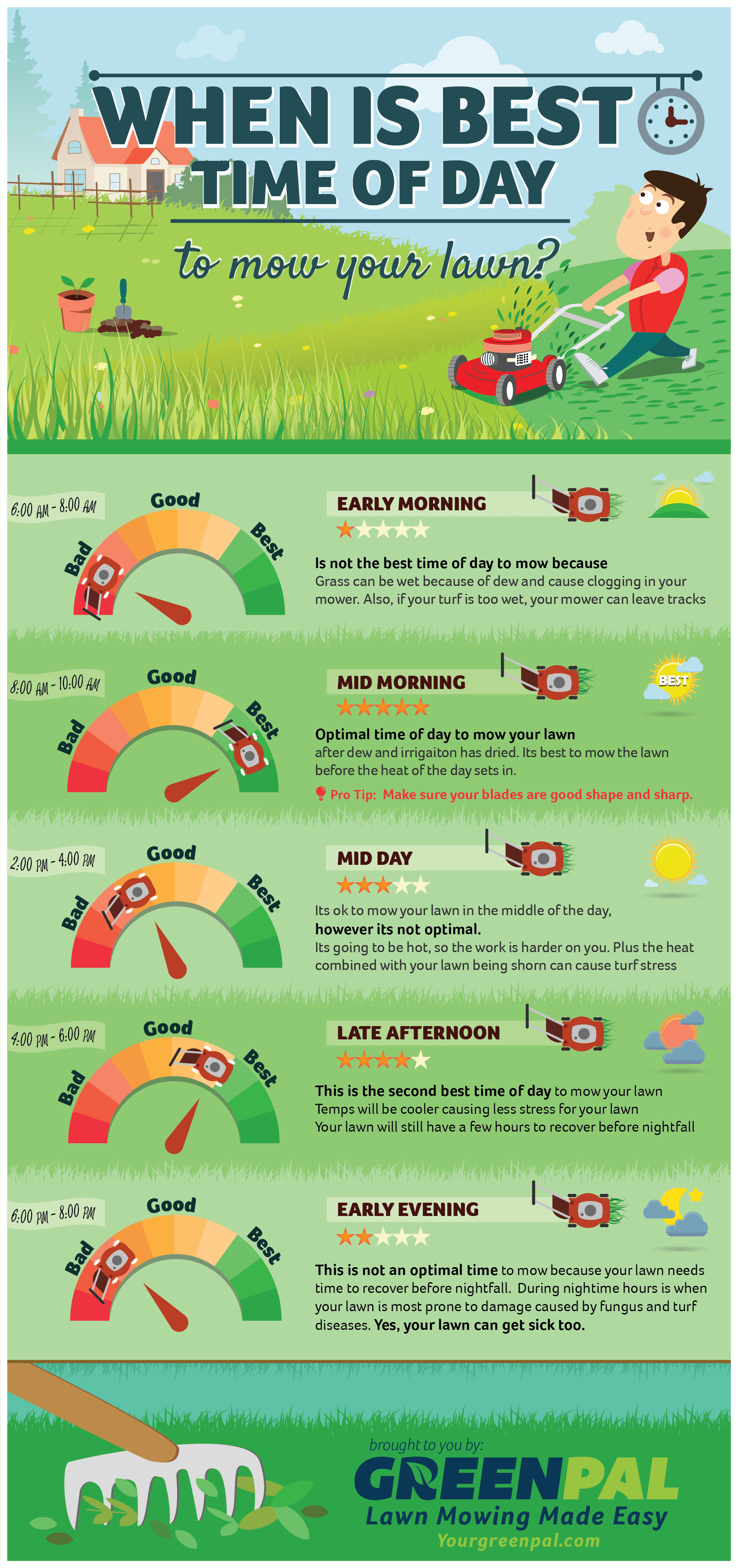
Best Time to Mow Your Lawn
The time of day you mow can also impact your lawn’s health and appearance.
- Best Time: Late morning to early afternoon is generally considered the best time to mow. By this time, the grass blades have typically dried off from morning dew, reducing the risk of spreading fungal diseases. Mowing when the grass is dry also prevents clumping and makes for a cleaner cut.
- Avoid:
- Early Morning: Dew on the grass blades can stick to the mower deck and clump together, leading to an uneven cut and potential disease spread.
- Late Afternoon/Evening: Mowing too late in the day can stress the grass as it prepares for the cooler night. It’s also less ideal for the grass to heal before nightfall.
Lawn Care Schedule: Integrating Mowing
A consistent lawn care schedule is essential for a thriving lawn. Mowing is just one piece of the puzzle.
- Fertilizing: Time your fertilizer applications based on your grass type and the season.
- Watering: Water deeply and infrequently to encourage strong root growth. Early morning is the best time to water.
- Aeration: This process helps relieve soil compaction, allowing air, water, and nutrients to reach the roots. Typically done once a year in the fall for cool-season grasses and early summer for warm-season grasses.
- Dethatching: If thatch (a layer of dead grass stems and roots) builds up to more than half an inch, it can hinder water and nutrient penetration. Dethatch when the grass is actively growing.
- Weed Control: Address weeds proactively through proper mowing and fertilizing, and spot treat as needed.
Tips for Efficient and Healthy Mowing
Implementing these lawn maintenance tips will make your mowing routine more effective.
- Sharp Mower Blades: This is perhaps the most critical tip. Dull blades tear grass, leaving jagged edges that turn brown and are more susceptible to disease. Sharpen your blades at least once a year, or more often if you have a large lawn or mow frequently.
- Mulching vs. Bagging: Most modern mowers offer a mulching option. Mulching grass clippings returns valuable nutrients to the soil and helps retain moisture. Bagging is useful for removing excessive clippings during rapid growth periods or if the grass is wet and clumping.
- Vary Mowing Patterns: Mowing in the same direction every time can cause the grass blades to lean in that direction, creating ruts and an uneven appearance. Alternating your mowing pattern (e.g., horizontal one week, vertical the next, then diagonal) helps the grass stand upright and promotes a healthier, more uniform look.
- Clean Your Mower: After each use, clear grass clippings and debris from the mower deck. This ensures efficient operation and prevents the buildup of corrosive materials.
- Mow When Dry: As mentioned earlier, mowing dry grass is best for a clean cut and to prevent disease.
Troubleshooting Common Mowing Issues
Even with careful planning, you might encounter issues.
Uneven Cut
- Cause: Dull mower blades, uneven terrain, mower deck not level, or grass is too tall and wet.
- Solution: Sharpen blades, check tire pressure for deck levelness, ensure mower is set to the correct height for the grass condition, and mow when dry.
Grass Clippings Clumping
- Cause: Mowing too much grass at once (violating the one-third rule), wet grass, or dull blades.
- Solution: Mow more frequently, wait for grass to dry, or sharpen blades. If you must mow tall grass, do it in two passes, removing no more than one-third at a time.
Brown Patches After Mowing
- Cause: Scalping (mowing too short), dull mower blades tearing the grass, or applying chemicals improperly.
- Solution: Ensure you are adhering to the one-third rule and maintaining the ideal mowing height. Sharpen blades. Review any chemical applications.
The Importance of Observation
Ultimately, your lawn is the best indicator of how often it needs to be cut. Pay attention to its appearance and growth rate.
- Listen to Your Lawn: Does it look like it’s getting too tall? Are the blades starting to lean over? These are signs it’s time for a trim.
- Monitor Growth: If you notice significant growth within a few days, it’s time to mow again. If growth seems slow, you can likely extend your mowing intervals.
By combining knowledge of your grass type with careful observation, you can establish a mowing frequency that keeps your lawn healthy, attractive, and resilient. This proactive approach to lawn maintenance tips will contribute to a beautiful yard year-round.
Frequently Asked Questions (FAQ)
Q1: Can I mow my lawn if it’s slightly wet?
A: It’s best to avoid mowing when the grass is very wet. This can lead to clumping, an uneven cut, and potentially spread fungal diseases. If it’s only slightly damp from morning dew, waiting an hour or two for it to dry is usually sufficient.
Q2: What happens if I don’t mow my lawn for a long time?
A: If you don’t mow your lawn for an extended period, the grass will grow very tall. This can lead to several problems: the grass will become leggy and weak, it will be more susceptible to diseases and pests, it can become difficult to mow evenly (potentially requiring a “high-mow” or multiple passes), and the taller grass can shade out desirable species, allowing weeds to take over.
Q3: Is it okay to mow my lawn at different heights each time?
A: While it’s generally best to stick to the ideal mowing height for your grass type, occasional slight variations are usually fine, especially if you’re adhering to the one-third rule. However, consistently mowing too short will stress your lawn. Conversely, letting it get excessively tall and then cutting it way down is also harmful. Focus on maintaining the recommended height range.
Q4: When is the best time to start mowing in the spring?
A: Start mowing your lawn in the spring when the grass has actively started to grow and has reached a height where you need to cut it. Avoid mowing too early when the grass is still dormant or recovering from winter. A good rule of thumb is to wait until the grass has grown about a third longer than its ideal mowing height.
Q5: Does mowing frequency affect how often I need to water?
A: Yes, it can. A lawn that is mowed correctly and not stressed is generally more drought-tolerant. Mowing too short, however, can dry out the soil faster, increasing the need for watering. Conversely, if you’re letting your grass get too tall, it might require more water to support the excess foliage. Maintaining the correct mowing height and frequency contributes to overall turf health and water efficiency.