
So, how much will a yard of rock cover? A single cubic yard of rock, spread at a depth of 2 inches, will typically cover an area of approximately 162 square feet. This is a fundamental question for anyone planning landscaping or construction projects, and the answer hinges on a few key factors. This guide will help you accurately determine your rock needs, ensuring you purchase the right amount for your project, whether you’re calculating landscape rock coverage, using a gravel coverage estimator, or figuring out how much rock per square foot you’ll need.
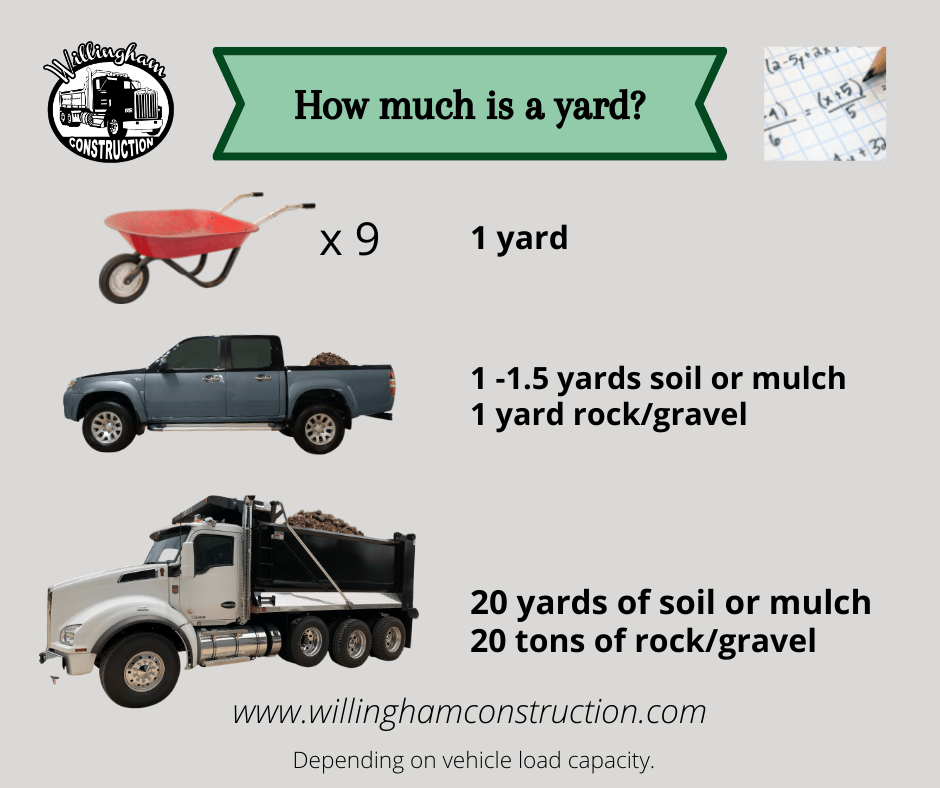
Image Source: lirp.cdn-website.com
Deciphering Rock Coverage: The Core Concepts
When you buy rock, it’s usually sold by the cubic yard. This is a measure of volume, not area. To figure out how much ground a cubic yard will cover, you need to consider the desired depth of your rock layer. Think of it like filling a box: the volume of the box is fixed, but you can spread its contents thinly or thickly over a surface.
The Math Behind Coverage: From Cubic Yards to Square Feet
The relationship between cubic yards and square feet for coverage is based on the conversion of volume to area and then accounting for depth.
- 1 Cubic Yard = 27 Cubic Feet
To calculate coverage, we use the formula:
Coverage Area (in square feet) = Volume (in cubic feet) / Depth (in feet)
Let’s break this down:
- Volume: You have 27 cubic feet in one cubic yard.
- Depth: This is where the desired thickness of your rock layer comes in. You’ll need to convert your desired depth (usually measured in inches) into feet. For example, 2 inches is 2/12 of a foot, or 0.167 feet.
Using these figures, we can calculate the coverage for a common depth:
Coverage Area = 27 cubic feet / 0.167 feet (for 2 inches of depth) ≈ 162 square feet
This 162 square feet per cubic yard coverage is a widely used benchmark for landscaping projects, but remember, this is a starting point.
Factors Influencing Your Rock Coverage
While the basic math is straightforward, several real-world factors can affect your actual rock coverage. It’s crucial to consider these when planning your project to avoid under or overbuying.
Depth: The Most Significant Variable
The depth at which you spread your rock is the single biggest factor determining how much area a cubic yard will cover.
- Shallow Depth (e.g., 1 inch): Will cover a much larger area.
- Deeper Depth (e.g., 4 inches): Will cover a smaller area.
Let’s look at how different depths impact coverage per cubic yard:
| Desired Depth | Depth in Feet | Coverage Area per Cubic Yard (approx.) |
|---|---|---|
| 1 inch | 0.083 | 324 square feet |
| 2 inches | 0.167 | 162 square feet |
| 3 inches | 0.250 | 108 square feet |
| 4 inches | 0.333 | 81 square feet |
| 5 inches | 0.417 | 65 square feet |
| 6 inches | 0.500 | 54 square feet |
This table clearly shows how adjusting the depth dramatically changes the area you can cover with the same amount of rock.
Rock Type and Size
Different types and sizes of rock also play a role, though their impact is often less pronounced than depth.
- Angular vs. Rounded Rocks: Angular rocks tend to interlock more effectively, creating a denser layer. Rounded rocks might settle and create voids more readily, potentially requiring slightly more material for the same perceived coverage.
- Size of Gravel: Finer gravels might settle more compactly than larger, chunkier stones. This can influence how “fluffy” or compacted the final layer is.
While these are considerations, for most landscaping purposes, the differences in coverage due to rock type are minimal compared to the impact of depth.
Compaction and Settling
As rocks settle over time, especially after rain or foot traffic, the initial layer might become slightly less voluminous. If you’re aiming for a very precise final depth, you might want to account for a small amount of settling, potentially by spreading slightly thicker initially.
Tools to Help You Calculate Rock Needs
Manually calculating your needs is effective, but several tools can simplify the process, especially for larger or more complex projects. These tools help with determining rock needs efficiently.
Online Rock Coverage Calculators
Numerous websites offer free rock coverage calculators or gravel coverage estimators. These are incredibly user-friendly. You typically input:
- The desired area (in square feet or square meters).
- The desired depth of the rock (in inches or centimeters).
The calculator then outputs the number of cubic yards (or tons, if you have density information) you’ll need. These are excellent for quickly checking your calculations or getting a rapid estimate.
Using Your Own Rock Quantity Calculator
You can also create a simple rock quantity calculator on a spreadsheet.
- Area: Calculate the total square footage of the area you need to cover.
- Depth: Decide on your desired depth in inches and convert it to feet (inches / 12).
- Volume in Cubic Feet: Area (sq ft) * Depth (ft) = Cubic Feet
- Volume in Cubic Yards: Cubic Feet / 27 = Cubic Yards
For example, if you have a 10ft x 20ft patio area (200 sq ft) and want a 3-inch depth:
- Depth in feet = 3 inches / 12 = 0.25 feet
- Volume in Cubic Feet = 200 sq ft * 0.25 ft = 50 cubic feet
- Volume in Cubic Yards = 50 cubic feet / 27 = 1.85 cubic yards
This step-by-step approach ensures you know exactly how much rock per square foot you’re using and the total quantity needed.
Converting Square Footage to Cubic Yards Rock
A common point of confusion is converting between square footage (area) and cubic yards (volume). Remember, you can’t directly convert square feet to cubic yards because one is a 2D measurement and the other is 3D. You always need to incorporate the depth.
Square footage to cubic yards rock calculations are fundamental to avoiding errors. The core idea is to find the volume in cubic feet first.
Formula Recap:
(Area in Square Feet * Depth in Inches) / 324 = Cubic Yards
(Note: This formula combines the steps and uses a pre-calculated factor for 12 inches of depth, where 1 cubic yard covers 27 sq ft at 12 inches depth. So, 27 * 12 = 324. This is a handy shortcut.)
Let’s re-do the patio example using this shortcut:
- Area = 200 sq ft
- Depth = 3 inches
- Cubic Yards = (200 sq ft * 3 inches) / 324 = 600 / 324 ≈ 1.85 cubic yards
This shortcut is excellent for quick checks and using online gravel coverage estimators.
Practical Applications and Considerations
Knowing how much rock coverage you can expect is vital for various projects.
Landscape Rock Coverage for Driveways and Paths
Driveways and walking paths often require a more substantial depth of gravel for stability and durability. A common recommendation for a gravel driveway is a minimum of 4 inches, and sometimes up to 6 inches, layered and compacted.
For a driveway that is 10 feet wide by 50 feet long:
- Area = 10 ft * 50 ft = 500 sq ft
- Desired depth = 4 inches
Using our shortcut:
- Cubic Yards = (500 sq ft * 4 inches) / 324 = 2000 / 324 ≈ 6.17 cubic yards
For a 6-inch depth:
- Cubic Yards = (500 sq ft * 6 inches) / 324 = 3000 / 324 ≈ 9.26 cubic yards
It’s often wise to order slightly more than your calculation to account for settling and potential unevenness. This is where a good rock quantity calculator or gravel coverage estimator becomes invaluable.
Decorative Gravel for Garden Beds and Flower Beds
For decorative purposes, such as mulching around plants or creating pathways in a garden, a depth of 2 to 3 inches is usually sufficient.
Consider a flower bed that is 8 feet by 15 feet:
- Area = 8 ft * 15 ft = 120 sq ft
- Desired depth = 2 inches
Calculating coverage:
- Cubic Yards = (120 sq ft * 2 inches) / 324 = 240 / 324 ≈ 0.74 cubic yards
For a 3-inch depth:
- Cubic Yards = (120 sq ft * 3 inches) / 324 = 360 / 324 ≈ 1.11 cubic yards
In this scenario, ordering 1 cubic yard would likely be sufficient, possibly with a small top-up if needed.
Base Layer for Patios and Hardscaping
When installing patios, pavers, or other hardscaping features, a compacted base layer of gravel is crucial for stability and drainage. This base layer is often thicker, typically 4 to 6 inches.
If you’re preparing a patio area that’s 12 feet by 15 feet, and you need a 6-inch compacted base:
- Area = 12 ft * 15 ft = 180 sq ft
- Desired depth = 6 inches
Calculating the volume:
- Cubic Yards = (180 sq ft * 6 inches) / 324 = 1080 / 324 ≈ 3.33 cubic yards
This calculation is critical for determining rock needs accurately for structural projects.
Tips for Accurate Measurement and Ordering
To ensure you get the right amount of rock for your project, follow these tips:
Measure Your Area Accurately
- For Rectangular/Square Areas: Multiply length by width.
- For Irregular Areas: Break them down into simpler shapes (rectangles, triangles, circles) and add their areas. You can also use measuring tapes and chalk to outline the area on the ground and then measure the outline.
- Check for Slopes: If your area has significant slopes, you might need slightly more material to achieve a consistent depth.
Determine Your Desired Depth Carefully
- Think About Function: Will it be walked on? Will it need to support weight?
- Aesthetic Goals: What look are you going for?
- Consider Compaction: Especially for high-traffic areas or base layers, factor in some settling. A 3-inch spread might settle to 2 inches of compacted material.
Factor in Waste and Extra
It’s almost always better to have a little extra rock than to run out. Running out often means another delivery charge, which can be more expensive than buying a bit extra upfront. A good rule of thumb is to add 5-10% to your calculated total. This accounts for settling, uneven distribution, and accidental spills.
Consider Delivery Options
Rock is heavy! A cubic yard of gravel can weigh anywhere from 2,000 to 3,000 pounds (1 to 1.5 tons) depending on the type and moisture content.
- Bulk Delivery: Most suppliers deliver in bulk quantities (by the cubic yard or ton). This is usually the most cost-effective option for larger projects.
- Bagged Rock: For smaller projects, you can buy bagged rock. A typical bag might contain 0.5 cubic feet of rock. You’d need 54 bags (27 cubic feet / 0.5 cubic feet) to equal one cubic yard. Bagged rock is more expensive per unit but convenient for small jobs.
Communicate with Your Supplier
Don’t hesitate to ask your rock supplier for advice. They often have experience with local projects and can help you estimate needs based on the specific type of rock you choose.
Frequently Asked Questions (FAQ)
Here are answers to some common questions about rock coverage.
Q1: How many square feet does one cubic yard of rock cover at a 3-inch depth?
A1: One cubic yard of rock will cover approximately 108 square feet when spread at a uniform depth of 3 inches. This is a common depth for decorative landscaping.
Q2: How do I calculate how much rock I need for my garden path?
A2: To calculate how much rock you need for your garden path, first measure the length and width of the path to get the total square footage. Then, decide on the desired depth (e.g., 2 inches). Use the formula: (Area in sq ft * Depth in inches) / 324 = Cubic Yards. For example, a path that is 4 feet wide by 30 feet long (120 sq ft) with a 2-inch depth would need (120 * 2) / 324 = 0.74 cubic yards. It’s wise to round up to the nearest full yard if you’re close, or add a small percentage for extras.
Q3: Is it better to order rock by the cubic yard or by the ton?
A3: It depends on your supplier and the type of rock. Many suppliers sell decorative landscaping rock by the cubic yard. However, for base materials like crushed gravel or road base, it’s often sold by the ton because their density varies. If buying by the ton, ask your supplier for the approximate weight per cubic yard for the specific rock you’re interested in to convert accurately. A general estimate is that 1 cubic yard of gravel weighs about 1.5 tons, but this can vary.
Q4: What is a good depth for decorative rock in flower beds?
A4: A good depth for decorative rock in flower beds is typically between 2 to 3 inches. This depth is usually enough to suppress weeds, retain moisture, and provide an attractive aesthetic without being excessively deep or costly.
Q5: How do I convert square feet to cubic yards for rock?
A5: To convert square feet to cubic yards for rock, you must include the desired depth. The formula is: Cubic Yards = (Area in Square Feet × Depth in Inches) / 324. The ‘324’ is a constant that accounts for the conversion of cubic feet to cubic yards and the conversion of inches to feet for a standard 12-inch depth.
Q6: Do I need a special tool to calculate rock coverage?
A6: While you can do the math manually, using an online rock coverage calculator or a gravel coverage estimator can make the process much simpler and quicker. These tools are readily available online and are designed to help you accurately calculate rock coverage for your specific needs.
Q7: How much does a yard of rock typically weigh?
A7: A yard of rock, or a cubic yard, can weigh anywhere from 2,000 to 3,000 pounds (1 to 1.5 tons). The exact weight depends on the type of rock, its size, and its moisture content. For example, lighter decorative stones will weigh less than denser crushed gravel.
By following this comprehensive guide, you can confidently tackle any project involving rock, ensuring you have the right quantities to achieve your desired results. Whether you’re using a rock quantity calculator or performing your own determining rock needs calculations, precision and a little extra planning go a long way.