
So, you’re wondering, “How much mulch is a cubic yard?” A cubic yard of mulch is a unit of volume, equal to 3 feet by 3 feet by 3 feet, or 27 cubic feet. This is the standard way mulch is sold, and knowing this is key to getting your landscaping projects right.
Estimating mulch needs can seem tricky, but with a little information, you can easily figure out how much mulch to buy. Whether you’re topping up existing beds or creating new ones, proper mulch estimating ensures you have enough without overspending. This guide will walk you through everything you need to know about cubic yards of mulch and how to calculate your needs.
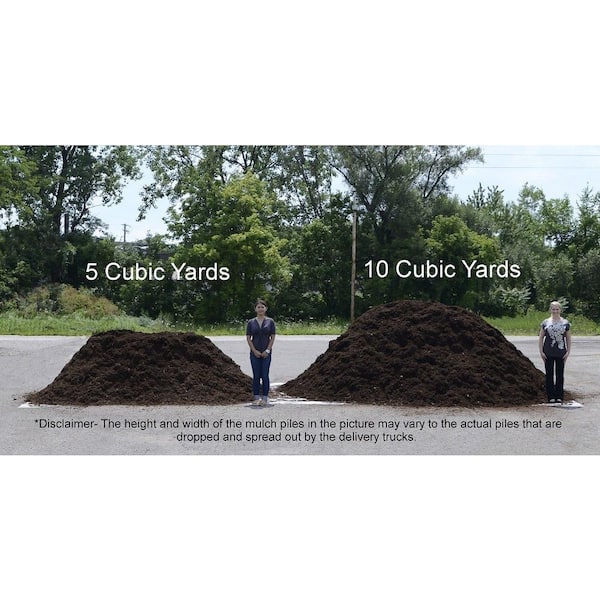
Image Source: images.thdstatic.com
Deciphering Cubic Yard Measurements
When you buy mulch, it’s typically sold by the cubic yard. But what does that actually mean in terms of what you get? A cubic yard is a measurement of volume.
How Many Cubic Feet in a Cubic Yard?
This is a fundamental piece of information for any mulch calculation.
- One cubic yard contains 27 cubic feet.
Think of it like this: a cubic yard is a cube that is 3 feet long, 3 feet wide, and 3 feet tall. Multiply those dimensions together: 3 ft x 3 ft x 3 ft = 27 cubic feet. This conversion is vital for understanding coverage.
What Constitutes a Cubic Yard of Mulch?
A cubic yard of mulch is a large volume of material. It’s often delivered in a large pile or in large bags. The key thing to remember is that this volume measurement refers to the space the mulch occupies, not necessarily the weight, which can vary based on moisture content.
Calculating Your Mulch Needs
The most common question after “How much mulch is a cubic yard?” is “How much mulch do I need for my project?” This involves measuring your space and deciding on the desired depth.
The Importance of Mulch Depth Calculation
The depth at which you apply mulch significantly impacts how much you’ll need. Too thin, and it won’t provide adequate benefits. Too thick, and you can harm your plants.
- Typical recommended mulch depth: 2 to 4 inches for most applications.
- New bed preparation: May require a deeper layer initially.
- Existing beds: Often need a top-up of 1-2 inches.
A good mulch depth calculation considers the type of mulch and the plants you’re covering. For instance, shredded bark might settle more than wood chips.
Using a Mulch Coverage Calculator
Many landscaping supply websites and gardening resources offer a mulch coverage calculator. These tools simplify the process. You typically input the area you want to cover (in square feet) and the desired depth (in inches), and the calculator tells you how many cubic yards you need. This is one of the easiest methods for mulch estimating.
Mulch Calculator by Square Foot: Your Go-To Tool
To use a mulch calculator by square foot, you first need to determine the area of your garden beds.
Measuring Your Garden Beds
- Rectangular or Square Beds: Multiply the length by the width to get the square footage.
- Example: A bed that is 10 feet long and 5 feet wide has an area of 10 x 5 = 50 square feet.
- Circular Beds: Measure the diameter of the circle. Divide the diameter by 2 to get the radius. Use the formula: Area = π * radius². (π is approximately 3.14).
- Example: A circular bed with a diameter of 6 feet has a radius of 3 feet. Area = 3.14 * (3 ft)² = 3.14 * 9 sq ft = 28.26 square feet.
- Irregularly Shaped Beds: Break them down into smaller, simpler shapes (rectangles, squares, triangles, semi-circles) and add their areas together. Or, you can approximate by finding the longest length and widest width and treating it like a rectangle, then adjusting the estimate.
Applying Depth to Area Calculations
Once you have your area in square feet, you need to account for the depth.
- Convert inches to feet: Divide the desired depth in inches by 12 (since there are 12 inches in a foot).
- Example: 3 inches = 3 / 12 = 0.25 feet.
The Mulch Calculation Formula
The basic mulch calculation formula to find the volume needed in cubic feet is:
Volume (cubic feet) = Area (square feet) x Depth (feet)
Once you have this volume in cubic feet, you can convert it to cubic yards by dividing by 27 (because there are 27 cubic feet in a cubic yard).
Volume (cubic yards) = Volume (cubic feet) / 27
Let’s combine this into one formula:
Mulch Needed (cubic yards) = [Area (sq ft) x Depth (inches) / 12] / 27
This simplifies to:
Mulch Needed (cubic yards) = Area (sq ft) x Depth (inches) / 324
How Much Mulch Per Bag?
Mulch is also commonly sold in bags. Understanding how much mulch per bag is crucial when you’re dealing with smaller quantities or when delivery for bulk is not an option.
- Common Bag Sizes: Mulch bags typically come in 1, 2, or 3 cubic foot sizes.
-
Calculating Bag Needs: If you know your total cubic yard requirement, you can convert it back to bags.
Number of Bags = Total Cubic Yards Needed x 27 / Cubic Feet Per Bag
- Example: If you need 3 cubic yards and bags are 2 cubic feet:
Number of Bags = 3 cubic yards x 27 cubic feet/cubic yard / 2 cubic feet/bag = 81 / 2 = 40.5 bags. You’d round up to 41 bags.
- Example: If you need 3 cubic yards and bags are 2 cubic feet:
Example: How Much Mulch for Flower Bed?
Let’s put this into practice with a common scenario: how much mulch for flower bed.
Imagine you have a rectangular flower bed that is 15 feet long and 6 feet wide. You want to apply mulch at a depth of 3 inches.
-
Calculate the Area:
Area = Length x Width = 15 ft x 6 ft = 90 square feet. -
Convert Depth to Feet:
Depth = 3 inches / 12 inches/foot = 0.25 feet. -
Calculate Volume in Cubic Feet:
Volume (cubic feet) = Area x Depth = 90 sq ft x 0.25 ft = 22.5 cubic feet. -
Convert Volume to Cubic Yards:
Volume (cubic yards) = Volume (cubic feet) / 27 = 22.5 cubic feet / 27 cubic feet/cubic yard = 0.83 cubic yards.
Since you usually can’t buy fractions of a cubic yard, you’d round up to 1 cubic yard. If you were buying 2 cubic foot bags:
Number of Bags = 0.83 cubic yards x 27 cubic feet/cubic yard / 2 cubic feet/bag = 22.41 / 2 = 11.2 bags. You would need 12 bags.
Factors Affecting Mulch Coverage
While the formulas provide a good estimate, several real-world factors can influence your actual mulch coverage.
Type of Mulch
Different types of mulch have different densities and particle sizes, which can affect how much area a cubic yard covers.
- Shredded Bark: Tends to be lighter and can expand more, potentially offering slightly better coverage than heavier wood chips for the same volume.
- Wood Chips: Can be denser and may require slightly more to achieve the same depth and coverage compared to lighter materials.
- Gravel or Stone: These are not technically mulch, but if used for ground cover, their coverage is determined purely by volume and desired depth.
Compaction and Settling
Mulch, especially organic types, will settle over time as it decomposes and moisture is absorbed.
- Initial Application: You might apply mulch slightly thicker than your target depth to account for settling.
- Topping Up: When adding to existing beds, the old mulch might already be compacted, so you’re essentially filling the space over it.
Base Preparation
The surface you’re applying mulch to also plays a role.
- Bare Soil: Mulch will be absorbed slightly into the soil.
- Existing Mulch: You are simply covering the existing layer.
- Weed Barrier Fabric: The fabric will prevent the mulch from mixing with the soil but might slightly alter the visual coverage.
Your Specific Mulch Depth Calculation
Always double-check your desired depth. A common mistake is to estimate depth visually rather than measuring it. Using a ruler or tape measure to check your depth after spreading a section of mulch is a good practice.
Estimating Mulch for Different Projects
Beyond flower beds, mulch is used in many landscaping scenarios.
How Much Mulch for Flower Bed (Larger Scale)
For larger gardens or multiple beds, multiply the individual bed calculations and sum them up. Alternatively, measure the total area of all beds you intend to mulch.
- Example: If you have three beds:
- Bed 1: 90 sq ft
- Bed 2: 120 sq ft
- Bed 3: 70 sq ft
Total Area = 90 + 120 + 70 = 280 sq ft.
If you want 3 inches of mulch:
Mulch Needed (cubic yards) = 280 sq ft x 3 inches / 324 = 2.6 cubic yards. You would round up to 3 cubic yards.
Mulch for Trees
When mulching trees, the goal is to create a wide, even ring around the base, extending to the drip line (the edge of the canopy).
- Avoid “Mulch Volcanoes”: Do not pile mulch directly against the tree trunk. Leave a few inches of space to prevent rot and pest issues.
- Measurement: For a circular area around a tree, use the circular bed calculation. Measure from the trunk to the edge of the desired mulch ring.
- Example: A tree with a drip line extending 5 feet from the trunk. The mulched area might be a circle with a radius of 4 feet (leaving a clear space around the trunk).
Area = 3.14 x (4 ft)² = 3.14 x 16 sq ft = 50.24 sq ft.
For 4 inches of mulch:
Mulch Needed (cubic yards) = 50.24 sq ft x 4 inches / 324 = 0.62 cubic yards. Round up to 1 cubic yard.
- Example: A tree with a drip line extending 5 feet from the trunk. The mulched area might be a circle with a radius of 4 feet (leaving a clear space around the trunk).
Mulch for Larger Areas (Pathways, Groundcover)
For larger areas like pathways or large groundcover zones, accurate square footage is key.
- Consistency is Key: Ensure a uniform depth across the entire area for both aesthetic appeal and effective weed suppression.
- Calculating for Large Areas: Use the same mulch calculator by square foot method, but ensure your measurements are precise.
Tips for Efficient Mulch Estimating and Purchasing
Getting your mulch estimating right saves you time, money, and effort.
Always Buy a Little Extra
It’s almost always better to have a bit too much mulch than not enough.
- Why Extra? Accounts for settling, uneven application, unexpected needs, or if you decide to extend a bed slightly.
- How Much Extra? A common recommendation is to add 5-10% to your calculated amount.
- If you calculated 3 cubic yards, add 0.15 to 0.3 cubic yards. So, buy 3.5 cubic yards.
Consider Delivery Costs
When buying in bulk (cubic yards), delivery fees can add up.
- Delivery Thresholds: Many suppliers offer free delivery above a certain quantity.
- Bag vs. Bulk: For very small projects, bags might be more convenient. For larger ones, bulk is usually more cost-effective per cubic yard.
When to Mulch
The best times to mulch are typically spring and fall.
- Spring: After the ground has warmed up, but before weeds get established.
- Fall: Helps insulate plants over winter and keeps beds looking tidy.
Mulch Types and Their Benefits
Choosing the right mulch is as important as calculating the quantity.
- Organic Mulches (Wood Chips, Bark, Compost): Improve soil structure as they break down, suppress weeds, retain moisture, and regulate soil temperature.
- Inorganic Mulches (Gravel, Stone, Rubber Mulch): Durable, don’t decompose, and can offer a decorative look. Less beneficial for soil health.
Frequently Asked Questions (FAQ)
Here are some common questions about mulch and cubic yards.
How thick should mulch be?
Generally, 2 to 4 inches is recommended. Check specific plant needs, as some prefer thinner layers or different types of mulch.
Can I use a mulch coverage calculator by square foot if my area is circular?
Yes, you can. You just need to accurately calculate the area of the circle using the radius and the formula Area = πr².
What happens if I put too much mulch down?
Applying mulch too thickly, especially against tree trunks or plant stems, can lead to root rot, suffocation, and pest problems. It can also create a barrier that prevents water and air from reaching the roots.
Is it better to buy mulch in bags or in bulk?
It depends on the quantity needed and your transportation capabilities. For small projects (e.g., a few small beds), bags are convenient. For larger areas, bulk is typically more economical and environmentally friendly (less packaging).
How do I figure out how much mulch per bag I need if I calculated in cubic yards?
Convert your total cubic yards needed into cubic feet (multiply by 27) and then divide by the cubic feet per bag size you are purchasing.
What is the best way for mulch estimating for a large, irregularly shaped garden?
Break the irregular shape into smaller, regular geometric shapes (rectangles, squares, triangles). Calculate the area of each shape, add them together for the total area, and then use the mulch calculation formula.
How much mulch is a cubic yard of coverage?
A cubic yard of mulch, applied at a depth of 3 inches, will cover approximately 108 square feet. This is a common benchmark. If you’re using a mulch coverage calculator, this is often built into the calculation.
Does the type of mulch affect mulch volume needed?
Yes, slightly. Denser mulches might compress more, so you might need a touch more to achieve the same visible depth as a lighter, fluffier mulch. However, the primary determinant is the area and desired depth.
By following these guidelines and using simple tools like a mulch calculator by square foot, you can confidently estimate mulch volume needed for any project, ensuring your garden beds are beautifully and effectively covered.