
So, how many tons per cubic yard does a material weigh? This is a common question for anyone involved in construction, landscaping, or even just DIY projects. The answer isn’t a single number; it depends entirely on the density of the specific material you’re working with. While a cubic yard is a measure of volume conversion, a ton is a measure of weight. To convert between them, we need to know how much that volume of material weighs. This guide will help you navigate the world of material weight and volume conversion, specifically focusing on the cubic yard to ton calculation. We’ll explore common materials, the factors affecting their weight, and provide you with the tools to make accurate estimations for your projects.
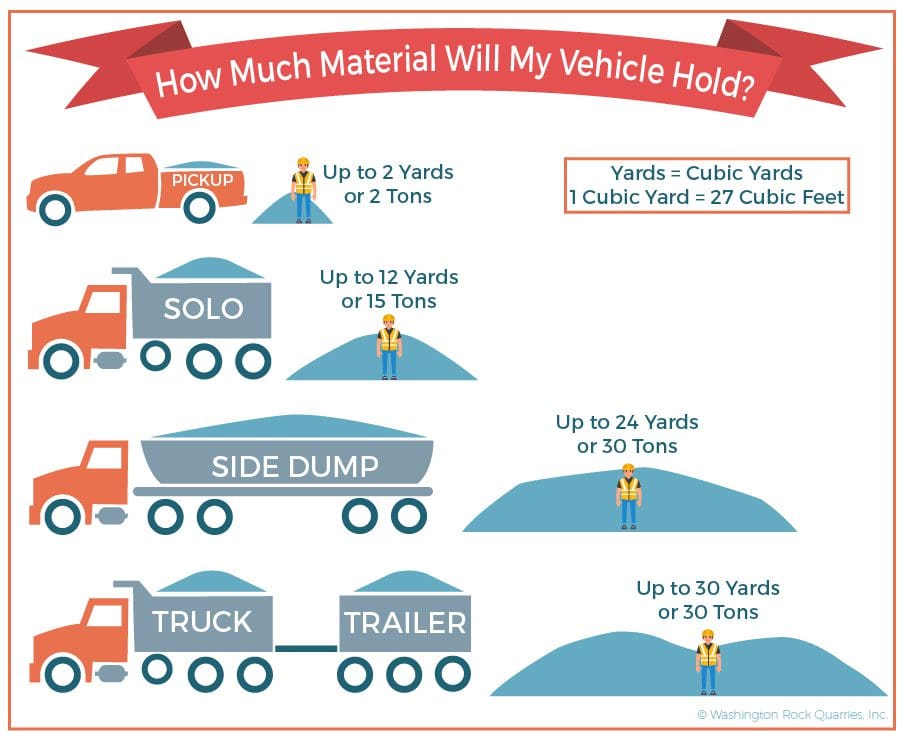
Image Source: www.wa-rock.com
Deciphering Material Density: The Key to Accurate Conversions
The core concept behind converting cubic yards to tons is density. Density is defined as mass per unit volume. In simpler terms, it tells us how much “stuff” is packed into a certain amount of space. For construction and landscaping materials, this is usually expressed as pounds per cubic foot or kilograms per cubic meter. Once we know the density, we can calculate the weight of any given volume.
Factors Influencing Material Density
Several factors can affect the density of a material, leading to variations in the material weight per cubic yard:
- Moisture Content: Water is heavy! Wet materials will always weigh more than their dry counterparts. For example, wet sand will have a higher sand weight per cubic yard than dry sand.
- Compaction: How tightly packed a material is makes a big difference. Loose material will occupy more space for the same amount of mass. Think about how a pile of gravel might settle significantly after being dumped and then compacted. This is particularly relevant when calculating aggregate weight.
- Particle Size and Shape: Finer materials might pack more tightly than coarser ones. The shape of the particles (round vs. angular) also influences how well they fit together, impacting compaction and overall density.
- Material Type: Obviously, different materials have inherently different densities. For example, the soil density of topsoil will be different from that of crushed stone.
Common Materials and Their Approximate Weights per Cubic Yard
To help you get started, here’s a look at the approximate material weight for some commonly used construction and landscaping materials. It’s crucial to remember these are averages, and actual weights can vary due to the factors mentioned above. Always try to confirm with your supplier if precise weights are critical for your project.
Aggregate and Stone
Aggregates, including gravel and crushed stone, are fundamental to many construction projects. Their weight can vary significantly based on the type of rock and how it’s processed.
Gravel Weight
Gravel, typically consisting of rounded stones, generally weighs less per cubic yard than crushed stone because the irregular shapes of crushed stone allow for tighter packing.
- Typical Range: 2,400 to 2,800 pounds per cubic yard.
- Conversion to Tons: Approximately 1.2 to 1.4 tons per cubic yard.
Crushed Stone (e.g., Granite, Limestone)
Crushed stone, with its angular edges, tends to compact more effectively, leading to a higher aggregate weight per cubic yard.
- Typical Range: 2,500 to 3,000 pounds per cubic yard.
- Conversion to Tons: Approximately 1.25 to 1.5 tons per cubic yard.
Sand
The sand weight per cubic yard is also subject to moisture content and compaction. Dry, loose sand will be lighter than damp, compacted sand.
- Typical Range: 2,500 to 3,000 pounds per cubic yard.
- Conversion to Tons: Approximately 1.25 to 1.5 tons per cubic yard.
Topsoil
The soil density of topsoil can be quite variable, depending on its organic content, moisture, and particle composition (clay, silt, sand).
- Typical Range: 2,000 to 2,600 pounds per cubic yard.
- Conversion to Tons: Approximately 1 to 1.3 tons per cubic yard.
Concrete (Unmixed)
When ordering concrete, it’s often specified by cubic yards, but knowing the approximate weight of the raw materials can be helpful. The weight of concrete depends on the mix design (cement, sand, gravel, water).
- Typical Range: 3,800 to 4,000 pounds per cubic yard for a standard mix.
- Conversion to Tons: Approximately 1.9 to 2 tons per cubic yard.
Asphalt
Similar to concrete, asphalt’s weight is dependent on its composition.
- Typical Range: 3,800 to 4,200 pounds per cubic yard.
- Conversion to Tons: Approximately 1.9 to 2.1 tons per cubic yard.
The Cubic Yard to Ton Conversion Formula
The fundamental formula for converting volume to weight is:
Weight = Volume × Density
Since we want to find tons per cubic yard, and we have volume in cubic yards, we need density in tons per cubic yard. If you have density in pounds per cubic yard, you’ll divide by 2000 (since there are 2000 pounds in a ton).
Weight (tons) = Volume (cubic yards) × Density (tons/cubic yard)
Alternatively, if you have density in pounds per cubic foot:
- Convert Cubic Yards to Cubic Feet: There are 27 cubic feet in 1 cubic yard (3 ft × 3 ft × 3 ft = 27 cu ft).
- Calculate Weight in Pounds: Weight (lbs) = Volume (cu yd) × 27 cu ft/cu yd × Density (lbs/cu ft)
- Convert Pounds to Tons: Weight (tons) = Weight (lbs) / 2000 lbs/ton
Let’s illustrate with an example. If you have 5 cubic yards of gravel that weighs 2,700 pounds per cubic yard:
- Weight in Tons: 5 cubic yards × (2700 lbs / 1 cubic yard) / 2000 lbs/ton = 6.75 tons
Calculating Tons per Cubic Meter
While cubic yards are common in the United States, the rest of the world predominantly uses the metric system. Here, the relevant conversion is often tons per cubic meter. The principle remains the same: density is key.
- 1 cubic yard ≈ 0.764555 cubic meters
- 1 ton (metric ton) = 1000 kilograms
- 1 kilogram ≈ 2.20462 pounds
- 1 ton (US short ton) ≈ 907.185 kilograms
To convert tons per cubic meter, you’ll need the density in kilograms per cubic meter or pounds per cubic foot.
Example: If a material has a density of 1600 kg/m³:
- Weight in Metric Tons per Cubic Meter: 1600 kg/m³ / 1000 kg/metric ton = 1.6 metric tons/m³
To convert this to tons per cubic yard:
- Weight in US Tons per Cubic Meter: 1.6 metric tons/m³ × (2204.62 lbs/metric ton) / (2000 lbs/US ton) ≈ 1.76 US tons/m³
- Weight in US Tons per Cubic Yard: 1.76 US tons/m³ × 0.764555 m³/cubic yard ≈ 1.35 US tons/cubic yard
As you can see, the conversion involves multiple steps if you’re switching between imperial and metric units.
Creating Your Own Conversion Tables
For projects requiring frequent calculations, creating a personalized conversion table can be incredibly useful. Here’s how you can build one:
Step 1: Find Reliable Density Data
- Supplier Information: The best source is often your material supplier. They deal with these materials daily and can provide specific density figures for their products.
- Manufacturer Specifications: For manufactured products like concrete mixes or asphalt, check the manufacturer’s technical data sheets.
- Industry Standards: Organizations like the American Society for Testing and Materials (ASTM) or the Department of Transportation (DOT) publish standards that may include density information.
- Online Resources: Many construction and landscaping websites offer tables of material weights. Be sure to cross-reference information from multiple sources.
Step 2: Perform the Calculations
Using the formula: Weight (tons/cubic yard) = Density (lbs/cubic yard) / 2000
Let’s populate a sample table:
| Material | Approximate Density (lbs/cu yd) | Approximate Weight (tons/cu yd) | Notes |
|---|---|---|---|
| Gravel (Loose) | 2,400 | 1.2 | Rounded stone, uncompacted |
| Gravel (Compacted) | 2,800 | 1.4 | Rounded stone, compacted |
| Crushed Stone | 2,500 | 1.25 | Angular, uncompacted |
| Crushed Stone | 3,000 | 1.5 | Angular, compacted |
| Sand (Dry, Loose) | 2,500 | 1.25 | |
| Sand (Wet, Loose) | 2,800 | 1.4 | Higher weight due to moisture |
| Topsoil (Dry) | 2,000 | 1.0 | Lighter due to organic content |
| Topsoil (Moist) | 2,600 | 1.3 | Heavier when moist |
| Concrete (Mix) | 3,900 | 1.95 | Unmixed components, ready-mix |
| Asphalt (Mix) | 4,000 | 2.0 | Common asphalt mix weight |
Important Considerations for Your Table:
- Specify Conditions: Always note whether the density is for loose or compacted material, and whether it’s dry or wet.
- Material Source: If possible, note the source of your density data (e.g., “Supplier X – Crushed Granite”).
- Units: Be extremely clear about the units you are using (lbs/cu yd, kg/m³, tons/cu yd, metric tons/m³).
Practical Applications: Why This Matters
Knowing how many tons per cubic yard a material weighs is crucial for various practical reasons:
1. Ordering Materials Accurately
Suppliers often sell materials by the cubic yard or by the ton. If you need to order, say, 10 cubic yards of gravel, and you know your gravel weighs 2,700 lbs/cu yd (1.35 tons/cu yd), you can accurately order 13.5 tons. Conversely, if you have a budget for 20 tons of sand, you can calculate how many cubic yards that is:
- Volume (cu yd) = Weight (tons) / Density (tons/cu yd)
- Volume (cu yd) = 20 tons / 1.35 tons/cu yd ≈ 14.8 cubic yards
This prevents over-ordering (leading to waste) or under-ordering (leading to project delays and extra delivery fees).
2. Estimating Project Costs
The cost of materials is often tied to their weight. By accurately converting volumes to weights, you can get a more precise estimate of your total material expenses. This is particularly important for large projects where even small miscalculations can add up to significant cost differences.
3. Planning for Transportation and Equipment
The weight of materials dictates the type of transportation needed and the capacity of your loading equipment. A full cubic yard to ton conversion helps you understand the total load you’ll be moving.
- Truck Capacity: Knowing the weight of materials is essential for ensuring your truck or trailer can handle the load legally and safely. An overloaded vehicle can lead to fines, accidents, and damage to the vehicle itself.
- Equipment Lifting Capacity: If you’re using a skid steer, backhoe, or other heavy machinery, knowing the weight of the material you’re scooping or lifting is vital for preventing damage to the equipment.
4. Understanding Soil and Aggregate Properties
For civil engineering and construction, precise knowledge of soil density and aggregate weight is paramount for structural integrity. This data informs calculations for:
- Foundation Design: The bearing capacity of the soil depends on its density and composition.
- Roadway Construction: The compaction and weight of base layers are critical for pavement longevity.
- Slope Stability: The weight of soil influences the forces acting on slopes.
Tools and Resources for Conversion
While manual calculation is straightforward, several tools can assist with these conversions:
- Online Calculators: Many websites offer dedicated volume-to-weight calculators where you can input material type, volume, and sometimes moisture content to get an estimated weight.
- Mobile Apps: Several construction and material calculation apps are available for smartphones, providing on-the-go conversions.
- Conversion Charts: Printed or digital charts are readily available from suppliers, construction associations, and engineering resources.
Frequently Asked Questions (FAQ)
Q1: What is the average weight of a cubic yard of dirt?
A: The average weight of a cubic yard of dirt (topsoil) can range from 2,000 to 2,600 pounds, which translates to 1 to 1.3 tons per cubic yard. This varies significantly based on moisture content, organic matter, and compaction.
Q2: Can I just use a single number for all my material weight conversions?
A: No, it’s not recommended. While averages exist, the weight of materials like gravel, sand, and soil can vary considerably due to factors like moisture, compaction, and particle size. Always try to find the most accurate density data for the specific material you are using.
Q3: How do I convert cubic yards to tons if the supplier gives me weight per cubic foot?
A: First, convert cubic yards to cubic feet by multiplying by 27 (since 1 cubic yard = 27 cubic feet). Then, multiply that figure by the weight per cubic foot to get the total weight in pounds. Finally, divide the total weight in pounds by 2,000 to convert it to tons.
Q4: Is there a standard density for all types of gravel?
A: No, there isn’t a single standard density. Gravel density depends on the type of rock (e.g., limestone, granite, river rock), its particle size distribution, and how tightly it’s compacted. Crushed gravel tends to be denser than rounded gravel.
Q5: How does moisture affect the weight of materials?
A: Moisture significantly increases the weight of materials. Water is heavy, so wet sand, gravel, or soil will weigh more per cubic yard than dry material of the same type and compaction.
Q6: What is the difference between tons and metric tons?
A: In the United States, a “ton” typically refers to a short ton, which is 2,000 pounds. A “metric ton” (or tonne) is 1,000 kilograms, which is approximately 2,204.62 pounds. This difference is important when working with international specifications or materials.
By carefully considering the density of your materials and applying the correct volume conversion factors, you can confidently navigate material weight calculations, ensuring your projects are planned, budgeted, and executed with precision. Whether you’re calculating aggregate weight, soil density, gravel weight, sand weight, or concrete weight, this guide provides the foundation for accurate cubic yard to ton conversions and a better grasp of tons per cubic meter.