
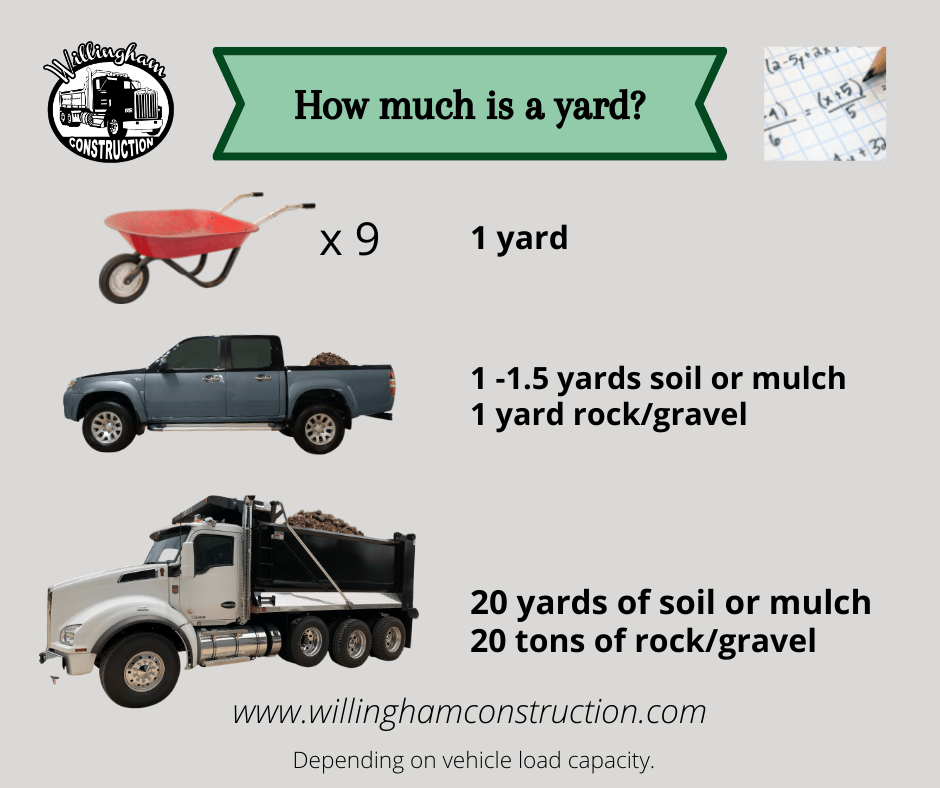
Image Source: lirp.cdn-website.com
How Many Square Feet Does A Yard Of Rock Cover?
A yard of gravel, also known as a cubic yard, will cover approximately 100 square feet when spread at a depth of 2 inches. This is a general rule of thumb, and the actual square footage can vary depending on the type of rock and the desired depth. Let’s dive deeper to help you with your landscaping rock calculation.
Deciphering the Cubic Yard to Square Foot Conversion
When you’re planning a landscaping project, whether it’s a pathway, a mulch bed, or a decorative gravel area, you’ll likely encounter the term “cubic yard.” This refers to the volume of material. However, what you’re often concerned with is the area it will cover, measured in square feet. This is where a volume to area calculation comes into play.
A cubic yard is a unit of volume. It represents a cube with sides measuring one yard (3 feet) in length, width, and height. So, one cubic yard is equal to 3 feet x 3 feet x 3 feet = 27 cubic feet.
To figure out how many square feet a yard of rock covers, we need to consider the depth at which you’ll spread it. Area is a two-dimensional measurement (length x width), while volume is three-dimensional (length x width x depth).
The basic formula for calculating coverage is:
Coverage (in square feet) = Volume (in cubic feet) / Depth (in feet)
Since we know one cubic yard is 27 cubic feet, and the common landscaping depth is 2 inches (which is 2/12 or 1/6 of a foot), we can plug these numbers in:
Coverage = 27 cubic feet / (1/6 feet)
Coverage = 27 cubic feet * 6 feet
Coverage = 162 square feet
Wait, didn’t we say 100 square feet earlier? This highlights the importance of the “rule of thumb” versus precise calculation. The 100 sq ft figure is often used because it accounts for several real-world factors.
Factors Influencing Your Gravel Coverage Estimate
While the math gives us a theoretical number, several practical aspects affect your actual gravel coverage estimate.
1. Rock Size and Shape
- Larger rocks: Tend to leave more voids between them, meaning you might need more material to achieve a consistent depth.
- Smaller rocks/finer gravel: Can compact more tightly, potentially spreading further than larger aggregates.
- Angular rocks: Lock together better and can sometimes create a denser, more stable surface.
- Rounded rocks: May shift more easily, requiring a slightly deeper layer for stability.
2. Compaction
When you spread rock, especially with foot traffic or vehicle use, it will settle and compact. This compaction reduces the overall volume and means the material spreads out to cover a larger area, but also at a shallower depth. The initial depth is always greater than the final settled depth.
3. Desired Depth
This is the most significant factor.
- 2 inches: A common depth for pathways and decorative ground cover. As we calculated, this theoretically gives more coverage, but compaction and voids bring it closer to the 100 sq ft mark.
- 3 inches: Often used for driveways or areas with heavier traffic. This will significantly reduce the square footage covered by a cubic yard. Using our formula: 27 cubic feet / (3/12 feet) = 27 / 0.25 = 108 square feet. Still surprisingly close, but remember compaction.
- 4 inches: For very heavy-duty use or to create a very stable base, you might opt for 4 inches. 27 cubic feet / (4/12 feet) = 27 / (1/3) = 81 square feet.
4. Sub-base Preparation
If your sub-base is uneven, you might need to spread the rock slightly deeper in some areas to achieve a uniform surface, which will reduce your overall coverage.
Creating Your Own Gravel Coverage Estimate
To get a more accurate idea for your specific project, you can use a rock coverage calculator or perform a simple calculation yourself.
The key is to convert your desired depth to feet.
- 1 inch = 1/12 feet
- 2 inches = 2/12 = 1/6 feet
- 3 inches = 3/12 = 1/4 feet
- 4 inches = 4/12 = 1/3 feet
Let’s look at yard of gravel coverage for different depths, keeping in mind these are theoretical and compaction will reduce these numbers slightly in practice:
| Desired Depth (Inches) | Desired Depth (Feet) | Square Feet Covered Per Cubic Yard (Theoretical) | Approximate Real-World Coverage (Accounting for Compaction) |
|---|---|---|---|
| 1 | 1/12 | 324 sq ft | 250 – 300 sq ft |
| 2 | 1/6 | 162 sq ft | 90 – 120 sq ft |
| 3 | 1/4 | 108 sq ft | 80 – 100 sq ft |
| 4 | 1/3 | 81 sq ft | 60 – 75 sq ft |
These real-world estimates are based on common experience and assume a typical gravel blend that compacts somewhat.
How Much Rock Per Square Foot?
This is the inverse question, and it’s just as important. If you know the square footage you want to cover and your desired depth, you can figure out how much rock you need.
Let’s say you want to cover 200 square feet with 2 inches of gravel.
-
Calculate the volume needed in cubic feet:
- Area = 200 sq ft
- Depth = 2 inches = 1/6 feet
- Volume (cubic feet) = Area x Depth = 200 sq ft x (1/6) ft = 33.33 cubic feet
-
Convert cubic feet to cubic yards:
- There are 27 cubic feet in 1 cubic yard.
- Volume (cubic yards) = Volume (cubic feet) / 27
- Volume (cubic yards) = 33.33 / 27 = 1.23 cubic yards
So, for 200 sq ft at a 2-inch depth, you’d need approximately 1.23 cubic yards of rock. It’s always wise to round up to the nearest half or full yard to account for any errors or spills.
Understanding the Square Footage of Crushed Stone
Crushed stone, like gravel, comes in various sizes and types. The principle for calculating its coverage remains the same. Whether you’re using pea gravel, crushed granite, or decorative river rock, the square footage of crushed stone you can expect from a cubic yard will vary based on its specific characteristics and the depth you choose.
For instance, a very fine crusher run material might compact more than larger, rounded river stones. This means the fine material might spread further for a given volume.
Tips for Accurate Landscaping Rock Calculation
- Measure Accurately: Before you buy any rock, carefully measure the length and width of the area you want to cover.
- Choose Your Depth: Decide on the desired depth. For most landscaping applications, 2 inches is sufficient. For high-traffic areas like driveways, 3-4 inches is recommended.
- Use a Reliable Rock Coverage Calculator: Many landscape supply companies offer online calculators. These tools often have pre-programmed rock types that factor in typical compaction rates.
- Round Up: It’s always better to have a little extra rock than to run short. Running out mid-project can be costly and frustrating.
- Consider a Trial Area: If you’re unsure, buy a small amount of your chosen rock and spread it over a measured 10×10 foot area at your desired depth. This will give you a tangible idea of its coverage.
- Factor in Edge Containment: If you’re creating borders or pathways, ensure you have enough rock to fill them without it spilling over.
Interpreting a Stone Coverage Chart
A stone coverage chart is a valuable tool that landscape suppliers often provide. These charts typically list various types of stone and their estimated coverage per cubic yard at different depths. They are based on industry experience and general stone properties.
While helpful, remember that these charts are generalizations. The actual coverage can still be influenced by the specific batch of stone, your site conditions, and how you spread it.
FAQ: Your Burning Questions About Rock Coverage
Q: How much does a cubic yard of gravel weigh?
A: A cubic yard of gravel typically weighs between 1.4 to 1.7 tons (2,800 to 3,400 pounds). This can vary depending on the type of rock and its moisture content.
Q: Can I use a rock coverage calculator for any type of rock?
A: Most rock coverage calculators are designed for common landscaping aggregates like gravel and crushed stone. If you’re using very large decorative boulders or specialized materials, you might need a different approach to estimate coverage.
Q: What is the best depth for gravel in a garden path?
A: For a garden path, a depth of 2 inches is generally recommended. This provides enough coverage to suppress weeds and create a comfortable walking surface without being too deep or difficult to maintain.
Q: Do I need to compact gravel after spreading it?
A: For pathways and decorative areas, natural compaction from foot traffic is usually sufficient. For driveways or areas with vehicular traffic, using a plate compactor after spreading the gravel is highly recommended to create a stable and durable surface.
Q: How does the color of the rock affect its coverage?
A: The color of the rock itself doesn’t directly affect its coverage. What matters is the size, shape, and density of the individual pieces, as well as the depth you apply them.
Q: What if my area is not a perfect rectangle?
A: For irregularly shaped areas, you can break them down into simpler shapes (rectangles, squares, triangles) and calculate the area of each section, then add them together. Alternatively, you can measure the longest and widest points to get an approximate overall size and then adjust based on the actual shape.
Q: What is the difference between gravel and crushed stone?
A: “Gravel” is a general term that can include rounded stones. “Crushed stone” refers to rock that has been broken down by machinery, resulting in angular pieces. Both are used in landscaping, and the calculation principles for their coverage are similar.
By following these guidelines and using a bit of math, you can confidently estimate how many square feet your yard of rock will cover, ensuring your landscaping project goes smoothly.