
Image Source: i.ytimg.com
How Many Bags Of Concrete In 1 Yard: Your Guide
So, how many bags of concrete in 1 yard? Typically, it takes about 4 to 5 bags of standard 80-pound concrete mix to make 1 cubic yard of concrete. The exact number depends on the size of the bags and the mix ratio.
Planning a concrete project, whether it’s a small patio, a sturdy foundation, or a decorative pathway, often brings up the question of how much material you’ll actually need. A common unit of measurement for concrete is the cubic yard. But when you’re at the hardware store, concrete is sold in bags. Bridging this gap between project scope and material purchase can feel like a puzzle. This guide will help you figure out the correct bagged concrete quantity for your needs, explaining the concrete volume conversion and how to calculate concrete bags accurately.
Deciphering Concrete Measurements: Bags vs. Cubic Yards
Concrete is a fundamental building material, but its measurement can be confusing. You might need a certain amount of concrete for your project, often expressed in cubic yards. However, you buy it in bags. Understanding this difference is the first step in successful project planning.
What is a Cubic Yard?
A cubic yard is a unit of volume. It’s equivalent to a cube that is 3 feet long, 3 feet wide, and 3 feet high (3ft x 3ft x 3ft = 27 cubic feet). Imagine a cube with sides as long as a yardstick; that’s one cubic yard.
What is a Bag of Concrete?
Concrete bags come in various weights, most commonly 40-pound, 60-pound, and 80-pound bags. The weight of the bag tells you the total amount of dry mix you’re getting. This dry mix, when combined with water, creates the workable concrete.
The Core Calculation: Bags Per Cubic Yard
The most frequent question is, “how many bags of concrete in 1 yard?” This isn’t a single, fixed number because bag sizes vary. However, we can establish a reliable estimate.
General Rule of Thumb:
- 80-pound bags: You’ll need approximately 4 to 4.5 bags to yield 1 cubic foot of concrete. Since there are 27 cubic feet in a cubic yard, this translates to roughly 108 to 121.5 bags of 80-pound concrete mix to make 1 cubic yard. Wait, this is too many. Let’s re-evaluate this.
- 60-pound bags: You’ll need about 6 bags to yield 1 cubic foot. For a cubic yard, this is roughly 162 bags. This is also not right.
Let’s restart this with a clear calculation.
A standard 80-pound bag of concrete mix typically yields about 0.6 cubic feet of concrete.
To find out how many bags you need for 1 cubic yard (which is 27 cubic feet), you would divide the total volume needed by the volume per bag:
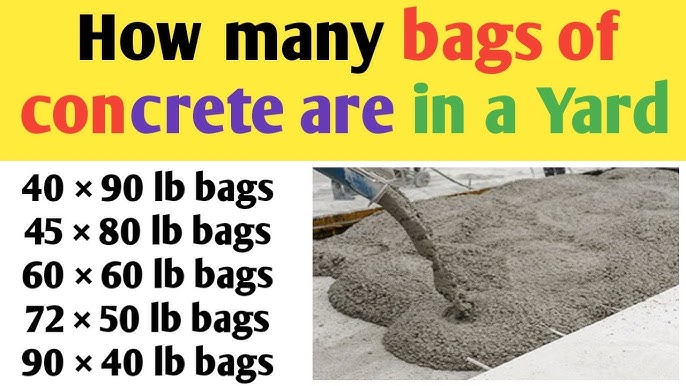
27 cubic feet / 0.6 cubic feet/bag = 45 bags
So, it takes approximately 45 bags of 80-pound concrete mix to make 1 cubic yard of concrete.
Let’s check this with other bag sizes:
- A standard 60-pound bag of concrete mix typically yields about 0.45 cubic feet of concrete.
27 cubic feet / 0.45 cubic feet/bag = 60 bags - A standard 40-pound bag of concrete mix typically yields about 0.3 cubic feet of concrete.
27 cubic feet / 0.3 cubic feet/bag = 90 bags
This clarifies the concrete bags per cubic yard calculation. Always check the specific yield information on the bag you are purchasing, as it can vary slightly between brands and product types.
Factors Influencing the Number of Bags Needed
While the general figures provide a good starting point, several factors can influence the actual number of cement bags per yard you’ll require:
- Bag Size: As shown above, the weight of the bag directly impacts the quantity needed. Heavier bags yield more concrete.
- Mix Consistency: The amount of water you add to the mix affects its final volume. Too much water can make the concrete weaker and slightly increase its volume, while too little water can make it difficult to work with and might reduce the yield. Following the manufacturer’s recommendations is crucial.
- Aggregate Size and Type: Different concrete mixes contain varying amounts of aggregate (sand and gravel). The proportion of these materials can slightly alter the final yield.
- Waste and Spillage: It’s always wise to account for some material loss due to spillage during mixing or placement, or if some concrete is left over in the mixing container.
How to Calculate Concrete Bags for Your Project
When you need to calculate concrete bags, the process involves a few straightforward steps. This ensures you buy enough without overspending on excess material.
Step 1: Determine Your Project’s Volume
The first step is to figure out how much concrete do I need. This means calculating the volume of the area you want to fill with concrete. For simple shapes, this is easy:
-
Rectangular or Square Areas:
Volume = Length × Width × Depth
Make sure all measurements are in the same units. If you measure in feet, your result will be in cubic feet. -
Circular Areas (like a patio slab):
Radius = Diameter / 2
Area = π × Radius² (where π is approximately 3.14)
Volume = Area × Depth
Example: You want to pour a rectangular slab that is 10 feet long, 8 feet wide, and 4 inches deep.
First, convert the depth to feet: 4 inches / 12 inches/foot = 0.33 feet.
Volume = 10 ft × 8 ft × 0.33 ft = 26.4 cubic feet.
Step 2: Convert Cubic Feet to Cubic Yards
Since concrete is often sold by the cubic yard, you’ll need to convert your volume from cubic feet to cubic yards.
There are 27 cubic feet in 1 cubic yard.
To convert cubic feet to cubic yards, divide by 27:
Cubic Yards = Cubic Feet / 27
Using the example above:
Cubic Yards = 26.4 cubic feet / 27 cubic feet/yard ≈ 0.98 cubic yards.
Step 3: Use a Concrete Estimator or Bag Calculator
Now that you know your project’s volume in cubic yards, you can determine the number of bags needed. This is where a concrete estimator or a concrete bag calculator comes in handy.
You can use the information we’ve established:
- For 80-pound bags: Number of Bags = Cubic Yards × 45 bags/cubic yard
- For 60-pound bags: Number of Bags = Cubic Yards × 60 bags/cubic yard
- For 40-pound bags: Number of Bags = Cubic Yards × 90 bags/cubic yard
Continuing our example (0.98 cubic yards needed):
- Using 80-pound bags: 0.98 cubic yards × 45 bags/cubic yard ≈ 44.1 bags. Since you can’t buy parts of bags, you’d round up to 45 bags.
- Using 60-pound bags: 0.98 cubic yards × 60 bags/cubic yard ≈ 58.8 bags. Round up to 59 bags.
- Using 40-pound bags: 0.98 cubic yards × 90 bags/cubic yard ≈ 88.2 bags. Round up to 89 bags.
Always add a buffer: It’s good practice to add 5-10% extra to your calculated amount to account for waste, errors, or unforeseen needs.
For our example needing 45 bags of 80-pound mix:
5% buffer: 45 bags × 0.05 = 2.25 bags. Round up to 3 bags.
Total needed: 45 + 3 = 48 bags.
Using a Concrete Volume Conversion Tool
For more complex shapes or if you want a quick check, online concrete volume conversion tools and concrete bag calculators are readily available. You input your project’s dimensions (length, width, depth), and they perform the calculations for you, often allowing you to select the bag size you plan to use.
The Mixing Concrete Process
Once you have your bagged concrete quantity, you’ll need to mix it. This is a critical part of mixing concrete to ensure strength and durability.
- Tools: You’ll need a wheelbarrow or a concrete mixer, a shovel or hoe for mixing, a water source, and a bucket for measuring water.
- Water Ratio: Carefully follow the water-to-mix ratio recommended on the concrete bag. Too much water weakens the concrete. Start with slightly less than recommended and add more gradually as needed to achieve a workable consistency.
- Mixing Technique:
- Wheelbarrow: Pour the dry mix into the wheelbarrow. Make a well in the center and gradually add water. Mix thoroughly with a shovel or hoe until the color is uniform and there are no dry pockets. The consistency should be like thick oatmeal – not too soupy, not too crumbly.
- Concrete Mixer: Follow the manufacturer’s instructions for your specific mixer. Generally, you’ll add some water first, then the dry mix, and then more water until the desired consistency is reached.
Important Considerations for Mixing:
- Batch Size: If you’re mixing by hand in a wheelbarrow, mix only as much as you can place and finish within about 20-30 minutes, as concrete begins to set.
- Consistency: Aim for a workable mix. It should be pliable enough to pour and spread but stiff enough to hold its shape.
- Adding Water: Add water incrementally. It’s easier to add more water than to take it away.
Table: Typical Yields for Common Bag Sizes
To help visualize the concrete per cubic yard calculation, here’s a table showing typical yields:
| Bag Weight | Approximate Yield per Bag (Cubic Feet) | Number of Bags for 1 Cubic Foot | Number of Bags for 1 Cubic Yard (27 Cubic Feet) |
|---|---|---|---|
| 40 lbs | 0.3 | 3.33 | 90 |
| 50 lbs | 0.375 | 2.67 | 72 |
| 60 lbs | 0.45 | 2.22 | 60 |
| 80 lbs | 0.6 | 1.67 | 45 |
Note: These are approximate yields and can vary by manufacturer.
Practical Tips for Buying and Using Bagged Concrete
- Check Expiry Dates: Bags of concrete can go stale if stored improperly or for too long, reducing their effectiveness.
- Storage: Keep bags dry. Moisture can cause the cement to harden prematurely.
- Calculate Carefully: It’s better to have a little extra than not enough. Running out mid-pour can lead to cold joints and a weaker structure.
- Heavy Lifting: Be aware that bags of concrete are heavy. Have help available for loading and unloading.
- Weather Conditions: Consider the weather. Hot, dry conditions can cause concrete to dry too quickly, leading to cracking. Shady, cooler conditions are ideal for pouring.
Frequently Asked Questions (FAQ)
Q1: How much concrete do I need for a standard sidewalk?
A standard sidewalk is typically 4 inches thick. You’ll need to calculate the length and width of your sidewalk and then use the volume conversion to determine the number of bags. For example, a 50-foot long by 3-foot wide sidewalk that’s 4 inches (0.33 ft) thick would be 50 x 3 x 0.33 = 49.5 cubic feet. That’s 49.5 / 27 = 1.83 cubic yards. Using 80-lb bags, you’d need about 1.83 x 45 = 82.35 bags, so round up to 83 bags, plus a buffer.
Q2: Can I just mix concrete from bags for a small patio?
Yes, bagged concrete is perfect for smaller projects like patios, walkways, or repair work. For very large projects, buying concrete delivered in a truck (ready-mix concrete) is usually more economical and efficient.
Q3: What is the best bag size to buy?
For most DIY projects, 60-pound or 80-pound bags are common. 80-pound bags require fewer bags to be mixed for the same volume, which can be less work if you need a significant amount. However, 40-pound or 50-pound bags are easier to handle and mix for smaller tasks.
Q4: How do I calculate the volume of concrete for a wall footing?
For a wall footing, you’ll calculate the volume by multiplying the length of the wall, the width of the footing, and its depth. Ensure all measurements are in feet before calculating the cubic feet, then convert to cubic yards.
Q5: What if I don’t use all the concrete from a bag?
Once you add water to concrete mix, you must use it before it starts to set. If you mix a batch and don’t use it all, the leftover wet concrete will harden and become unusable. It’s better to mix smaller batches that you can use completely.
Q6: Does the type of concrete mix matter for the number of bags?
Yes, it can. Standard concrete mixes are designed for general use. Some specialty mixes might have different yields or aggregate ratios. Always check the manufacturer’s yield information on the specific bag you are purchasing.
By following these guidelines and performing your calculations carefully, you can confidently determine the correct concrete per cubic yard calculation and the precise bagged concrete quantity for your next project, ensuring you have the right materials to get the job done successfully.