
So, you’re wondering, “How many bags of concrete are in a yard?” The straightforward answer is that it generally takes about 4 to 6 bags of concrete, depending on the bag size and the specific mix, to create one cubic yard of concrete. This guide will help you figure out exactly how many you need for your project.
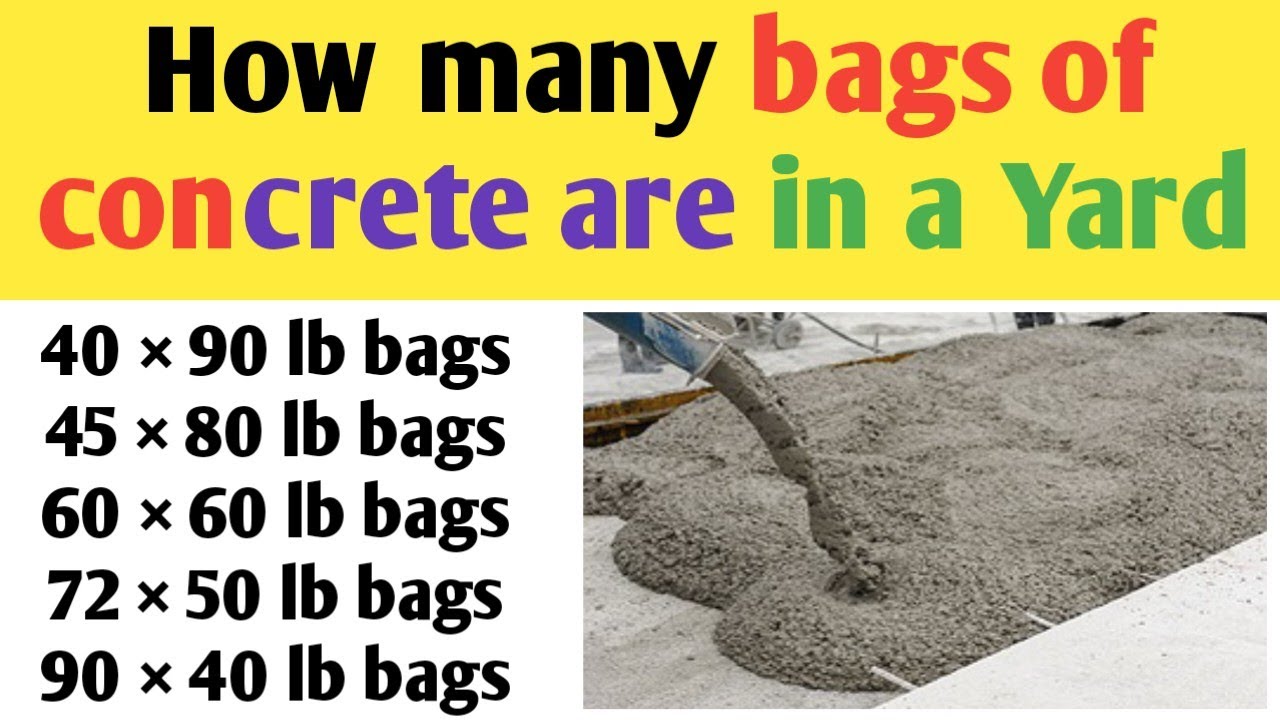
Image Source: i.ytimg.com
Demystifying Concrete Bag Yields: What You Need to Know
When you’re planning a concrete project, whether it’s a small patio, a garden path, or a larger foundation, one of the first questions that comes to mind is how much material you’ll need. Specifically, you’ll likely ask yourself, “How much concrete per bag?” This is where understanding the concept of concrete bag yield becomes crucial.
A cubic yard of concrete is a standard unit of measurement for concrete volume. Imagine a cube that’s 3 feet wide, 3 feet deep, and 3 feet tall. That’s one cubic yard. Concrete is typically sold in bulk by the cubic yard, but for smaller jobs, it comes in pre-mixed bags. The challenge lies in converting the volume you need (in cubic yards) into the number of bags required.
This guide will break down the factors that influence this conversion, provide you with practical tools like a concrete bag calculator, and help you make informed decisions for your DIY or professional projects.
Fathoming the Cubic Yard: The Foundation of Your Calculation
A cubic yard concrete measurement is the industry standard. It represents a volume of 27 cubic feet. So, if you need to pour a slab that’s 3 feet by 3 feet and 3 feet deep, you need 1 cubic yard of concrete. Most home improvement projects will require you to calculate your needs in cubic yards before you can determine the number of bags.
The Standard Concrete Bag: Size Matters
The first variable in our calculation is the standard concrete bag weight. These bags come in several common sizes, most frequently:
- 40-pound bags
- 50-pound bags
- 60-pound bags
- 80-pound bags
It’s essential to know the weight of the bags you are purchasing because this directly impacts their yield. A heavier bag generally contains more material and will therefore produce a larger volume of mixed concrete.
Gauging Concrete Bag Volume Conversion: From Bag to Yard
The magic number we’re all trying to find is the concrete bag volume conversion. How much wet concrete does a single bag produce? This varies depending on the manufacturer and the specific type of concrete mix (e.g., standard concrete, mortar mix, or rapid-set concrete). However, manufacturers usually provide an estimated yield on the bag itself.
Generally, you can expect the following approximate yields:
- A 40-pound bag yields about 0.25 cubic feet of concrete.
- A 50-pound bag yields about 0.35 cubic feet of concrete.
- A 60-pound bag yields about 0.45 cubic feet of concrete.
- An 80-pound bag yields about 0.60 cubic feet of concrete.
Let’s use these figures to calculate how many bags of concrete for 1 cubic yard. Remember, 1 cubic yard = 27 cubic feet.
- For 40-pound bags: 27 cubic feet / 0.25 cubic feet/bag = 108 bags
- For 50-pound bags: 27 cubic feet / 0.35 cubic feet/bag = 77.14 bags (round up to 78)
- For 60-pound bags: 27 cubic feet / 0.45 cubic feet/bag = 60 bags
- For 80-pound bags: 27 cubic feet / 0.60 cubic feet/bag = 45 bags
These numbers represent the theoretical maximum yield. In reality, you might need a few extra bags due to spillage, uneven mixing, or slight variations in the mix. It’s always a good idea to purchase about 5-10% more concrete than your calculation suggests.
Deciphering Concrete Mix Ratio Per Yard: The Recipe for Success
While pre-mixed bags simplify the process, it’s helpful to have a basic understanding of the concrete mix ratio per yard. A typical concrete mix consists of cement, sand, gravel (aggregate), and water. For a standard concrete mix, the ratio by volume might be roughly:
- 1 part cement
- 2 parts sand
- 3 parts gravel
The amount of water is crucial and should be just enough to create a workable mixture, typically around 0.4 to 0.6 parts water to cement. When you buy pre-mixed bags, the manufacturer has already pre-measured these ingredients for you, so you simply need to add water according to the instructions.
Calculating Concrete Bags Needed: Your Step-by-Step Approach
To accurately determine how many bags of concrete are in a yard for your specific project, you need to follow a few steps:
Step 1: Determine the Volume of Your Project
First, you need to calculate the volume of the area you intend to pour. This usually involves measuring the length, width, and depth (or thickness) of your project. Ensure all measurements are in the same units (feet are most common for concrete calculations).
- For a rectangular slab: Volume = Length × Width × Depth
- For a circular slab: Volume = π × Radius² × Depth (where π ≈ 3.14159)
Let’s say you want to pour a rectangular patio that is 10 feet long, 8 feet wide, and 4 inches thick.
- Convert the depth to feet: 4 inches / 12 inches/foot = 0.333 feet
- Calculate the volume in cubic feet: 10 ft × 8 ft × 0.333 ft = 26.64 cubic feet
Step 2: Convert Cubic Feet to Cubic Yards
Once you have the volume in cubic feet, convert it to cubic yards by dividing by 27 (since 1 cubic yard = 27 cubic feet).
- Volume in cubic yards = Volume in cubic feet / 27
- For our patio example: 26.64 cubic feet / 27 cubic feet/cubic yard = 0.987 cubic yards
Step 3: Select Your Bag Size and Consult Yield Information
Now, decide which bag size you will be using. Let’s assume you’ve chosen 80-pound bags because they are common and yield a good amount of concrete.
Step 4: Use the Concrete Bag Calculator (or Do the Math)
This is where you can use a concrete bag calculator or perform the calculation manually.
-
Manual Calculation:
- Number of bags = Total volume in cubic yards / Yield per bag in cubic yards
To use this formula, you need the yield per bag in cubic yards. We know an 80-pound bag yields approximately 0.60 cubic feet.
-
Yield per bag in cubic yards = 0.60 cubic feet / 27 cubic feet/cubic yard = 0.0222 cubic yards/bag
-
Number of bags = 0.987 cubic yards / 0.0222 cubic yards/bag = 44.46 bags
Always round up to the next whole bag. So, you would need 45 bags of 80-pound concrete.
-
Using a Concrete Bag Calculator: Many online tools are available. You simply input your project dimensions (length, width, depth) and the size of the bags you plan to use, and the calculator will provide an estimate.
Step 5: Add a Buffer for Waste and Errors
As mentioned earlier, it’s wise to add a buffer of 5-10% to your total. This accounts for any spillage, uneven subgrade, or slight inaccuracies in your measurements.
- Buffer amount = Total bags × 5% (or 10%)
- For our example (45 bags): 45 bags × 0.05 = 2.25 bags (round up to 3 extra bags)
- Total bags needed = 45 bags + 3 bags = 48 bags
So, for a 10 ft x 8 ft x 4 in slab, you’d need approximately 48 bags of 80-pound concrete.
Factors Influencing Concrete Bag Yield
While the general yields are useful, several factors can affect the actual amount of concrete you get from a bag:
Water Content
The amount of water you add is critical. Too little water and the mix will be difficult to work with and may not reach its full strength. Too much water and the concrete will be weaker and more prone to cracking. Always follow the manufacturer’s instructions precisely for water addition.
Compaction
When you pour and finish the concrete, you compact it. This process removes air pockets and ensures a denser, stronger finished product. Proper compaction can slightly increase the effective yield of your concrete.
Aggregates Size
The size of the gravel (aggregate) in the mix can also play a minor role. Larger aggregates take up more space, potentially leading to a slightly lower yield per bag compared to mixes with smaller aggregates, all other factors being equal. However, for pre-mixed bags, this variation is usually minimal and accounted for by the manufacturer.
Common Concrete Bag Weights and Their Yields Summarized
Here’s a quick reference table for common bag sizes and their typical yields. Always check the bag itself for the most accurate information.
| Bag Weight | Typical Yield (Cubic Feet) | Yield (Cubic Yards) | Approximate Bags for 1 Cubic Yard |
|---|---|---|---|
| 40 lbs | 0.25 | 0.0093 | 108 |
| 50 lbs | 0.35 | 0.0130 | 77 |
| 60 lbs | 0.45 | 0.0167 | 60 |
| 80 lbs | 0.60 | 0.0222 | 45 |
Note: These are approximate figures. Always verify with the product packaging.
Practical Tips for Using Concrete Bags
- Read the Bag: The manufacturer’s instructions are your best friend. They will specify the exact amount of water to add and the estimated yield.
- Mixing: Use a clean wheelbarrow or mixing tub. For larger quantities, a concrete mixer is highly recommended. Add the dry mix first, then gradually add the specified amount of water. Mix thoroughly until you achieve a consistent color and texture with no dry pockets.
- Storage: Store bags in a dry place. Damp bags can cause the cement to harden prematurely.
- Weather: Avoid pouring concrete in extreme temperatures (too hot or too cold) or when rain is expected.
- Subgrade Preparation: Ensure your base material is properly compacted and graded before you start mixing. This will help prevent cracking and settling later on.
When Bulk Concrete Might Be Better
For projects requiring more than 1 cubic yard of concrete, ordering ready-mix concrete delivered by a truck is often more cost-effective and convenient than mixing dozens or hundreds of bags. The price per cubic yard is typically lower when bought in bulk, and you eliminate the labor-intensive process of mixing countless bags.
Frequently Asked Questions About Concrete Bags
Q1: How many 60 lb bags of concrete make a cubic yard?
A: Generally, it takes about 60 bags of 60-pound concrete to make 1 cubic yard.
Q2: Can I mix concrete in a wheelbarrow?
A: Yes, you can mix concrete in a wheelbarrow for small projects. For larger amounts, a concrete mixer is much more efficient and will result in a more consistent mix.
Q3: What happens if I add too much water to the concrete mix?
A: Adding too much water reduces the strength and durability of the concrete. It can lead to cracking, dusting, and reduced resistance to weathering.
Q4: How much extra concrete should I buy?
A: It’s recommended to buy 5-10% more concrete than your calculated amount to account for waste, spillage, and minor errors.
Q5: What’s the difference between concrete and mortar?
A: Concrete is a mixture of cement, sand, aggregate (gravel), and water. Mortar is typically a mixture of cement, sand, and water, and does not contain aggregate. Mortar is used for binding bricks or stones together, while concrete is used for structural elements like slabs, walls, and foundations.
Q6: How long does it take for concrete to cure?
A: Concrete curing is a process that takes time. While it hardens enough to walk on in about 24-48 hours, it continues to gain strength for weeks and months. Full curing can take up to 28 days.
By now, you should have a solid grasp on how to calculate the number of concrete bags needed for your project. Remember to measure accurately, check the bag yields, and always add a little extra for safety. Happy building!