
So, you’re wondering, “How many acres is my yard?” Your yard size, often referred to as your lawn acreage or the square footage of your yard, is a common question, especially when planning landscaping projects, considering fencing, or even just out of curiosity. Determining your lot size measurement is easier than you might think, and this guide will walk you through how to calculate your yard size accurately. Whether you’re measuring your backyard or your entire property dimensions, we’ll help you figure out just how big is my yard.
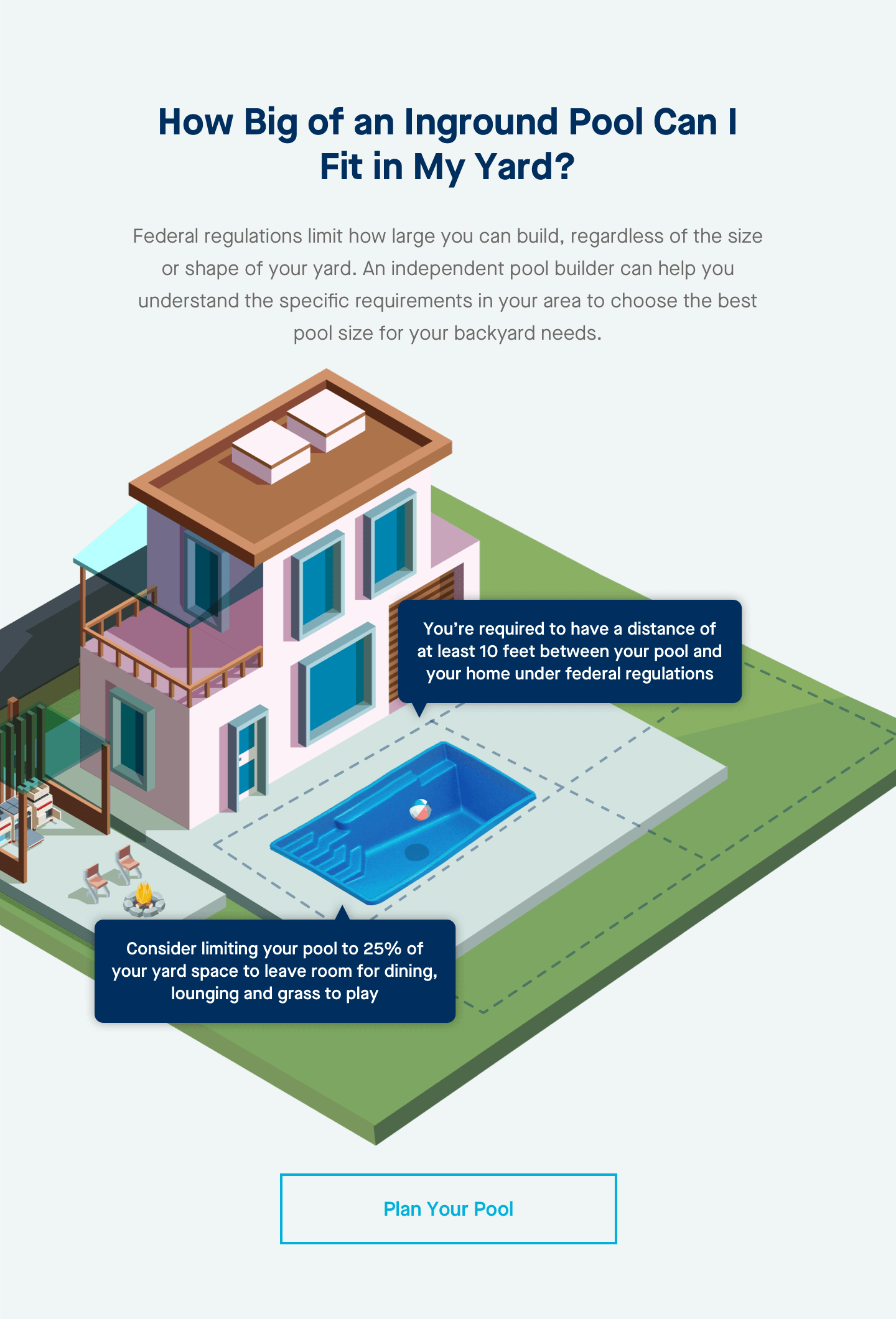
Image Source: www.lathampool.com
Why Knowing Your Yard Size Matters
Knowing the precise acreage of your yard offers several practical benefits. It’s not just about satisfying curiosity; it’s about informed decision-making.
Landscaping and Gardening Projects
- Material Estimation: When buying soil, mulch, grass seed, or sod, knowing your yard area calculation is crucial. You can avoid over or under-buying, saving both money and effort.
- Planting Plans: Certain plants thrive in specific amounts of space. Accurate measurements help you determine how many trees, shrubs, or flower beds your yard can comfortably accommodate.
- Pest and Disease Control: Understanding your yard’s size aids in calculating the correct dosage for pesticides, herbicides, or fertilizers, ensuring effective treatment without overuse.
Property Value and Taxes
- Real Estate: The size of your lot is a significant factor in determining your property’s market value. When selling or buying, knowing your exact acreage is essential for accurate pricing.
- Property Taxes: Local tax assessments often use lot size as a component in calculating property taxes. If there’s a discrepancy, correcting it could impact your tax burden.
Home Improvement and Maintenance
- Fence Installation: The linear footage of your property lines, combined with understanding your lot size, is needed for accurate fencing quotes and material purchases.
- Irrigation Systems: Designing an efficient sprinkler system requires knowing the total area to be covered and the specific zones within your yard.
- Deck or Patio Construction: Planning outdoor living spaces depends heavily on having enough room, which is directly related to your yard’s dimensions.
Practical Applications
- Animal Containment: If you have pets, knowing your yard’s size helps in planning safe and spacious enclosed areas.
- Recreational Use: Whether you’re planning a play area for children, a space for outdoor games, or just want to know how much room you have to roam, the square footage of your yard is key.
Measuring Your Yard: Tools and Techniques
To accurately determine your yard size, you’ll need a few basic tools and a systematic approach. The most common method involves breaking down your yard into simpler shapes like rectangles and triangles.
Essential Tools
- Measuring Tape: A long, durable measuring tape (at least 50-100 feet) is indispensable. For very large properties, a laser distance measure is highly recommended.
- Stakes or Markers: To mark corners and boundaries as you measure.
- Calculator: For performing the necessary calculations.
- Pen and Paper (or a Digital App): To sketch your yard and record measurements.
- Optional: Measuring Wheel: Useful for covering long distances, especially on uneven terrain.
Breaking Down Your Yard
Most yards are not perfect squares or rectangles. You’ll likely need to divide your yard into smaller, manageable shapes. The most common shapes you’ll encounter are:
- Rectangles: Length x Width
- Squares: Side x Side (a special type of rectangle)
- Triangles: (Base x Height) / 2
Steps for Measuring a Rectangular Yard
- Identify the Boundaries: Clearly mark the corners of your yard.
- Measure Length: Stretch your measuring tape along one of the longer sides from one corner to the opposite corner. Record this measurement.
- Measure Width: Stretch your measuring tape along one of the shorter sides from a corner to the adjacent corner. Record this measurement.
- Calculate Area: Multiply the length by the width. This gives you the square footage of your yard.
- Formula: Area = Length × Width
Steps for Measuring an L-Shaped Yard
An L-shaped yard can be divided into two rectangles.
- Divide the Yard: Mentally or physically divide the L-shape into two distinct rectangular sections. You can do this by drawing an imaginary line.
- Measure Each Section:
- Section 1: Measure the length and width of the first rectangular section. Calculate its area.
- Section 2: Measure the length and width of the second rectangular section. Calculate its area.
- Sum the Areas: Add the areas of the two sections together to get the total square footage of your L-shaped yard.
Steps for Measuring a Yard with Irregular Shapes
For yards with more complex or irregular shapes, you’ll need to combine multiple shapes (rectangles, squares, triangles).
- Sketch Your Yard: Draw a rough sketch of your yard, including any significant features like sheds, patios, or driveways that you want to exclude from your lawn acreage calculation.
- Divide into Simpler Shapes: Break down the sketch into basic geometric shapes (rectangles, squares, triangles).
- Measure Each Shape:
- Rectangles/Squares: Measure length and width, then calculate area (L x W).
- Triangles: Measure the base and the height (the perpendicular distance from the base to the opposite vertex). Calculate area ((Base x Height) / 2).
- Other Shapes: For curved or irregular sections, you might need to approximate or use more advanced techniques. Often, breaking them into smaller trapezoids or even triangles can provide a good estimate.
- Calculate Individual Areas: For each shape, calculate its area in square feet.
- Add All Areas: Sum up the areas of all the individual shapes to get the total square footage of your yard.
Measuring Curved Boundaries
Measuring curved boundaries accurately can be tricky.
- Approximation: For gentle curves, you can approximate by measuring a series of short, straight lines that follow the curve. The more lines you use, the more accurate your measurement will be.
- Trapezoid Method: If you have a curved boundary that connects two parallel lines (like the side of a house to a fence line), you can approximate the area under the curve as a series of trapezoids. Measure the width of each segment and the lengths of the two parallel sides of each trapezoid.
Converting Square Feet to Acres
Once you have the total square footage of your yard, you’ll likely want to know how many acres this represents. An acre is a unit of land area, and knowing the conversion is essential for understanding larger land measurements.
- Conversion Factor: There are 43,560 square feet in one acre.
The Calculation
To convert your yard’s square footage to acres, you will divide the total square footage by 43,560.
- Formula: Acres = Total Square Feet / 43,560
Example:
Let’s say your yard measures 10,000 square feet.
- Acres = 10,000 sq ft / 43,560 sq ft/acre
- Acres ≈ 0.23 acres
This means your yard is approximately a quarter of an acre.
Quick Reference Table: Common Yard Sizes in Acres
To give you a better sense of scale, here are some common yard sizes and their equivalent in acres:
| Yard Size (Square Feet) | Acres (Approximate) | Common Description |
|---|---|---|
| 1,000 sq ft | 0.023 | Small urban lot, backyard patio space |
| 5,000 sq ft | 0.115 | Typical suburban house lot |
| 10,000 sq ft | 0.23 | Larger suburban lot, good for gardens |
| 15,000 sq ft | 0.34 | Generous suburban or semi-rural property |
| 20,000 sq ft | 0.46 | Large lot, often found in more rural settings |
| 43,560 sq ft | 1.00 | Exactly one full acre |
| 87,120 sq ft | 2.00 | Two full acres |
| 130,680 sq ft | 3.00 | Three full acres |
Using Property Records and Online Tools
If measuring your yard manually seems daunting, or if you need a quick estimate, there are other resources available to help determine your lot size measurement.
Property Records
Your local county assessor’s office or recorder’s office maintains public records of property information, including lot dimensions and acreage.
- Online Search: Most county assessor websites allow you to search for your property by address or parcel number.
- Official Documents: You can often find information about your property’s dimensions, lot size, and sometimes even a survey map.
- Benefits: This is usually the most accurate source for official property dimensions.
Online Mapping Tools
Several online tools can help you estimate your yard size.
- Google Earth/Maps: These platforms often allow you to measure distances and areas by drawing polygons on the map.
- Search for your address.
- Find the “measure distance” or “measure area” tool.
- Click on the corners of your property to outline it. The tool will then display the calculated area in square feet or acres.
- Real Estate Websites: Sites like Zillow, Realtor.com, or Redfin often list property details, including lot size. However, these might be approximations or include areas you don’t consider your “yard” (e.g., driveways, parts of the sidewalk).
Important Note: While online tools and property records are convenient, they might not always account for recent boundary changes, additions, or specific nuances of your yard’s layout. For critical projects, manual measurement or a professional survey is always the most reliable method.
Dealing with Obstacles and Non-Yard Areas
When calculating your yard size, you might need to exclude certain areas that aren’t considered part of your usable lawn acreage.
Common Exclusions
- House Footprint: The area occupied by your home.
- Driveways and Walkways: Paved or gravel surfaces.
- Decks and Patios: Hardscaped outdoor living areas.
- Sheds and Outbuildings: Structures like garages or storage sheds.
- Water Features: Ponds or pools.
- Public Sidewalks/Easements: Areas that are technically part of your property but are often reserved for public use or utilities.
How to Exclude Areas
If you need to determine the usable lawn acreage rather than the total lot size, you’ll need to subtract the area of these excluded features from your total lot measurement.
- Measure Each Obstacle: Measure the dimensions of each feature you want to exclude (house, driveway, shed, etc.) using the same methods described earlier (breaking them into rectangles, squares, etc.).
- Calculate Individual Areas: Calculate the square footage of each excluded area.
- Sum Excluded Areas: Add up the square footage of all the excluded features.
- Subtract from Total: Subtract the total square footage of excluded areas from the total square footage of your lot.
Formula: Usable Lawn Area = Total Lot Square Footage – Total Excluded Area Square Footage
Example:
- Your total lot is 15,000 sq ft.
- Your house footprint is 2,000 sq ft.
- Your driveway is 500 sq ft.
- Your patio is 300 sq ft.
Total excluded area = 2,000 + 500 + 300 = 2,800 sq ft.
Usable lawn area = 15,000 sq ft – 2,800 sq ft = 12,200 sq ft.
Now you can convert this usable lawn area to acres if needed: 12,200 sq ft / 43,560 sq ft/acre ≈ 0.28 acres.
Advanced Considerations and Professional Help
For most homeowners, the methods described above will provide a sufficiently accurate measurement. However, for complex properties or when absolute precision is required, you might consider professional help.
Legal Boundaries and Surveys
- Property Surveys: A professional land surveyor can provide a precise boundary survey of your property. This document will show all property lines, easements, and the exact acreage.
- When to Get a Survey:
- When buying or selling property.
- When installing fences or making major construction near property lines.
- When there are disputes with neighbors about boundaries.
- When you need to prove your exact property dimensions for legal or tax purposes.
Measuring Very Large Properties
For properties that are several acres or more, using a measuring wheel or a GPS-based acreage calculator app can be more efficient than a standard tape measure.
- Measuring Wheel: Roll the wheel along the perimeter of your property. The wheel has a counter that records the distance traveled. Be mindful of the terrain, as uneven ground can affect accuracy.
- GPS Apps: Many smartphone apps use GPS to map out an area and calculate its acreage. The accuracy can vary depending on GPS signal strength and the app’s sophistication.
Frequently Asked Questions (FAQ)
Q1: What is the standard size of a yard in the US?
There isn’t a single “standard” size, as it varies greatly by location (urban, suburban, rural) and property type. However, a typical suburban lot might range from 5,000 to 15,000 square feet, which is roughly 0.115 to 0.34 acres.
Q2: Do I need to include my house and driveway when calculating my yard’s acreage?
Typically, when people ask “how many acres is my yard,” they are referring to the usable outdoor living space or the lawn area. It’s common practice to exclude the footprint of the house, driveways, patios, and other structures when calculating your lawn acreage, though the total lot size will include these.
Q3: Is it better to measure my yard in feet or meters?
In the United States, measurements are predominantly done in feet and square feet for land area. If you are in a country that uses the metric system, you would use meters and square meters, with 1 acre being approximately 4,046.86 square meters. Always ensure you are consistent with your units.
Q4: My property is irregularly shaped. How can I accurately measure it?
For irregularly shaped yards, the best approach is to sketch the area and divide it into simpler geometric shapes like rectangles, squares, and triangles. Measure each shape separately and sum their areas to get the total square footage. Online tools or professional surveys can also help with complex shapes.
Q5: How do I convert my yard’s square footage to acres?
To convert square footage to acres, divide the total square footage by 43,560, as there are 43,560 square feet in one acre.
Q6: What if my property has slopes or hills? How does that affect measurements?
When measuring length and width for area calculations, you are measuring along the surface of the ground, not horizontally in a 2D plane. While slopes can affect the volume of soil or the amount of material needed for certain projects, the basic area calculation (length x width) for determining acreage typically uses the ground-level measurements. Professional surveys account for these variations more precisely.
By following these steps and using the right tools, you can confidently determine just how big your yard is and how many acres it encompasses. This knowledge will empower you for all your future yard projects and property management needs.