
A cubic yard of concrete typically requires around 9 to 10 bags of 90 lb concrete mix. The exact number can vary slightly depending on the specific brand and its dry yield.
Planning a concrete project, whether it’s a small patio, a sturdy foundation, or a decorative pathway, often starts with a crucial question: “How much concrete do I need?” For DIY enthusiasts and seasoned contractors alike, accurately estimating your concrete needs is the first step to a successful build and avoiding costly over or under-ordering. This guide dives deep into the world of concrete, focusing on the common question of how many 90 lb bags of concrete in a yard. We’ll explore the factors influencing this number, how to calculate your project’s requirements, and provide practical tips for your next concrete endeavor.
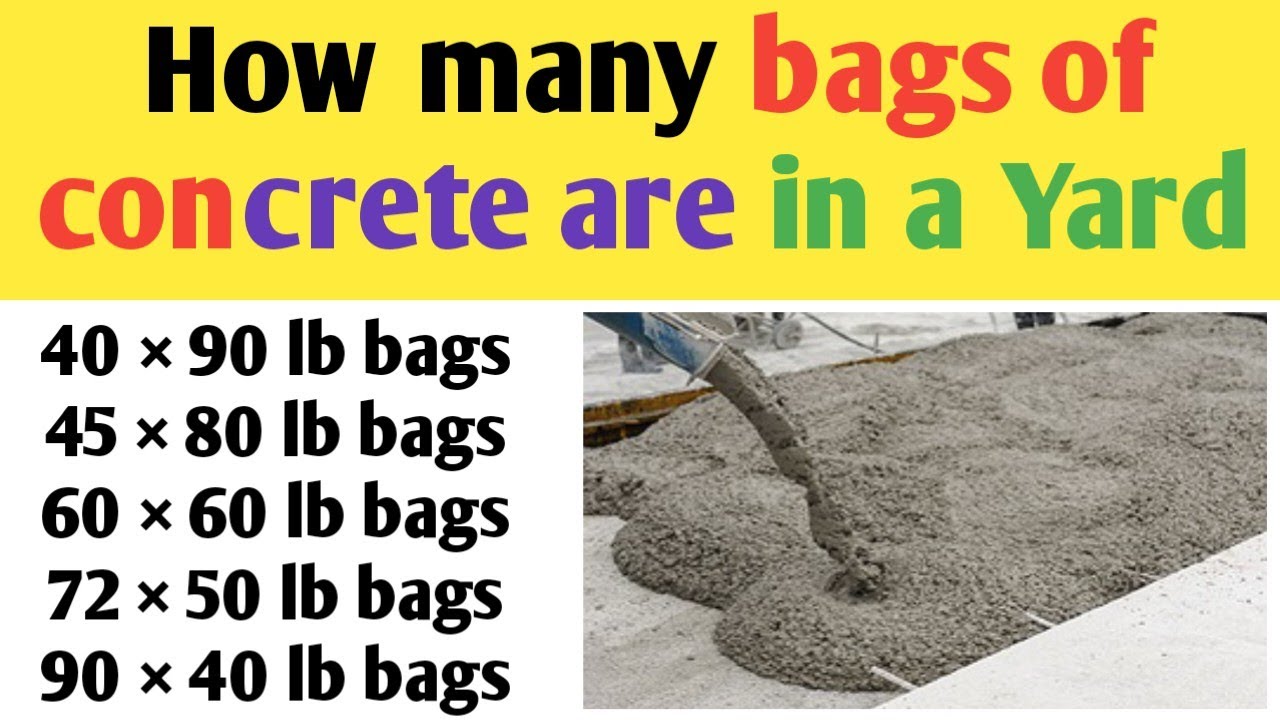
Image Source: i.ytimg.com
Deciphering Concrete Volume: What is a Cubic Yard?
Before we can figure out how many bags of concrete we need, we must first understand what a cubic yard of concrete actually is. Volume is measured in three dimensions: length, width, and height. A cubic yard is a unit of volume in the U.S. customary and imperial systems. It represents a cube that is one yard long, one yard wide, and one yard high.
To visualize this, imagine a cube with each side measuring 3 feet.
* Length: 3 feet
* Width: 3 feet
* Height: 3 feet
To find the volume, we multiply these dimensions: 3 ft * 3 ft * 3 ft = 27 cubic feet.
So, 1 cubic yard = 27 cubic feet.
Knowing this is fundamental for calculating concrete needs. When you order concrete from a supplier, it’s typically measured in cubic yards. However, when working with pre-mixed bags, you’ll be dealing with the yield of each bag, which is usually stated in cubic feet.
The Yield of a 90 Lb Concrete Bag: What to Expect
When you pick up a bag of concrete mix from your local hardware store, you’ll often see its weight (e.g., 60 lb, 80 lb, or 90 lb) and its estimated yield. The 90lb bag concrete mix is a popular choice for many projects due to its manageable weight and convenient size.
The concrete bag yield for a 90 lb bag is generally around 0.75 cubic feet when properly mixed with water. This means that one 90 lb bag, when mixed with the correct amount of water, will produce approximately three-quarters of a cubic foot of concrete.
It’s important to note that this is an estimate. The actual yield can be influenced by several factors:
- Water Content: Adding too much water will increase the volume but decrease the strength and durability of the concrete. Too little water will make it difficult to mix and place.
- Compaction: How well the concrete settles into your forms can affect the final volume.
- Manufacturer Specifications: Different brands may have slightly different aggregate sizes and mix designs, leading to minor variations in yield.
Always check the manufacturer’s instructions on the bag for the most accurate yield information. This is where a good concrete bag calculator can be immensely helpful.
How Many 90 Lb Bags of Concrete in a Yard? The Calculation
Now that we know a cubic yard is 27 cubic feet, and a 90 lb bag yields about 0.75 cubic feet, we can do the math to answer the core question: How many 90 lb bags of concrete in a yard?
Here’s the simple calculation:
Total Cubic Feet in a Yard / Yield per Bag = Number of Bags
27 cubic feet / 0.75 cubic feet per bag = 36 bags
So, theoretically, you would need 36 bags of 90 lb concrete mix to make one cubic yard of concrete.
However, this is the bare minimum. In real-world scenarios, you need to account for waste, spills, and the need for a little extra to ensure you have enough for your project. It’s always better to have a bit too much than not enough. Therefore, most professionals recommend adding a buffer of 10-15%.
Let’s factor in that buffer:
- Adding 10%: 36 bags * 1.10 = 39.6 bags. You would round up to 40 bags.
- Adding 15%: 36 bags * 1.15 = 41.4 bags. You would round up to 42 bags.
This means that for every cubic yard of concrete you need, you should plan for approximately 40 to 42 bags of 90 lb concrete mix.
This is crucial information for any concrete project estimate. Knowing this number helps you budget for materials and plan your purchasing.
Beyond the Yard: Calculating Concrete Needs for Your Project
While knowing the number of bags per cubic yard is essential, your actual concrete needs will depend on the dimensions of your specific project. Whether you’re pouring a footing, a sidewalk, or a small slab, you’ll need to measure the area and depth.
Here’s a step-by-step guide on how to calculate concrete needs:
-
Measure Your Project Dimensions:
- Length: Measure the length of the area you want to pour.
- Width: Measure the width of the area.
- Depth (or Thickness): Determine how thick you want the concrete to be. This is critical for strength and usability. For a patio, 4 inches is common. For a driveway, 5-6 inches is recommended. For structural elements, consult building codes or an engineer.
-
Convert All Measurements to Feet:
- If your measurements are in inches, divide by 12 to convert them to feet. For example, 4 inches is 4/12 = 0.33 feet.
-
Calculate the Volume in Cubic Feet:
- Volume (cubic feet) = Length (ft) * Width (ft) * Depth (ft)
-
Convert Cubic Feet to Cubic Yards:
- Volume (cubic yards) = Volume (cubic feet) / 27
-
Determine the Number of Bags:
- Number of Bags = Volume (cubic yards) * Number of 90 lb Bags per Cubic Yard (using our estimate of 40-42 bags)
Let’s work through an example. Suppose you want to pour a rectangular patio that is 10 feet long, 8 feet wide, and 4 inches thick.
- Length: 10 ft
- Width: 8 ft
- Depth: 4 inches = 4/12 ft = 0.33 ft
Calculate Volume in Cubic Feet:
10 ft * 8 ft * 0.33 ft = 26.4 cubic feet
Convert to Cubic Yards:
26.4 cubic feet / 27 cubic feet/yard = 0.978 cubic yards
Calculate Number of Bags (using a 10% buffer, so 40 bags/yard):
0.978 yards * 40 bags/yard = 39.12 bags
In this case, you would need to purchase 40 bags of 90 lb concrete mix. It’s always a good idea to round up to the nearest whole bag.
Using a Concrete Bag Calculator
Many online tools and apps serve as a concrete bag calculator. These tools simplify the process by allowing you to input your project’s dimensions (length, width, and depth) and the bag size you plan to use (e.g., 90 lb bags). The calculator then automatically performs the conversions and provides an estimated number of bags required. These can be incredibly helpful for quick estimates and can help prevent errors in calculation.
Factors Affecting Your Concrete Project Estimate
While the calculations provide a solid baseline, several other factors can influence your final concrete project estimate:
1. Project Complexity and Shape
- Simple Rectangles/Squares: Easiest to measure and calculate.
- Curved or Irregular Shapes: Can be more challenging to measure accurately. Breaking down complex shapes into simpler geometric forms (rectangles, triangles) can help. You might also need to account for a slightly higher waste factor due to cutting and fitting.
2. Sub-base Preparation
- A well-compacted and level sub-base (gravel or crushed stone) is crucial for the longevity of your concrete pour. The thickness of this layer doesn’t directly affect the concrete volume but is vital for the overall integrity of the project.
3. Forms and Reinforcement
- Formwork: The materials you use to create the mold for your concrete pour can sometimes absorb a small amount of water from the mix, slightly affecting its consistency. This is usually a minor factor.
- Reinforcement (Rebar/Mesh): If your project requires rebar or wire mesh for added strength, these elements will occupy a small volume within the concrete. While not typically accounted for in basic bag calculations, for very precise structural work, a professional might consider this. For most DIY projects, the standard buffer is sufficient.
4. Site Accessibility
- Consider how you will get the concrete mix to your pour site. If you have to carry bags a long distance, you might want to buy slightly more to account for any fatigue-induced spills or the need for extra trips.
Mixing Concrete Bags: The Process Matters
Simply having the right number of bags is only part of the equation. Proper mixing concrete bags is essential for achieving the desired strength, workability, and finish.
What You’ll Need:
- Concrete Bags: Your calculated amount.
- Water: Clean, potable water.
- Mixing Container: A wheelbarrow is ideal for smaller to medium projects. For larger quantities, a mechanical mixer (like a concrete mixer rented from a tool hire shop) is highly recommended.
- Shovel or Hoe: For mixing in a wheelbarrow.
- Measuring Container: To accurately measure the water per bag.
- Safety Gear: Gloves, eye protection, and a dust mask are essential.
Mixing Steps:
- Read the Bag: Always start by reading the manufacturer’s instructions on the concrete bag. They will specify the recommended water amount per bag.
- Add Dry Mix to Container: Place the dry concrete mix into your wheelbarrow or mixer. If using a mixer, add about half the dry mix first.
- Add Water Gradually: Add about three-quarters of the recommended water to the dry mix.
- Mix Thoroughly: Use your shovel or hoe (or the mixer) to combine the dry ingredients and water. Mix until there are no dry pockets.
- Adjust Consistency: Continue adding water in small increments, mixing after each addition, until you reach the desired consistency. The concrete should be like thick oatmeal or peanut butter – it should hold its shape but still be workable. Avoid making it too soupy.
- Workability Time: Once water is added, concrete has a limited working time (typically 30-90 minutes, depending on temperature and humidity). Mix only as much as you can use within that timeframe.
The Importance of the Right Water-to-Cement Ratio
The strength of concrete is directly related to its water-to-cement ratio. The 90lb bag concrete mix is designed with specific proportions of cement, aggregate (sand and gravel), and additives. Adding too much water dilutes the cement, leading to weaker, less durable concrete. For example, a common recommendation for a 90 lb bag might be around 3 to 4 quarts of water. Using 4.5 quarts instead, even if it makes mixing easier, will compromise the concrete’s strength.
Alternative Bag Sizes and Their Yields
While 90 lb bags are common, you might encounter other sizes. Knowing their yields helps with comparisons and planning:
| Bag Size (lbs) | Approximate Yield (Cubic Feet) | Approximate Bags per Cubic Yard (with 10% buffer) |
|---|---|---|
| 40 | 0.30 | 144 bags (27 / 0.30 * 1.10) |
| 50 | 0.38 | 113 bags (27 / 0.38 * 1.10) |
| 60 | 0.45 | 95 bags (27 / 0.45 * 1.10) |
| 80 | 0.60 | 50 bags (27 / 0.60 * 1.10) |
| 90 | 0.75 | 40 bags (27 / 0.75 * 1.10) |
As you can see, the 90 lb bag offers a good balance of yield and weight for many DIY projects. Lighter bags require significantly more to achieve the same volume, while heavier bags offer a larger yield but can be harder to transport and mix for smaller jobs.
When to Consider Bulk Concrete Delivery
For larger projects, such as pouring a substantial patio, a driveway, or a foundation, buying bags of concrete can become impractical and expensive. The cost per cubic yard is often lower when ordered in bulk from a concrete supplier.
Consider bulk delivery if your project requires:
- More than 2-3 cubic yards of concrete.
- A need for specific strength or mix designs not available in bags.
- A desire to reduce the labor involved in mixing numerous bags.
When ordering in bulk, you’ll specify the total cubic yards needed. The concrete truck will deliver the mixed concrete directly to your site, often using a chute or a pump for placement. This is a much more efficient method for large volumes.
Common Pitfalls to Avoid
When embarking on a concrete project, even with careful planning, some common mistakes can lead to frustration and subpar results:
- Underestimating Needs: The most frequent error is not buying enough concrete. It’s nearly impossible to match the color and texture of a previously poured slab if you run out and have to pour a new batch later. Always add a buffer.
- Over-Adding Water: As discussed, this is a critical mistake that significantly reduces concrete strength. Stick to the manufacturer’s recommended water amount.
- Improper Mixing: Inconsistent mixing can lead to areas with different strengths and appearances. Ensure all dry pockets are eliminated.
- Poor Site Preparation: A weak or uneven sub-base will compromise the integrity of your concrete pour.
- Inadequate Curing: Concrete doesn’t “dry”; it cures. This is a chemical process that requires moisture. Proper curing (keeping the concrete damp for several days) is vital for achieving maximum strength.
Frequently Asked Questions (FAQ)
Q1: How many 80 lb bags of concrete are in a cubic yard?
An 80 lb bag of concrete typically yields about 0.60 cubic feet. To get one cubic yard (27 cubic feet), you’d need approximately 45 bags (27 / 0.60 = 45). Adding a 10% buffer brings this to about 50 bags of 80 lb concrete mix per cubic yard.
Q2: Can I mix concrete in batches for a larger pour?
Yes, you can mix concrete in batches, especially if you are using a mechanical mixer. The key is to ensure consistency between batches. Measure your water and mix your dry ingredients precisely the same way for each batch. Work quickly to place and finish the concrete before previous batches set. For larger pours, a concrete mixer or bulk delivery is highly recommended to maintain a consistent pour.
Q3: What’s the difference between concrete mix and mortar mix?
Concrete mix is designed for structural applications and contains larger aggregate (gravel) for strength. Mortar mix is used for binding bricks, stones, or blocks and contains sand but no large aggregate, making it finer and more workable for filling small gaps.
Q4: How thick should my concrete slab be?
The required thickness depends on the intended use.
* Patios and walkways: 4 inches is generally sufficient.
* Driveways and garage floors: 5-6 inches is recommended to withstand vehicle weight.
* Structural elements: Consult building codes or a structural engineer.
Q5: How long does concrete take to cure?
Concrete continues to gain strength for weeks, but it’s usually safe to walk on after 24-48 hours and drive on after about 7 days, depending on the mix and curing conditions. Proper curing involves keeping the concrete moist for at least 3-7 days to allow the cement to fully hydrate and gain strength.
Q6: Does the weather affect my concrete project?
Yes, weather plays a significant role.
* Hot weather: Can cause concrete to set too quickly, making it difficult to work and potentially leading to cracking.
* Cold weather: Can slow down the curing process and, if temperatures drop below freezing, can damage the concrete before it has fully set.
* Rain: Freshly poured concrete can be washed away or its surface texture altered by rain.
It’s best to plan your pour for mild temperatures (between 50°F and 75°F or 10°C and 24°C) and when no rain is expected for at least 24 hours.
By carefully measuring your project, using a reliable concrete bag calculator, understanding the yield of each bag, and paying attention to mixing and curing, you can confidently tackle your next concrete project with the right amount of material and achieve excellent results. Remember, precision in planning is the foundation of any successful construction endeavor.