
A yard of mulch can cover approximately 100 square feet at a depth of 2 inches, but this can vary based on the type of mulch and the desired depth. This guide will help you accurately estimate your needs for garden mulch coverage, ensuring you purchase the right amount of cubic yard mulch for your landscaping projects. We’ll explore how to calculate your requirements using a mulch coverage calculator and discuss the typical spread rate mulch you can expect from different materials.
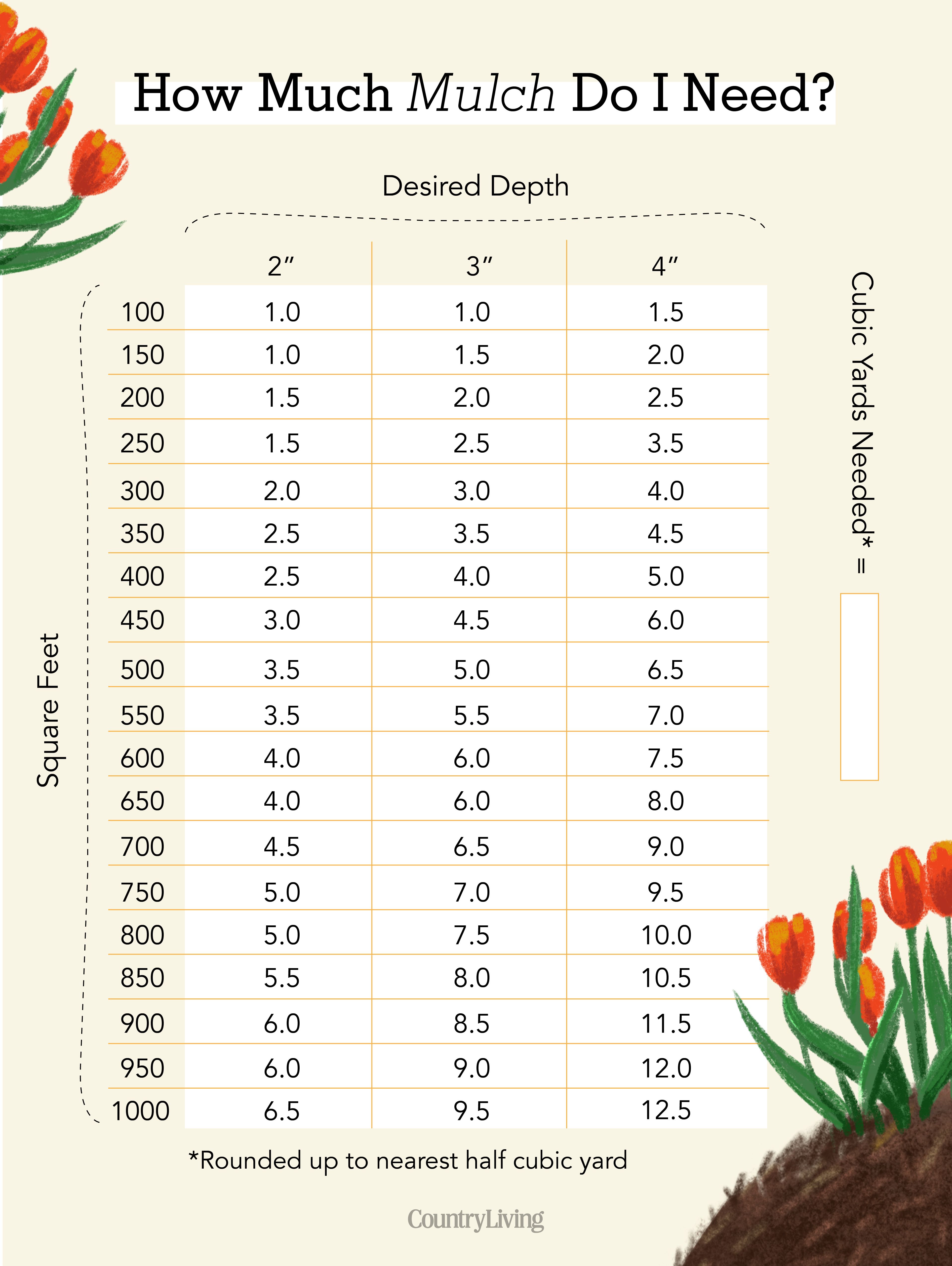
Image Source: hips.hearstapps.com
Figuring Out Your Mulch Needs
Planning is key when it comes to mulching. Whether you’re revamping flower beds, creating new garden paths, or protecting young trees, knowing how much mulch to buy prevents waste and saves you trips to the garden center. The primary factor influencing how much area a cubic yard of mulch covers is the depth you choose to spread it. Deeper layers provide better weed suppression and moisture retention but require more mulch.
The Importance of Mulch Depth
The ideal mulch depth is crucial for achieving the benefits of mulching without causing harm. Too little mulch won’t effectively suppress weeds or retain moisture. Too much mulch can suffocate plant roots, promote fungal growth, and even create a haven for pests.
Recommended Mulch Depths for Various Applications:
- General Garden Beds & Flower Beds: 2 to 3 inches. This is the sweet spot for weed control, moisture retention, and supporting healthy soil life.
- Around Trees (but not touching the trunk): 2 to 4 inches. A slightly deeper layer can be beneficial for moisture and temperature regulation.
- Around Shrubs: 2 to 3 inches. Similar to garden beds, this provides good coverage.
- Vegetable Gardens: 2 to 4 inches. Can help keep soil moist and reduce splashing soil onto plants.
- Erosion Control on Slopes: 3 to 4 inches. A deeper layer helps prevent the mulch from washing away.
Crucially, always leave a small gap of a few inches around the base of trees and shrubs. This “mulch-free collar” prevents moisture buildup against the bark, which can lead to rot and disease.
Calculating Your Coverage Area
To determine how much mulch you need, you first need to calculate the total area you intend to cover. This is measured in square feet.
Steps to Calculate Your Area:
- Measure your garden beds or areas: Use a tape measure to find the length and width of each area you plan to mulch.
- Calculate the area of each section: For rectangular or square areas, multiply the length by the width (Area = Length x Width).
- For irregular shapes: Break them down into smaller, manageable shapes (rectangles, squares, triangles, circles) whose areas you can calculate.
- Triangles: (0.5 x base x height)
- Circles: (π x radius²) – Remember that the radius is half the diameter.
- Sum up the areas: Add the areas of all the individual sections together to get your total square footage.
Example:
Imagine you have a rectangular flower bed that is 10 feet long and 4 feet wide.
Area = 10 ft x 4 ft = 40 square feet.
If you also have a circular tree ring with a diameter of 3 feet (radius of 1.5 feet):
Area = 3.14 x (1.5 ft)² = 3.14 x 2.25 sq ft = 7.07 square feet.
Your total area would be 40 sq ft + 7.07 sq ft = 47.07 square feet.
The Magic Number: How Much Area Does a Yard of Mulch Cover?
This is the million-dollar question, and the answer hinges on mulch depth. A standard cubic yard of mulch is 3 feet x 3 feet x 3 feet, which equals 27 cubic feet. However, mulch compacts and settles once spread. When calculating spread rate mulch, we generally consider the fluffy, uncompacted volume.
Standard Coverage at Recommended Depths
Here’s a general guideline for how much square footage a cubic yard of mulch covers at different depths:
| Mulch Depth (Inches) | Square Footage Covered per Cubic Yard |
|---|---|
| 1 | 200 sq ft |
| 2 | 100 sq ft |
| 3 | 67 sq ft |
| 4 | 50 sq ft |
These figures are approximations. Factors like the particle size and density of the mulch can slightly alter the actual spread rate mulch. Finer mulches might spread a bit further, while coarser, chunkier mulches might cover slightly less area.
Using a Mulch Coverage Calculator
To make estimating mulch needs simpler, many online resources offer a mulch coverage calculator. These tools are incredibly handy for visualizing how much mulch you’ll need. You typically input the total square footage of the area you want to cover and the desired mulch depth, and the calculator tells you how many cubic yards you’ll require. Some calculators also let you specify how many bags of mulch per yard you’re comparing against.
How to use a typical mulch coverage calculator:
- Measure and calculate your total square footage (as described above).
- Determine your desired mulch depth (e.g., 2 inches).
- Input these numbers into the mulch coverage calculator.
- The calculator will output the number of cubic yards needed.
These calculators are based on the same principles of mulch volume and spread rate mulch, providing a quick and easy way to estimate your mulch calculation.
Bags vs. Yards: Deciphering Mulch Volume
Mulch is commonly sold in two ways: in bulk by the cubic yard, or in smaller bags, often containing 2 or 3 cubic feet. Knowing how many bags of mulch per yard you’re dealing with is essential for comparison shopping.
Bag Size Variations
- 2 cubic foot bags: A common size.
- 3 cubic foot bags: Also widely available.
Converting Bags to Yards
Since a cubic yard is 27 cubic feet, you can easily convert:
- How many 2 cubic foot bags are in a cubic yard?
27 cubic feet / 2 cubic feet/bag = 13.5 bags.
So, you’ll need approximately 14 bags of 2 cubic foot mulch to equal one cubic yard. - How many 3 cubic foot bags are in a cubic yard?
27 cubic feet / 3 cubic feet/bag = 9 bags.
So, you’ll need approximately 9 bags of 3 cubic foot mulch to equal one cubic yard.
It’s important to check the bag size carefully, as manufacturers can vary. Always look for the cubic foot measurement on the bag.
Factors Influencing Mulch Coverage
While the depth is the primary driver, other elements can subtly affect how much area your mulch covers.
Mulch Type and Texture
- Shredded Bark/Wood Chips: Generally provide good coverage and are durable. Their irregular shapes interlock somewhat, helping them stay in place.
- Pine Needles (Pine Straw): Light and airy, they can spread further initially but might require replenishment more often than wood products. They tend to mat down.
- Compost/Soil Amendments: These often have finer particles and can compact more, potentially meaning you cover slightly less area per cubic yard than with wood products at the same depth.
- Colored Mulches: The coloring process doesn’t typically alter the mulch volume significantly, but the base material’s properties remain the same.
Compaction
Mulch naturally settles and compacts over time, especially with rain and foot traffic. The initial spread rate mulch might be slightly higher than the long-term coverage. If you spread mulch to a desired depth and it rains heavily, it will compact, and you might need to top it up sooner than expected to maintain that depth.
Application Method
How you spread the mulch matters. If you’re very meticulous and aim for precisely the desired depth everywhere, you’ll use mulch more efficiently. If you tend to apply it more haphazardly, some areas might be deeper and some shallower, potentially affecting your overall square foot coverage.
Estimating Mulch Needs: A Practical Approach
Let’s put it all together with a scenario.
Scenario: You have a garden bed that is 20 feet long and 5 feet wide, and you want to apply mulch at a depth of 3 inches.
Step-by-Step Estimation:
-
Calculate the area:
Area = 20 ft (length) x 5 ft (width) = 100 square feet. -
Determine the mulch depth in feet:
3 inches / 12 inches/foot = 0.25 feet. -
Calculate the total volume of mulch needed in cubic feet:
Volume (cubic feet) = Area (sq ft) x Depth (ft)
Volume = 100 sq ft x 0.25 ft = 25 cubic feet. -
Convert cubic feet to cubic yards:
There are 27 cubic feet in a cubic yard.
Volume (cubic yards) = Volume (cubic feet) / 27 cubic feet/yard
Volume = 25 cubic feet / 27 cubic feet/yard ≈ 0.93 cubic yards.
Conclusion for the scenario: You would need approximately 1 cubic yard of mulch for this bed.
Adjusting for Waste and Compaction
It’s always wise to buy a little extra mulch, perhaps 10-15% more than your calculation. This accounts for:
- Uneven application: Some spots may end up slightly deeper.
- Compaction: As mentioned, mulch will settle.
- Topping up: You might want to add a bit more later in the season.
- Occasional spills or errors.
So, for our scenario of needing 0.93 cubic yards, buying 1 cubic yard would be sufficient. If your calculation was closer to 1.2 cubic yards, you’d definitely want to round up to 1.5 or even 2 cubic yards, depending on how bulk mulch is sold in your area (often in half-yard increments).
When to Buy Bulk vs. Bags
The decision between buying mulch in bulk by the cubic yard or in bags often comes down to the scale of your project and convenience.
Bulk Mulch (Cubic Yard):
- Pros:
- Generally more cost-effective for larger areas.
- Less plastic waste from bags.
- Delivery to your home or job site is usually available.
- Easier to move around with a wheelbarrow once delivered.
- Cons:
- Requires a truck or trailer for self-pickup.
- Delivery fees can add to the cost.
- Can be harder to precisely measure out smaller quantities if you over-order.
Bagged Mulch:
- Pros:
- Convenient for smaller projects.
- Easy to transport in a car or small SUV.
- Available at most garden centers and home improvement stores.
- Often comes in specific types or colors not always available in bulk.
- Cons:
- More expensive per cubic yard than bulk mulch.
- Generates more plastic waste.
- Carrying heavy bags can be labor-intensive.
Recommendation: For anything larger than a few small garden beds, purchasing bulk mulch by the cubic yard is usually the more economical and environmentally friendly choice.
Frequently Asked Questions (FAQ)
Q: How much space does a cubic yard of mulch cover?
A: A cubic yard of mulch typically covers about 100 square feet at a depth of 2 inches.
Q: What is the standard mulch depth for garden beds?
A: The standard mulch depth for most garden beds and around plants is 2 to 3 inches.
Q: How do I calculate how many bags of mulch I need?
A: First, calculate the total square footage of your area. Then, determine the desired mulch depth. Divide the total square footage by the coverage rate for your chosen depth (e.g., 100 sq ft per cubic yard for 2 inches of depth). Then, divide that number by the cubic feet per bag (usually 2 or 3) to find the number of bags. For example, if you need 1 cubic yard and use 2 cubic foot bags, you’ll need about 14 bags.
Q: Does mulch compact over time?
A: Yes, mulch does compact over time due to rain, wind, and natural decomposition. You may need to top up mulch layers annually or bi-annually to maintain the desired depth.
Q: Can I use too much mulch?
A: Yes, applying mulch too deeply (more than 4 inches in most cases) can be detrimental. It can suffocate plant roots by preventing air and water from reaching them, promote fungal diseases, and create a favorable environment for rodents and insects. Always maintain a small gap around the base of trees and shrubs.
Q: What is the difference between mulch volume and coverage?
A: Mulch volume refers to the actual amount of mulch you purchase, typically measured in cubic yards or cubic feet. Mulch coverage refers to the area (in square feet) that this volume will cover at a specific depth.
Q: How do I use a mulch calculation?
A: A mulch calculation involves measuring your area in square feet, deciding on your desired mulch depth, and then using a formula or mulch coverage calculator to determine the total volume of mulch needed in cubic yards or bags.
Q: What is a good spread rate mulch for wood chips?
A: For most wood chip mulches, a spread rate of 100 square feet per cubic yard at a 2-inch depth is a good estimate.
Q: Is there a difference in garden mulch coverage between different types?
A: Yes, while the calculation of volume to area remains consistent, the “fluffiness” and compaction rate of different mulch types can slightly affect the actual square foot coverage you achieve for a given volume. For instance, finer compost might compact more than coarse wood chips.
By following these guidelines, you can confidently estimate your mulch needs, ensuring your garden beds look great and your plants thrive. Happy mulching!