
So, how much does a yard of concrete weigh? A typical yard of concrete weighs approximately 4,000 pounds, or about 2 tons. This weight can vary depending on the specific mix of ingredients used.
When you’re planning a concrete project, from pouring a small patio to constructing a sturdy foundation, knowing the weight of concrete is crucial. It impacts everything from transportation and handling to the structural integrity of your finished work. Understanding the concrete weight per cubic yard helps you order the right amount, choose appropriate equipment, and ensure your project is safe and sound. This in-depth guide will delve into the factors that influence the weight of concrete, explain how to calculate concrete weight, and compare asphalt vs concrete weight.
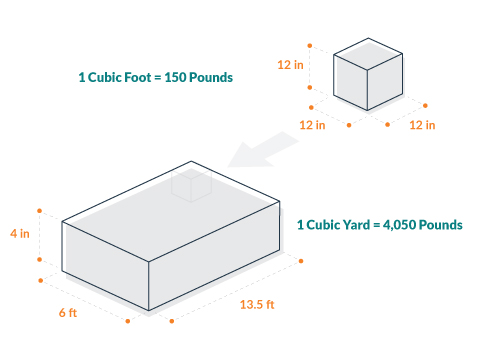
Image Source: www.dumpsters.com
Deciphering the Weight of Concrete
The question of “how much does concrete weigh” isn’t a simple one-size-fits-all answer. Several elements contribute to the final weight of a cubic yard of concrete. These include the types and proportions of the basic ingredients: cement, water, sand, and gravel (or crushed stone).
Key Ingredients and Their Weight Contributions
- Cement: Portland cement is the binder that holds concrete together. While cement itself is dense, it makes up a smaller portion of the total volume compared to the aggregates.
- Water: Water is essential for the chemical reaction (hydration) that hardens cement. The amount of water affects workability and strength, and also contributes to the overall weight.
- Aggregates (Sand and Gravel/Stone): These are the bulk of the concrete mix. The type, size, and density of the aggregates have the most significant impact on the final weight.
- Sand (Fine Aggregate): Typically silica-based, sand is relatively dense.
- Gravel or Crushed Stone (Coarse Aggregate): The density of the stone used (e.g., granite, limestone, or lighter materials) plays a major role. Dense, heavy stones will result in heavier concrete.
The Role of Water-to-Cement Ratio
The water-to-cement ratio is a critical factor in concrete mix design. A lower water-to-cement ratio generally leads to stronger, but less workable, concrete. While a lower ratio might mean slightly less water weight, the primary driver of density remains the aggregates.
Fathoming the Concrete Density
Concrete density is a fundamental property that dictates its weight. Density is defined as mass per unit volume. For concrete, this is usually expressed in pounds per cubic foot (pcf) or kilograms per cubic meter (kg/m³).
Typical Concrete Weight Variations
The typical concrete weight can range from about 140 pounds per cubic foot for lighter mixes to over 150 pounds per cubic foot for standard, denser mixes.
- Lightweight Concrete: Often uses expanded shale, clay, or slate as aggregate. Its density can be as low as 90-115 pcf.
- Normal-Weight Concrete: This is the most common type, using typical sand and gravel or crushed stone. Its density usually falls between 140-155 pcf.
- Heavyweight Concrete: Uses dense aggregates like barite or magnetite for specialized applications like radiation shielding. Its density can exceed 200 pcf.
For our primary question, how much does concrete weigh, we are generally referring to normal-weight concrete.
Calculating Concrete Weight: A Practical Guide
Now that we know what influences concrete weight, let’s look at how to calculate concrete weight. This is essential for accurately ordering materials and planning your project.
The Basic Formula
The fundamental formula to calculate the weight of concrete is:
Weight = Volume × Density
To find the weight of 1 cubic yard concrete, we need to know the density in pounds per cubic yard.
Converting Units
Since density is often given in pounds per cubic foot (pcf), and we’re interested in cubic yards, we need to convert.
- There are 3 feet in a yard.
- Therefore, there are 3 ft × 3 ft × 3 ft = 27 cubic feet in 1 cubic yard.
Step-by-Step Concrete Weight Calculation
Let’s take a common density for normal-weight concrete: 145 pounds per cubic foot (pcf).
- Start with Density per Cubic Foot: Assume our concrete mix has a density of 145 pcf.
- Determine Cubic Feet per Cubic Yard: We know there are 27 cubic feet in 1 cubic yard.
- Calculate Weight per Cubic Yard:
Weight per cubic yard = Density (pcf) × Cubic feet per cubic yard
Weight per cubic yard = 145 pcf × 27 cubic feet/cubic yard
Weight per cubic yard = 3,915 pounds
This calculation shows that a cubic yard of concrete with a density of 145 pcf weighs approximately 3,915 pounds. This is very close to the commonly cited figure of 4,000 pounds.
Estimating Your Project Needs
When you’re ordering concrete, it’s crucial to account for wastage and slight variations in the mix. It’s always better to have a little extra than to run short.
Example Calculation for a Patio
Imagine you need to pour a concrete patio that is 10 feet long, 10 feet wide, and 4 inches thick.
- Convert Thickness to Feet: 4 inches / 12 inches/foot = 0.333 feet (or 1/3 foot).
- Calculate Volume in Cubic Feet:
Volume = Length × Width × Thickness
Volume = 10 ft × 10 ft × 0.333 ft
Volume = 33.3 cubic feet - Convert Volume to Cubic Yards:
Volume (cubic yards) = Volume (cubic feet) / 27 cubic feet/cubic yard
Volume (cubic yards) = 33.3 / 27
Volume (cubic yards) ≈ 1.23 cubic yards - Estimate Weight: Using our 4,000 lbs/cubic yard estimate:
Total Weight = Volume (cubic yards) × Weight per cubic yard
Total Weight = 1.23 cubic yards × 4,000 lbs/cubic yard
Total Weight ≈ 4,920 pounds
Therefore, for a patio of these dimensions, you would need roughly 1.23 cubic yards of concrete, weighing close to 5,000 pounds. It’s common practice to round up to the nearest quarter or half yard when ordering, so you’d likely order 1.5 cubic yards.
Factors Affecting the Cubic Yard Concrete Weight
The cubic yard concrete weight isn’t static. The specific composition of the concrete mix directly influences its final density and, therefore, its weight.
Aggregate Type and Size
The most influential factor in concrete density is the type and size of the aggregates used.
- Dense Aggregates: Crushed granite or high-density gravel will result in heavier concrete.
- Lighter Aggregates: Crushed limestone or slag can also contribute to variations.
- Aggregate Size: While less impactful than type, larger aggregates can sometimes create small voids, slightly reducing overall density compared to a mix with well-graded smaller aggregates.
Water Content
While the weight of concrete is primarily driven by solids, the amount of water in the mix does contribute. However, as mentioned, the water-to-cement ratio is more about strength and workability than a major weight determinant in standard mixes. Excess water can lead to weaker concrete, but its direct weight contribution is less significant than the aggregate.
Air Entrainment
Air-entrained concrete is designed to improve durability by creating small, evenly distributed air bubbles within the mix. These bubbles reduce the overall density and thus the weight of the concrete. The weight reduction is typically proportional to the percentage of air entrained.
Additives and Admixtures
Modern concrete often includes admixtures to modify its properties. While most common admixtures don’t significantly alter the weight, very specialized ones might have a minor effect.
Typical Concrete Weight Table
To provide a clearer picture, here’s a table illustrating the typical concrete weight for common scenarios:
| Concrete Type / Mix Description | Approximate Density (pcf) | Approximate Weight (lbs/cubic yard) |
|---|---|---|
| Standard Structural Concrete (Normal Weight) | 140 – 155 | 3,780 – 4,185 |
| Lightweight Concrete (e.g., expanded shale) | 90 – 115 | 2,430 – 3,105 |
| High-Density Concrete (e.g., for shielding) | 200+ | 5,400+ |
| Air-Entrained Concrete (slight reduction) | Varies (slightly lower) | Typically 5-10% less than standard |
Note: These are approximations. Actual weights can vary based on precise mix design.
Asphalt vs. Concrete Weight
When discussing pavement materials, it’s common to compare asphalt vs. concrete weight. Both are widely used for roads, driveways, and other surfaces, but they have distinct properties, including weight.
Density Comparison
- Concrete: As we’ve established, normal-weight concrete typically weighs around 4,000 pounds per cubic yard (or roughly 145-150 pounds per cubic foot).
- Asphalt: Asphalt concrete, also known as asphaltic concrete or blacktop, is generally lighter than conventional concrete. Its density can range from about 3,500 to 3,900 pounds per cubic yard, depending on the mix (e.g., aggregate type, binder content, and compaction).
Why the Difference?
The primary reason for the weight difference lies in the aggregates and the binder.
- Concrete: Uses heavier stone and sand aggregates, bound by cement and water. The cement paste itself is dense.
- Asphalt: Uses similar aggregates, but the binder is petroleum-based asphalt cement. While asphalt cement is dense, asphalt mixes often incorporate a higher percentage of fine aggregates and may have slightly less dense coarse aggregates compared to typical structural concrete. Compaction plays a significant role in asphalt density.
Practical Implications
The weight difference between asphalt and concrete can be a consideration in certain applications, such as bridge decks or structures where the dead load is a critical factor. Lighter materials can reduce the overall load on supporting structures.
Frequently Asked Questions (FAQ)
Here are some common questions about concrete weight:
Q1: Does the color of concrete affect its weight?
A1: While the pigments used to color concrete are typically added in very small quantities, they can have a minuscule effect on the overall weight. However, this effect is negligible and not a significant factor in practical calculations. The primary drivers remain the aggregates and cement content.
Q2: How much does a bag of concrete weigh, and how much concrete is in a bag?
A2: Concrete is commonly sold in bags of 40 lb, 60 lb, and 80 lb. An 80 lb bag of concrete mix typically yields about 0.6 cubic feet of concrete. To figure out how many bags you need for a project, you would calculate your total cubic yardage, convert it to cubic feet (multiply by 27), and then divide by 0.6 (for 80 lb bags).
Q3: What is the average weight of concrete per square foot for a standard slab?
A3: This depends entirely on the thickness of the slab. For a 4-inch thick slab (0.333 cubic yards per 100 sq ft) weighing 4,000 lbs/cubic yard, the weight would be approximately 4,000 lbs/cubic yard * 0.333 cubic yards = 1,332 lbs per 100 sq ft, or about 13.3 lbs per square foot.
Q4: How does weather affect the weight of concrete?
A4: Once cured, concrete’s weight is stable. However, during the curing process, if the concrete absorbs a significant amount of water from its surroundings, its weight can temporarily increase due to saturation. Once dry, it returns to its cured weight.
Q5: Can I use the weight of concrete to determine its strength?
A5: While there’s a general correlation, the weight of concrete alone is not a precise indicator of its strength. Strength is determined by the mix design, particularly the water-to-cement ratio and the quality of aggregates and cement. A denser mix might be stronger, but it’s not a direct calculation you can rely on without knowing the exact mix proportions.
Conclusion
In summary, the weight of concrete is a critical piece of information for any construction or DIY project. A standard cubic yard of concrete typically weighs around 4,000 pounds, but this figure can fluctuate based on the specific ingredients used, especially the type of aggregates. By knowing the concrete density and employing simple concrete weight calculation methods, you can accurately estimate material needs, plan logistics, and ensure the success and safety of your concrete work. Whether you’re comparing asphalt vs. concrete weight or simply trying to figure out how much concrete weighs for your driveway, this knowledge is invaluable.