
A cubic yard of concrete is typically made up of around five to six 80 lb bags or seven to eight 60 lb bags of dry concrete mix. This conversion depends on the specific yield of the bag, which is usually stated on the packaging.
When planning a concrete project, one of the most common questions homeowners and DIYers ask is, “How much concrete is in a yard?” This isn’t just about curiosity; it’s about accurately estimating the materials you’ll need to avoid running short or buying far too much. A cubic yard of concrete is a standard unit of measurement in construction, and knowing how to translate that into the familiar bags of dry mix is crucial for any project, from pouring a small patio to building a new foundation.
This guide aims to demystify the process of converting cubic yards to bags of concrete. We’ll explore the factors that influence this conversion, provide practical examples, and introduce tools that can simplify your calculations. Whether you’re a seasoned contractor or tackling your first DIY project, this information will help you buy the right amount of concrete every time.
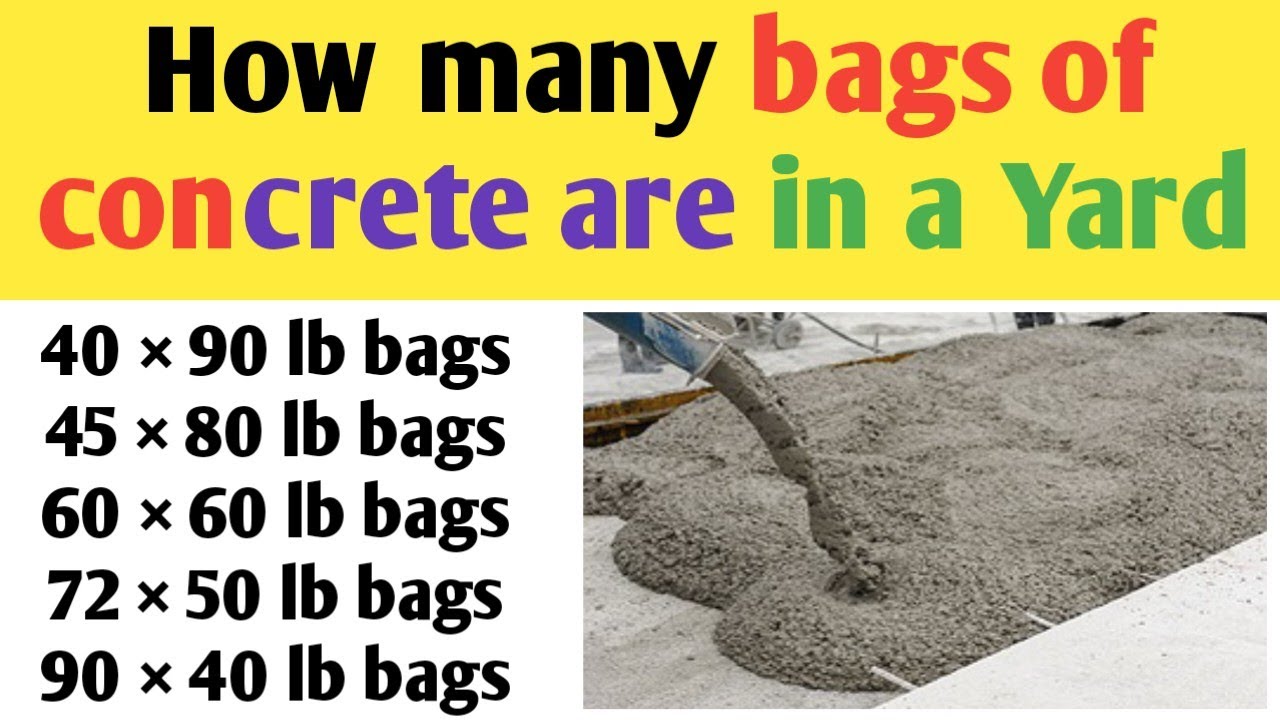
Image Source: i.ytimg.com
What Exactly is a Cubic Yard of Concrete?
Before we dive into bag counts, it’s important to grasp what a cubic yard truly represents. A cubic yard is a unit of volume. Imagine a cube that is three feet long, three feet wide, and three feet high. The total volume contained within that cube is one cubic yard.
In terms of concrete, this means you need enough material to fill a space that measures 3 feet x 3 feet x 3 feet. This might seem like a lot, and it is! A cubic yard of concrete is a substantial amount of material. When you order ready mix concrete bags, this is the volume you are referencing.
The Volume Breakdown: Feet, Inches, and Yards
- 1 yard = 3 feet
- 1 foot = 12 inches
So, a cubic yard can also be thought of as:
- 3 feet x 3 feet x 3 feet = 27 cubic feet
- 36 inches x 36 inches x 36 inches = 46,656 cubic inches
These dimensions are key when you’re calculating the volume of your project space, such as the area you want to pour for a sidewalk or a small slab.
Deciphering the Concrete Bag: Yield and Weight
The number of bags of concrete you need per cubic yard directly relates to the bag of concrete coverage and its standard concrete bag weight. Concrete bags come in various weights, with the most common being 50 lb, 60 lb, and 80 lb.
However, the weight of the bag doesn’t tell the whole story. What truly matters is the yield of the bag – how much mixed concrete it produces. Manufacturers determine this yield by mixing the dry ingredients according to their specifications. This yield is almost always printed on the bag itself, typically in cubic feet.
Why Yield Matters More Than Weight
Let’s say you have two different brands of 80 lb concrete bags. One might yield 0.6 cubic feet of concrete, while another might yield 0.75 cubic feet. If you’re trying to achieve a specific volume, like a cubic yard, the bag with the higher yield will get you there faster, meaning you’ll need fewer bags.
This is why relying solely on the bag’s weight can be misleading. Always look for the “yield” information on the packaging.
Common Bag Yields
Here’s a general guideline for the yield of common bag sizes:
- 50 lb bag: Typically yields about 0.38 cubic feet of concrete.
- 60 lb bag: Often yields around 0.45 cubic feet of concrete.
- 80 lb bag: Generally yields approximately 0.60 cubic feet of concrete.
These are approximations, and it’s essential to check the specific bag you are using for its stated yield.
Calculating Bags Per Cubic Yard: The Math
Now, let’s put the numbers together to answer the core question: how much concrete in a yard equates to how many bags.
We know:
- 1 cubic yard = 27 cubic feet
And we have the yield of individual bags (in cubic feet). To find out how many bags are needed for one cubic yard, we divide the total volume of a cubic yard by the yield of a single bag:
Number of Bags per Cubic Yard = Total Cubic Feet in a Yard / Yield per Bag (in Cubic Feet)
Let’s apply this to our common bag sizes:
For 80 lb Bags
Assuming an 80 lb concrete bag yield of 0.60 cubic feet:
Number of Bags = 27 cubic feet / 0.60 cubic feet/bag
Number of Bags = 45 bags
However, you’ll frequently see slightly different yields cited for 80 lb bags, often around 0.6 cubic feet or even slightly more. If an 80 lb bag yields 0.6 cubic feet, you’d need 45 bags for a cubic yard. If the yield is closer to 0.65 cubic feet, you’d need approximately 41.5 bags.
The widely accepted and practical answer, considering common product variations and accounting for a small buffer, is that five to six 80 lb bags of concrete are in a yard. This accounts for slight variations in yield and ensures you have a little extra.
For 60 lb Bags
Assuming a 60 lb concrete bag yield of 0.45 cubic feet:
Number of Bags = 27 cubic feet / 0.45 cubic feet/bag
Number of Bags = 60 bags
Again, the practical answer is usually cited as seven to eight 60 lb bags of concrete are in a yard. This range provides a buffer and accounts for slight variations.
For 50 lb Bags
Assuming a 50 lb bag yields about 0.38 cubic feet:
Number of Bags = 27 cubic feet / 0.38 cubic feet/bag
Number of Bags = 71 bags
So, for 50 lb bags, you’d typically need around nine to ten 50 lb bags for a cubic yard.
Table Summary: Bags per Cubic Yard
| Bag Weight | Typical Yield (Cubic Feet) | Approximate Bags per Cubic Yard |
|---|---|---|
| 80 lb | 0.60 | 45 bags (practical estimate: 5-6 bags) |
| 60 lb | 0.45 | 60 bags (practical estimate: 7-8 bags) |
| 50 lb | 0.38 | 71 bags (practical estimate: 9-10 bags) |
Important Note: These are theoretical calculations. In practice, it’s always wise to round up to the next whole bag and consider adding an extra bag for contingency. This helps account for spills, uneven subgrade, and minor measurement errors.
Using a Concrete Calculator: Simplifying Your Needs
Manually calculating the number of bags can be tedious, especially for larger projects. Fortunately, there are many online tools designed to help. A concrete bag calculator or a concrete calculator yards to bags can quickly and accurately determine your needs.
These calculators typically ask for:
- The dimensions of your project: Length, width, and depth (or thickness).
- The desired unit of measurement: Feet, inches, or yards.
- The type and weight of the concrete bags you plan to use: For example, 80 lb bags, 60 lb bags, etc.
The calculator then uses the standard formulas and common yields to tell you exactly how many bags you’ll need.
How a Concrete Calculator Works: The Underlying Logic
These tools essentially perform the same calculations we’ve discussed. They first calculate the total volume of your project in cubic feet or cubic yards using a concrete volume calculator.
For instance, if you have a slab that is 10 feet long, 10 feet wide, and 4 inches thick:
- Convert thickness to feet: 4 inches / 12 inches/foot = 0.333 feet
- Calculate volume in cubic feet: 10 ft * 10 ft * 0.333 ft = 33.3 cubic feet
- Convert to cubic yards: 33.3 cubic feet / 27 cubic feet/yard = 1.23 cubic yards
Once the total volume is known, the calculator divides this by the yield of the specific bag size you’ve chosen to get the number of bags required. If you’re using 80 lb bags yielding 0.60 cubic feet:
Number of Bags = Total Project Volume (in cubic feet) / Yield per Bag (in cubic feet)
Number of Bags = 33.3 cubic feet / 0.60 cubic feet/bag
Number of Bags = 55.5 bags
The calculator would then likely round this up to 56 bags, and often suggest adding one or two extra bags for safety.
Practical Considerations for Your Project
Beyond the basic conversion, several real-world factors can influence how much concrete you actually need.
1. Subgrade Preparation
The base on which you pour concrete must be firm and level. If your subgrade is not perfectly level, you might need slightly more concrete to fill low spots and achieve a uniform thickness. Conversely, if you over-excavate, you’ll definitely need more.
- Compaction: Ensure your base material (gravel, sand) is well-compacted. This prevents settling later.
- Slope: Most concrete surfaces need a slight slope for drainage. This means the thickness will vary slightly across the area.
2. Project Complexity
Simple slabs are straightforward. However, projects involving steps, curves, or intricate shapes might require more precise calculations and potentially a bit more material to account for waste or trimmings.
3. Waste and Spillage
Mistakes happen! Concrete can be spilled during mixing or transport. Some material will inevitably stick to your tools and mixing container. It’s always better to have a little extra than to run out in the middle of a pour, which can lead to unsightly cold joints.
4. Bag Quality and Moisture Content
While less common with modern bagged concrete, very old bags might have absorbed moisture, causing the dry mix to clump. This can affect the exact yield. Stick to purchasing from reputable suppliers and check that bags are sealed and dry.
5. Manufacturer Variations
As mentioned earlier, slight variations in the standard concrete bag weight and yield can exist between brands. Always refer to the specific product packaging for the most accurate information.
Estimating for Common Projects
Let’s look at a few common DIY projects and estimate the concrete bags needed.
Small Patio Slab (e.g., 10 ft x 10 ft x 4 inches thick)
- Volume: 33.3 cubic feet or 1.23 cubic yards.
- Using 80 lb bags (0.60 cubic feet yield):
- 33.3 cubic feet / 0.60 cubic feet/bag = 55.5 bags
- Recommendation: Purchase 56-58 bags.
- Using 60 lb bags (0.45 cubic feet yield):
- 33.3 cubic feet / 0.45 cubic feet/bag = 74 bags
- Recommendation: Purchase 75-77 bags.
Small Sidewalk Section (e.g., 4 ft wide x 20 ft long x 4 inches thick)
- Volume: 4 ft * 20 ft * (4/12) ft = 26.7 cubic feet or 0.99 cubic yards (essentially 1 cubic yard).
- Using 80 lb bags (0.60 cubic feet yield):
- 26.7 cubic feet / 0.60 cubic feet/bag = 44.5 bags
- Recommendation: Purchase 45-47 bags.
- Using 60 lb bags (0.45 cubic feet yield):
- 26.7 cubic feet / 0.45 cubic feet/bag = 59.3 bags
- Recommendation: Purchase 60-62 bags.
Fence Post Holes (e.g., 10 holes, 8 inches diameter, 2 feet deep)
This is a bit different as we’re dealing with cylinders.
- Volume of one cylinder: π * (radius)² * height
- Radius: 4 inches = 4/12 feet = 0.333 feet
- Height: 2 feet
-
Volume per hole: π * (0.333 ft)² * 2 ft ≈ 0.696 cubic feet
-
Total volume for 10 holes: 0.696 cubic feet/hole * 10 holes = 6.96 cubic feet
-
Using 80 lb bags (0.60 cubic feet yield):
- 6.96 cubic feet / 0.60 cubic feet/bag = 11.6 bags
- Recommendation: Purchase 12-14 bags.
These examples highlight the importance of accurate measurements and using a reliable concrete calculator yards to bags.
When to Consider Ready-Mix Concrete
For larger projects that require more than 10-15 bags of concrete, it often becomes more economical and practical to order ready mix concrete bags delivered by truck. While you can mix large volumes by hand or with a rented mixer, coordinating multiple batches can be challenging.
Ready-mix concrete is mixed at a plant and delivered to your site in a ready-to-pour state. This ensures consistent quality and eliminates the labor-intensive mixing process. When ordering ready-mix, you specify the volume you need in cubic yards.
Advantages of Ready-Mix Concrete:
- Consistency: Uniform mix design and quality.
- Efficiency: Saves time and labor for large volumes.
- Convenience: Delivered directly to your site.
- Quality Control: Mixed under controlled plant conditions.
Frequently Asked Questions (FAQ)
Q: How many 80 lb bags of concrete are in one cubic yard?
A: Typically, five to six 80 lb bags of concrete are needed for one cubic yard, assuming each bag yields approximately 0.6 cubic feet.
Q: How many 60 lb bags of concrete are in one cubic yard?
A: Generally, seven to eight 60 lb bags of concrete are required for one cubic yard, with each bag yielding about 0.45 cubic feet.
Q: Does the thickness of the concrete affect how many bags I need?
A: Yes, absolutely. The thickness is a critical dimension when calculating the total volume of concrete required for your project. Thicker layers will naturally need more concrete.
Q: What if I can’t find the yield information on my concrete bag?
A: If the yield information is missing, use the general approximations provided (0.60 cu ft for 80 lb, 0.45 cu ft for 60 lb). However, it’s always best to look for the manufacturer’s stated yield, as it’s the most accurate data. You can also often find this information on the manufacturer’s website.
Q: Should I always buy extra concrete bags?
A: Yes, it is highly recommended to buy at least one or two extra bags than your calculation suggests. This buffer accounts for minor miscalculations, spillage, or uneven subgrades. Running out of concrete mid-pour is a common problem that can lead to poor results.
Q: How do I calculate the volume of my project for a concrete calculator?
A: Measure the length, width, and depth (or thickness) of the area you want to pour. Ensure all measurements are in the same units (feet or inches). For non-rectangular shapes, you may need to break them down into simpler geometric shapes (rectangles, circles, triangles) and sum their volumes.
Q: Is it better to use 80 lb bags or 60 lb bags?
A: For larger projects, 80 lb bags are often more efficient as they typically yield more concrete per bag, meaning you’ll handle fewer bags overall. For smaller, more manageable projects, 60 lb bags can be easier to mix and handle for a single person. Always compare the yield per bag to determine the most cost-effective option for your specific needs.
Conclusion
Accurately estimating the amount of concrete needed for a project is a foundational skill for anyone involved in construction or DIY improvements. By knowing that one cubic yard of concrete is equivalent to a specific volume (27 cubic feet) and by paying close attention to the yield of each bag of concrete mix, you can confidently calculate your material requirements.
Whether you’re working with 80 lb concrete bag yield, 60 lb concrete bag yield, or any other size, using a concrete calculator can simplify the process. Remember to always factor in potential waste and over-excavation by purchasing a little extra. With this knowledge, you’re well-equipped to tackle your next concrete project, ensuring you have the right amount of material to achieve a successful and durable outcome.