
If you’re wondering how many bags of concrete make up one cubic yard, the general answer is typically six to nine bags, depending on the bag size and the specific concrete mix. This guide will help you precisely calculate the number of concrete bags you’ll need for your project.
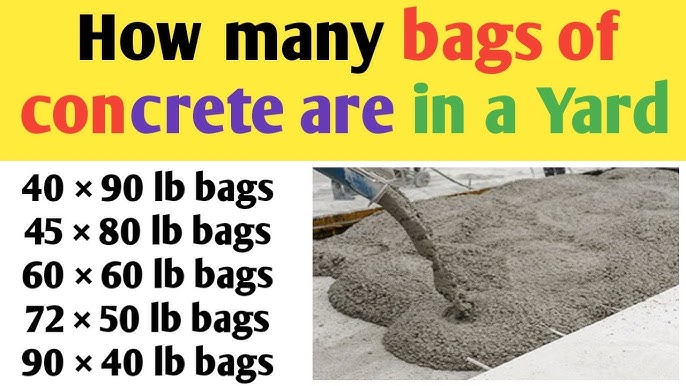
Image Source: i.ytimg.com
Figuring Out Concrete Bag Needs
When you’re planning a concrete project, one of the most common questions is about the quantity of concrete required. You’ve likely seen those bags of concrete mix at the hardware store, but translating those bags into the larger unit of a cubic yard can be a bit tricky. This is where a good concrete bag calculator comes in handy, but before we dive into that, let’s break down the core concepts.
What is a Cubic Yard of Concrete?
A cubic yard is a unit of volume. Think of a cube that is three feet long, three feet wide, and three feet high. That cube represents one cubic yard of space. It’s a standard measurement for ordering and calculating concrete for construction projects, from small patios to large foundations. Knowing how much concrete in a yard is essential for efficient purchasing and avoiding waste or shortfalls.
The Mystery of Cubic Yard Concrete Bags
The puzzle of how many cubic yard concrete bags you need boils down to the volume each bag yields. Concrete is sold in various bag sizes, and each size contains a different amount of dry mix. When you add water to this mix, it expands to a certain volume. The challenge is that not all bags are created equal.
Bag Size Concrete: What to Look For
Concrete bags are typically sold by weight, with common sizes being 40 lb, 60 lb, and 80 lb. The weight of the bag directly influences its concrete bag yield, or how much mixed concrete it produces.
- 40 lb bags: These are the smallest common size.
- 60 lb bags: A mid-range option, often used for general-purpose projects.
- 80 lb bags: The largest and most common size for larger projects.
The volume of concrete bags can vary significantly. For example, an 80 lb bag typically yields about 0.75 cubic feet of mixed concrete, while a 60 lb bag might yield around 0.5 cubic feet, and a 40 lb bag around 0.3 cubic feet.
Deciphering Bags of Concrete Per Cubic Yard
To figure out bags of concrete per cubic yard, we need to do some simple math. Since there are 27 cubic feet in one cubic yard (3 feet x 3 feet x 3 feet = 27 cubic feet), we can work backward.
Let’s assume an 80 lb bag yields 0.75 cubic feet of mixed concrete:
- Number of 80 lb bags per cubic yard = 27 cubic feet / 0.75 cubic feet/bag = 36 bags
Now, let’s consider a 60 lb bag that yields 0.5 cubic feet of mixed concrete:
- Number of 60 lb bags per cubic yard = 27 cubic feet / 0.5 cubic feet/bag = 54 bags
And for a 40 lb bag yielding 0.3 cubic feet:
- Number of 40 lb bags per cubic yard = 27 cubic feet / 0.3 cubic feet/bag = 90 bags
These numbers highlight why knowing the specific yield of the concrete mix bags you’re buying is crucial.
Calculating Concrete Bags for Your Project
The process of calculating concrete bags starts with knowing the dimensions of your project. Whether you’re pouring a small step, a patio slab, or a foundation, you need to determine the volume of concrete required in cubic feet.
Measuring Your Project Dimensions
Let’s say you’re pouring a rectangular patio slab. You’ll need to measure:
- Length: The longest dimension of your slab.
- Width: The shorter dimension of your slab.
- Depth (or Thickness): How thick you want the concrete to be. This is often expressed in inches for smaller projects.
Converting Measurements to Cubic Feet
All measurements need to be in feet before you calculate the volume.
- Length (ft) x Width (ft) x Depth (ft) = Volume (cubic feet)
Example: A patio slab that is 10 feet long, 8 feet wide, and 4 inches thick.
- First, convert the depth from inches to feet: 4 inches / 12 inches/foot = 0.33 feet.
- Now, calculate the volume: 10 ft x 8 ft x 0.33 ft = 26.4 cubic feet.
Converting Cubic Feet to Cubic Yards
Once you have the volume in cubic feet, divide by 27 to get the volume in cubic yards:
- Volume (cubic feet) / 27 = Volume (cubic yards)
In our patio example:
- 26.4 cubic feet / 27 = 0.98 cubic yards.
This means you’ll need almost exactly one cubic yard of concrete for this patio.
Putting it All Together: How Many Bags?
Now that you know the volume needed in cubic yards, you can determine the number of bags. Let’s use our patio example again, needing 0.98 cubic yards of concrete.
We’ll use the typical yields for different bag sizes:
-
80 lb bag yield: 0.75 cubic feet. To get cubic yards, we divide by 27: 0.75 cu ft / 27 cu ft/yd³ = 0.0278 cubic yards per bag.
- Number of 80 lb bags = 0.98 cubic yards / 0.0278 cubic yards/bag ≈ 35.25 bags. You’d round up to 36 bags.
-
60 lb bag yield: 0.5 cubic feet. To get cubic yards: 0.5 cu ft / 27 cu ft/yd³ = 0.0185 cubic yards per bag.
- Number of 60 lb bags = 0.98 cubic yards / 0.0185 cubic yards/bag ≈ 53 bags. You’d round up to 54 bags.
-
40 lb bag yield: 0.3 cubic feet. To get cubic yards: 0.3 cu ft / 27 cu ft/yd³ = 0.0111 cubic yards per bag.
- Number of 40 lb bags = 0.98 cubic yards / 0.0111 cubic yards/bag ≈ 88.3 bags. You’d round up to 89 bags.
This clearly shows the significant difference in the number of bags needed based on bag size.
Estimating Concrete Bag Yield: A Quick Reference
Here’s a handy table showing approximate yields for common bag sizes. Remember, these are estimates, and the actual yield can vary slightly based on the manufacturer and how well you mix the concrete.
| Bag Size (Weight) | Approximate Yield (Cubic Feet) | Approximate Yield (Cubic Yards) | Estimated Bags per Cubic Yard |
|---|---|---|---|
| 40 lb | 0.3 | 0.0111 | 90 |
| 60 lb | 0.5 | 0.0185 | 54 |
| 80 lb | 0.75 | 0.0278 | 36 |
So, to answer the initial question more directly: How many bags of concrete is 1 yard?
- For 80 lb bags, it’s approximately 36 bags per cubic yard.
- For 60 lb bags, it’s approximately 54 bags per cubic yard.
- For 40 lb bags, it’s approximately 90 bags per cubic yard.
This gives you a strong baseline for 1 yard concrete bags.
Factors Affecting Concrete Bag Yield
While the math provides a good estimate, several factors can influence the actual concrete bag yield:
Water Content
The amount of water you add is critical. Adding too much water can make the concrete easier to work with but will reduce its strength and increase its volume slightly. Adding too little water can make it difficult to mix and pour, and it won’t achieve its full potential volume. Always follow the manufacturer’s recommendations for water.
Compaction
When you pour concrete, you’ll often vibrate or tamp it to remove air pockets and ensure the concrete fills all spaces. Proper compaction can slightly increase the density of the concrete, potentially reducing the overall volume needed. However, for bag calculations, we usually assume a standard uncompacted volume.
Type of Concrete Mix
Different concrete mixes have different aggregate sizes and proportions. Some “high-strength” or “fast-setting” mixes might have slightly different yields than standard all-purpose mixes. Always check the bag for specific yield information.
Planning Your Concrete Purchase
It’s always wise to buy a little extra concrete than you think you’ll need. Running out mid-project is inconvenient, and ordering a small top-up can be costly and may result in slight color differences between batches.
- Contingency: A common recommendation is to add 5-10% to your calculated amount.
For our patio example needing approximately 0.98 cubic yards:
- Adding 10%: 0.98 cubic yards * 1.10 = 1.078 cubic yards.
- If using 80 lb bags (36 bags/yd³): 1.078 yd³ * 36 bags/yd³ ≈ 38.8 bags. You’d likely buy 39 or 40 bags.
Using Online Concrete Calculators
Many online resources offer a concrete bag calculator to simplify these calculations. You input your project dimensions (length, width, depth), and the calculator will tell you the total cubic yards needed. You then select the bag size you plan to use, and it will provide the number of bags required. These tools are excellent for confirming your own calculations.
Pouring Concrete: Beyond the Bags
While knowing how many bags you need is crucial, it’s also helpful to be aware of the process:
Mixing Concrete
- Tools: For small projects, you can mix concrete in a wheelbarrow or a large tub using a shovel or a concrete mixer attachment for a drill. For larger volumes, a portable concrete mixer is recommended.
- Water: Start with the recommended amount of water and add more gradually if needed. Mix thoroughly until you achieve a consistent, workable consistency – not too wet, not too dry.
- Workability: Freshly mixed concrete needs to be used within a limited time frame (typically 30-60 minutes) before it starts to set.
Pouring and Finishing
- Preparation: Ensure your forms are secure and greased (if necessary) to prevent the concrete from sticking. You might want to add a layer of gravel or sand for drainage and stability at the base of your pour.
- Distribution: Spread the concrete evenly into the forms.
- Leveling: Use a screed board (a straight piece of lumber) to level the surface.
- Floating: After screeding, use a float to smooth the surface and bring some of the cement paste to the top.
- Troweling: For a smoother finish, use a trowel.
- Curing: This is a vital step. Concrete needs to cure to reach its full strength. This involves keeping it moist for several days (usually 7 days or more). You can do this by covering it with plastic sheeting, wet burlap, or applying a curing compound.
Common Concrete Projects and Bag Estimates
Let’s look at some typical projects and the estimated number of bags needed, assuming you’re using the most common 80 lb concrete mix bags which yield approximately 0.75 cubic feet each (or 36 bags per cubic yard).
Small Concrete Steps
A single step might be 3 ft long, 1 ft wide, and 6 inches deep.
* Volume: 3 ft * 1 ft * 0.5 ft = 1.5 cubic feet.
* In cubic yards: 1.5 cu ft / 27 cu ft/yd³ = 0.056 cubic yards.
* Number of 80 lb bags: 0.056 yd³ * 36 bags/yd³ ≈ 2.0 bags. You’d likely buy 3 bags to be safe.
Concrete Patio Slabs (as calculated before)
A 10 ft x 8 ft slab, 4 inches thick (0.33 ft).
* Volume: 10 ft * 8 ft * 0.33 ft = 26.4 cubic feet.
* In cubic yards: 26.4 cu ft / 27 cu ft/yd³ = 0.98 cubic yards.
* Number of 80 lb bags: 0.98 yd³ * 36 bags/yd³ ≈ 35.3 bags. You’d buy 36-37 bags.
Sidewalk Section
A 10 ft long, 3 ft wide, 4 inches thick sidewalk section.
* Volume: 10 ft * 3 ft * 0.33 ft = 9.9 cubic feet.
* In cubic yards: 9.9 cu ft / 27 cu ft/yd³ = 0.37 cubic yards.
* Number of 80 lb bags: 0.37 yd³ * 36 bags/yd³ ≈ 13.3 bags. You’d buy 14-15 bags.
Small Foundation or Footing
A 4 ft x 4 ft footing that is 12 inches deep (1 ft).
* Volume: 4 ft * 4 ft * 1 ft = 16 cubic feet.
* In cubic yards: 16 cu ft / 27 cu ft/yd³ = 0.59 cubic yards.
* Number of 80 lb bags: 0.59 yd³ * 36 bags/yd³ ≈ 21.2 bags. You’d buy 22-23 bags.
These examples illustrate how important accurate measurements are for calculating concrete bags.
When to Consider Bulk Concrete Delivery
For projects requiring more than a cubic yard or two, buying bags of concrete can become very expensive and labor-intensive. If your project demands 1 cubic yard or more, it’s often more cost-effective and convenient to order ready-mix concrete delivered by a truck.
- Cost Savings: Bulk concrete is typically cheaper per cubic yard than bagged concrete.
- Labor Savings: You avoid the heavy lifting and mixing of dozens or hundreds of bags.
- Consistency: Ready-mix concrete is mixed in a plant under controlled conditions, ensuring consistent quality.
To order bulk concrete, you’ll need to know your project’s volume in cubic yards. You can then call a local concrete supplier. They’ll often have a minimum order requirement (usually around 1 cubic yard).
Final Thoughts on Bag Calculations
Mastering the calculation of how many bags of concrete is 1 yard is a fundamental skill for DIYers and contractors alike. By carefully measuring your project, converting units correctly, and knowing the yield of your chosen concrete bag size, you can confidently purchase the right amount of material. Remember to always add a small buffer for contingencies and consider ready-mix delivery for larger jobs. With this knowledge, your next concrete project will be smoother from planning to completion.
Frequently Asked Questions (FAQ)
Q1: What is the standard yield of an 80 lb bag of concrete?
A1: An 80 lb bag of standard concrete mix typically yields about 0.75 cubic feet of mixed concrete.
Q2: How do I calculate the volume of a concrete slab?
A2: Measure the length, width, and depth (thickness) of the slab in feet. Multiply these three dimensions together: Length (ft) x Width (ft) x Depth (ft) = Volume (cubic feet).
Q3: How many cubic feet are in a cubic yard of concrete?
A3: There are 27 cubic feet in one cubic yard (3 ft x 3 ft x 3 ft).
Q4: Can I mix concrete in a wheelbarrow?
A4: Yes, for small projects, a wheelbarrow is suitable for mixing concrete. Ensure you have enough space to work and mix thoroughly.
Q5: What happens if I use too much water in my concrete mix?
A5: Using too much water weakens the concrete, making it less durable and more prone to cracking. It also increases the volume but reduces the strength.
Q6: Is it better to buy a little extra concrete or just the exact amount?
A6: It’s always recommended to buy about 5-10% extra concrete. This accounts for minor measurement errors, spillage, and ensures you don’t run out mid-project, which can lead to a less uniform finish.
Q7: How do I convert inches to feet for concrete calculations?
A7: Divide the number of inches by 12. For example, 4 inches is 4/12 = 0.33 feet.
Q8: When should I consider ordering bulk concrete instead of bags?
A8: If your project requires more than 1 to 2 cubic yards of concrete, ordering a ready-mix delivery is usually more cost-effective and labor-efficient.
Q9: What does “concrete bag yield” mean?
A9: Concrete bag yield refers to the volume of mixed concrete that a single bag of dry concrete mix will produce after water has been added and it has been properly mixed.
Q10: Are there online tools to help me calculate concrete bags?
A10: Yes, many websites offer free “concrete bag calculators” where you can input your project dimensions to get an estimate of the number of bags needed.