
Image Source: images.thdstatic.com
How Many Bags Of Concrete In A Yard: Your Guide
So, how many bags of concrete are in a yard? Generally, it takes about five to six 80-pound bags of concrete mix to yield one cubic yard of concrete, or around seven to eight 60-pound bags. This is a crucial piece of information for any DIY project involving concrete, whether you’re building a small patio, a sturdy foundation for a shed, or even just a new walkway. Knowing the correct quantity ensures you don’t run out mid-pour, leading to costly delays and potentially weak joints, nor do you end up with excess material that can go to waste. This guide will walk you through everything you need to know to accurately estimate your concrete needs.
Fathoming Concrete Volume: What is a Cubic Yard?
Before we dive into bag counts, it’s essential to grasp what a “cubic yard” actually means in the context of concrete. A cubic yard is a unit of volume. Think of a cube that is three feet long, three feet wide, and three feet high. That entire cube, when filled with concrete, represents one cubic yard.
To visualize this, imagine a space approximately 3 feet by 3 feet by 3 feet. This is a significant amount of material. When you order concrete from a supplier, it’s almost always measured and priced by the cubic yard. For smaller DIY projects, however, you’ll likely be using pre-packaged bags from your local hardware store.
Estimating Concrete Bags: The Core Calculation
The primary question, “how many bags of concrete in a yard?” hinges on the yield of each bag. Concrete bags are sold in various weights, most commonly 40-pound, 60-pound, and 80-pound sizes. Each bag’s label will state its approximate yield in cubic feet.
Key Factors Affecting Bag Yield:
- Bag Weight: Heavier bags contain more material and therefore yield more concrete.
- Manufacturer Specifications: Different brands and product lines have slightly different formulations, affecting their yield. Always check the bag itself.
- Mixing Accuracy: Too much or too little water can affect the final volume and strength.
Concrete Mix Per Yard: The Yield Breakdown
Let’s look at the typical yields for common bag sizes to help answer “how many bags of concrete in a yard?”
- 80-pound bags: These are the most common for larger DIY projects. An 80-pound bag typically yields about 0.60 cubic feet of concrete.
- 60-pound bags: A good middle-ground option. A 60-pound bag typically yields about 0.45 cubic feet of concrete.
- 40-pound bags: Best for very small jobs like patching or setting fence posts. A 40-pound bag typically yields about 0.30 cubic feet of concrete.
To calculate how many bags you need for a cubic yard, you first need to convert cubic yards to cubic feet. There are 27 cubic feet in one cubic yard (3 feet x 3 feet x 3 feet = 27 cubic feet).
Calculation for 80-pound bags:
If one 80-pound bag yields 0.60 cubic feet, then:
27 cubic feet (per cubic yard) / 0.60 cubic feet (per bag) = 45 bags
Calculation for 60-pound bags:
If one 60-pound bag yields 0.45 cubic feet, then:
27 cubic feet (per cubic yard) / 0.45 cubic feet (per bag) = 60 bags
Calculation for 40-pound bags:
If one 40-pound bag yields 0.30 cubic feet, then:
27 cubic feet (per cubic yard) / 0.30 cubic feet (per bag) = 90 bags
Important Note: These are approximations. It’s always wise to buy a few extra bags to account for spills, uneven ground, or slight over-excavation.
Concrete Bags Per Cubic Yard: A Quick Reference Table
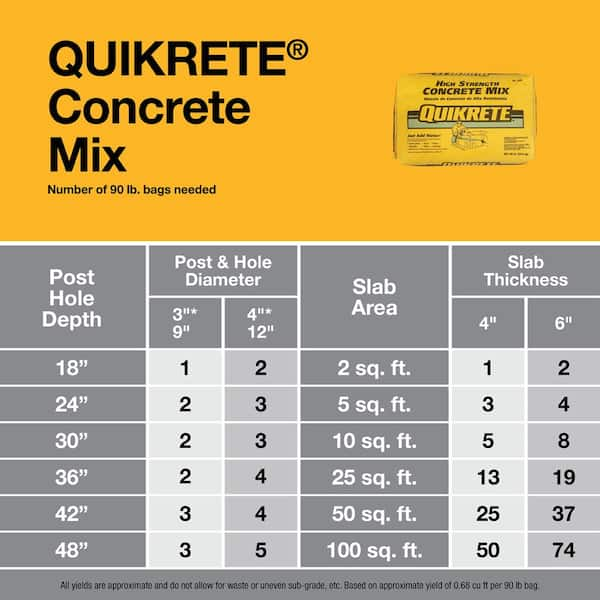
Here’s a handy table summarizing the approximate number of bags needed per cubic yard:
| Bag Weight | Approximate Yield per Bag (Cubic Feet) | Bags Needed per Cubic Yard |
|---|---|---|
| 80 lbs | 0.60 | 45 |
| 60 lbs | 0.45 | 60 |
| 40 lbs | 0.30 | 90 |
This table directly answers the “concrete bags per cubic yard” question for the most common bag sizes.
The Cubic Yard Concrete Bag Calculator: Your Project Planning Tool
While manual calculation is straightforward, a cubic yard concrete bag calculator can make planning even easier. These online tools allow you to input the dimensions of your project (length, width, and depth) and the type of bag you intend to use. The calculator will then directly tell you the total number of bags required.
How to Use a Concrete Volume Calculator:
- Measure Your Project Area: Determine the length and width of the area you need to fill with concrete.
- Determine the Depth: Decide on the thickness of your concrete pour. For typical patios or walkways, 4 inches is common. For driveways or structural elements, you might need 6 inches or more. Ensure your depth is in consistent units (e.g., feet or inches).
- Convert to Consistent Units: If your measurements are in inches, convert them to feet by dividing by 12. For example, 4 inches is 4/12 = 0.33 feet.
- Calculate the Volume: Multiply length x width x depth (all in feet) to get the volume in cubic feet.
- Convert to Cubic Yards: Divide the total cubic feet by 27 to get the volume in cubic yards.
- Use the Bag Calculator: Input your cubic yard requirement into a calculator, specifying the bag weight you plan to buy.
Example: You want to pour a patio that is 10 feet long, 8 feet wide, and 4 inches (0.33 feet) deep.
- Volume in cubic feet: 10 ft x 8 ft x 0.33 ft = 26.4 cubic feet
- Volume in cubic yards: 26.4 cubic feet / 27 cubic feet/cubic yard = 0.978 cubic yards (approximately 1 cubic yard).
Now, using the table or a calculator, you would determine that for about 1 cubic yard, you’d need roughly 45 bags of 80-pound mix. Always round up to ensure you have enough.
Concrete Bag Yield: Deciphering the Details
When you look at a bag of concrete mix, you’ll see the concrete bag yield printed on it. This is the manufacturer’s estimate of how much concrete the bag will produce when mixed according to their instructions.
- Example: An 80-pound bag might state “Yields 0.60 cubic feet.” This means that when mixed with the correct amount of water, it should produce a volume of 0.60 cubic feet.
It’s crucial to follow the water-to-mix ratio precisely. Adding too much water can weaken the concrete, while too little can make it unworkable and lead to dry pockets.
Mixing Concrete for Yard Projects: The Practicalities
Mixing concrete for yard projects requires careful preparation and execution.
Steps for Mixing Concrete:
- Gather Your Materials: You’ll need your bags of concrete mix, clean water, a wheelbarrow or mixing tub, a shovel or hoe for mixing, and potentially a cement mixer for larger batches.
- Prepare Your Workspace: Ensure you have a flat, stable surface for mixing.
- Measure Water: This is critical. Check the bag for the recommended water amount per bag. It’s often in the range of 2.5 to 4 quarts per 80-pound bag. It’s usually better to start with slightly less water and add more if needed to achieve the right consistency.
- Add Mix and Water: Pour the dry concrete mix into your wheelbarrow or mixer. Make a well in the center and add about two-thirds of the required water.
- Mix Thoroughly: Use your shovel or hoe to gradually incorporate the dry mix into the water. Continue mixing, adding the remaining water gradually, until you achieve a smooth, consistent, lump-free texture. The ideal consistency is like thick oatmeal or peanut butter – it should hold its shape without being too stiff or too soupy.
- Don’t Overwater: Remember, too much water weakens the concrete.
- Work Quickly: Once mixed, concrete begins to cure, so you’ll want to use it promptly.
Estimating Concrete Bags: Considering Project Specifics
Beyond the basic calculations, several factors can influence your estimating concrete bags:
- Sub-base Preparation: The ground beneath your concrete pour should be compacted and level. Uneven sub-bases might require slightly more concrete to fill voids.
- Reinforcement: If you’re using rebar or wire mesh, this won’t significantly change the volume of concrete needed, but it’s a factor in the overall project.
- Edge Forms: The thickness of your forms can slightly impact the final volume, but this is usually accounted for in the depth measurement.
- Waste and Spillage: It’s always prudent to add a buffer of 5-10% to your estimate to account for potential spills, uneven sub-grades, or slight inaccuracies in measurement.
How Much Concrete in a Cubic Yard: Fathoming the Practicality
Let’s revisit the question, “how much concrete in a cubic yard” from a practical perspective. A cubic yard of concrete is a substantial amount of material. It weighs approximately 3,000 to 4,000 pounds when dry, and once mixed with water, it’s even heavier.
Imagine a standard pickup truck bed. A cubic yard of concrete would fill a significant portion of it, depending on the truck’s size and how high you pile it. This gives you a sense of the volume you’re dealing with when planning your project.
Bags of Cement Per Yard: Differentiating Mixes
It’s important to distinguish between “concrete mix” and “cement.” The bags you buy from the hardware store are typically concrete mix, which is a pre-blended combination of cement, sand, and aggregate (gravel or crushed stone). You just add water.
If you were buying materials separately to make concrete from scratch, you would be dealing with bags of cement. A typical concrete mix recipe might use around six to eight 94-pound bags of Portland cement per cubic yard, along with sand and aggregate. However, for DIY purposes, using pre-mixed bags is far more convenient and cost-effective for most projects.
Concrete Supplier Bags vs. DIY Bags
When you buy concrete from a large concrete supplier, you’re buying it in bulk, measured in cubic yards. They deliver it wet and ready to pour via a concrete truck. The pricing is per cubic yard.
When you buy concrete bags from a hardware store, you’re buying pre-portioned dry mix. This is ideal for smaller jobs where ordering a full cubic yard would be excessive or uneconomical. The pricing here is per bag.
A Step-by-Step Guide to Estimating Your Needs
Let’s consolidate the process for estimating your concrete needs:
-
Measure Your Project:
- Length (L)
- Width (W)
- Depth (D)
- Ensure all measurements are in the same unit (e.g., feet). If your depth is in inches, divide by 12 to convert to feet.
-
Calculate Volume in Cubic Feet:
- Volume (cu ft) = L x W x D
-
Calculate Volume in Cubic Yards:
- Volume (cu yd) = Volume (cu ft) / 27
-
Determine the Number of Bags:
- Decide on the bag weight you want to use (e.g., 80 lbs).
- Find the yield per bag from the manufacturer’s specifications (e.g., 0.60 cu ft for an 80 lb bag).
- Number of Bags = Volume (cu yd) x 27 / Yield per Bag (cu ft)
- Alternatively, use the number of bags per cubic yard from our table and multiply by your cubic yard requirement.
-
Add a Buffer:
- Multiply your total bag count by 1.05 or 1.10 to add 5-10% for waste. Always round up to the next whole bag.
Example Project: A Small Sidewalk Slab
Let’s say you want to pour a sidewalk that is 30 feet long, 3 feet wide, and 4 inches (0.33 feet) deep.
- Measurements: L = 30 ft, W = 3 ft, D = 0.33 ft
- Volume (cu ft): 30 ft x 3 ft x 0.33 ft = 29.7 cu ft
- Volume (cu yd): 29.7 cu ft / 27 cu ft/cu yd = 1.1 cu yd
- Number of 80 lb Bags:
- Using the table: 1.1 cu yd x 45 bags/cu yd = 49.5 bags
- Using yield: 1.1 cu yd x 27 cu ft/cu yd / 0.60 cu ft/bag = 49.5 bags
- Add Buffer: 49.5 bags x 1.05 (for 5% buffer) = 51.975 bags.
- Final Count: Round up to 52 bags of 80-pound concrete mix.
Frequently Asked Questions (FAQ)
Q1: How much water do I need per bag of concrete?
A1: The amount of water varies by product. Always check the concrete bag for the manufacturer’s recommendation, typically between 2.5 to 4 quarts per 80-pound bag. Start with less water and add more gradually until you reach the desired consistency.
Q2: Can I just add water to bags of cement?
A2: No. Bags of cement are just the binder. You need to add sand and aggregate (gravel) in the correct proportions to make concrete. Pre-mixed concrete bags already contain all these ingredients; you just add water.
Q3: What is the difference between concrete and mortar?
A3: Concrete is a mixture of cement, sand, aggregate, and water, used for structural purposes like slabs, foundations, and walls. Mortar is a mixture of cement, sand, and water (without aggregate), used for binding bricks or stones together.
Q4: How do I calculate the concrete needed for a circular project?
A4: For a circular column or footing, calculate the radius (half the diameter). The area of the circle is π * radius². Then, multiply the area by the depth to get the volume.
* Area = π * (radius)²
* Volume (cu ft) = Area (sq ft) * Depth (ft)
* Then convert cubic feet to cubic yards and calculate bags as usual.
Q5: What if I buy too much concrete mix?
A5: Unopened bags of concrete mix can usually be returned to the store, but check the return policy. Opened bags that have been properly stored in a dry place might still be usable for small repairs, but their shelf life is limited. It’s always better to estimate accurately and buy slightly more than you think you’ll need for a single project rather than have a large surplus.
By following this comprehensive guide, you can confidently estimate the number of concrete bags needed for your next yard project, ensuring a smooth and successful outcome. Remember to always check the specific product details on the bags you purchase and factor in a small buffer for unexpected issues.