
Figuring out how many bags of concrete you need for your project is a common question for DIYers and even some professionals. Typically, it takes about 5 to 6 bags of standard 80-pound concrete mix to make one cubic yard of concrete. However, this number can change depending on the specific weight of the bags you buy and the desired consistency of your concrete mix.
Planning any construction or landscaping project that involves concrete requires accurate estimations. Knowing how many bags of concrete are in a yard of concrete is fundamental to ensuring you have enough material without overspending on excess. This guide will walk you through the process of calculating your concrete needs, explaining the factors involved, and providing helpful tools to make your project a success.
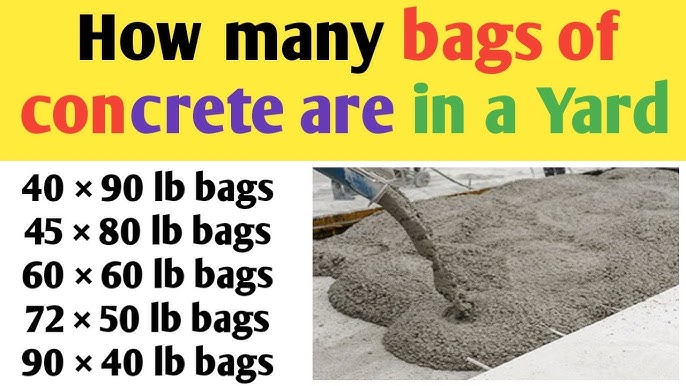
Image Source: i.ytimg.com
Deciphering Concrete Measurement: Bags vs. Cubic Yards
Before we dive into the numbers, it’s important to grasp the units of measurement. Concrete is typically sold in bulk by the cubic yard, a measure of volume. However, for smaller projects, it’s often purchased in bags, each containing a specific weight, usually 40 or 80 pounds.
A cubic yard is a volume measurement equivalent to a cube that is 3 feet wide, 3 feet deep, and 3 feet high (3 ft x 3 ft x 3 ft = 27 cubic feet).
Standard Concrete Bag Size
The most common standard concrete bag size you’ll encounter at hardware stores is 80 pounds. You’ll also find 60-pound and 40-pound bags, which are lighter and easier to handle for smaller tasks. The weight of the bag directly influences how much concrete per bag you can expect.
Cubic Yard to Bag Conversion
The conversion from cubic yards to bags is not a simple one-to-one ratio because it depends on the bag’s weight and the amount of water added during mixing.
- 80-pound bags: Generally, an 80-pound bag yields approximately 0.6 cubic feet of concrete.
- 60-pound bags: A 60-pound bag yields about 0.45 cubic feet of concrete.
- 40-pound bags: A 40-pound bag yields around 0.3 cubic feet of concrete.
To find the bags of concrete per cubic yard, we can do a simple calculation. Since a cubic yard is 27 cubic feet:
- For 80-pound bags: 27 cubic feet / 0.6 cubic feet per bag = 45 bags. This is the theoretical maximum if the bag yielded a full 0.6 cubic feet. In practice, due to water and mix variations, this number is closer to 5 to 6 bags.
- For 60-pound bags: 27 cubic feet / 0.45 cubic feet per bag = 60 bags. Again, practically, this translates to about 6 to 7 bags per cubic yard.
- For 40-pound bags: 27 cubic feet / 0.3 cubic feet per bag = 90 bags. Practically, this means about 9 to 10 bags per cubic yard.
This is why the commonly cited figure is 5 to 6 bags of concrete in a yard of concrete when referring to 80-pound bags, as it accounts for practical usage and some yield variability.
Factors Influencing Your Concrete Quantity Estimate
Making an accurate concrete quantity estimate involves more than just knowing the bag size. Several factors can affect how much concrete you’ll actually need.
Project Dimensions: The Foundation of Your Calculation
The most crucial element in any concrete quantity estimate is the size and depth of your project. Whether you’re planning how many bags of concrete for patio or a small footing, you need precise measurements.
- Length: Measure the longest side of your concrete area.
- Width: Measure the shorter side of your concrete area.
- Depth (Thickness): This is critical. For patios, walkways, or slabs, a common thickness is 4 inches. For driveways or areas that will bear heavier loads, 6 inches or more is often recommended. Always check local building codes for required depths.
Calculating Volume: From Dimensions to Cubic Feet
Once you have your dimensions, you need to convert them to a consistent unit, usually feet, and then calculate the volume.
- Convert all measurements to feet:
- If you measured in inches, divide by 12 (e.g., 4 inches / 12 inches/foot = 0.33 feet).
- Calculate the volume in cubic feet:
- Volume (cubic feet) = Length (feet) × Width (feet) × Depth (feet)
- Convert cubic feet to cubic yards:
- Volume (cubic yards) = Volume (cubic feet) / 27
Example Calculation:
Let’s say you’re building a patio that is 10 feet long, 8 feet wide, and 4 inches thick.
- Length = 10 feet
- Width = 8 feet
- Depth = 4 inches = 4 / 12 feet = 0.33 feet
Volume (cubic feet) = 10 ft × 8 ft × 0.33 ft = 26.4 cubic feet
Volume (cubic yards) = 26.4 cubic feet / 27 cubic feet/yard = 0.98 cubic yards.
This is very close to 1 cubic yard.
Waste Factor: Accounting for the Unforeseen
It’s wise to add a small percentage for waste. This accounts for concrete left in the wheelbarrow, spills, or slight inaccuracies in measurements and finishing. A typical waste factor is between 5% and 10%.
For our 0.98 cubic yard example:
- With a 10% waste factor: 0.98 cubic yards × 1.10 = 1.08 cubic yards.
So, for this patio, you’d round up to 1.1 cubic yards to be safe.
Using a Concrete Bag Calculator
To simplify these calculations, especially for those new to DIY projects, a concrete bag calculator or a concrete volume calculator can be incredibly helpful. These tools are readily available online from various construction supply companies and DIY websites.
How a Concrete Bag Calculator Works
You input your project’s length, width, and depth, and the calculator automatically performs the volume conversions and helps you determine the number of bags needed based on the standard concrete bag size you select (e.g., 80 lb, 60 lb, or 40 lb).
For instance, if you input the patio dimensions (10 ft x 8 ft x 4 inches), a good concrete calculator for DIY will tell you approximately how many bags you need. For our 0.98 cubic yards (or 1.08 with waste), using 80-pound bags:
- 1.08 cubic yards × (approximately 5.5 bags per cubic yard) = 5.94 bags.
You would then round up to 6 bags of 80-pound concrete.
How Many Bags of Concrete For Patio Projects
Patio projects are very common for DIYers, and they often fall into the 4-inch thickness range. Let’s look at some common patio sizes and estimate the number of 80-pound bags needed. Remember to always add a waste factor!
Patio Size Estimates (4-inch thickness, 80-pound bags)
| Patio Size (L x W) | Area (sq ft) | Volume (cu ft) | Volume (cu yd) | Estimated Bags (80 lb) | Estimated Bags (with 10% waste) |
|---|---|---|---|---|---|
| 4 ft x 4 ft | 16 | 5.3 | 0.20 | 1-2 | 2 |
| 6 ft x 8 ft | 48 | 16 | 0.59 | 3-4 | 4 |
| 8 ft x 10 ft | 80 | 26.4 | 0.98 | 5-6 | 6 |
| 10 ft x 12 ft | 120 | 40 | 1.48 | 8-9 | 9 |
| 12 ft x 15 ft | 180 | 60 | 2.22 | 12-13 | 13 |
Note: These numbers are estimates. The exact yield can vary slightly between brands and batches of concrete mix.
Mixing Concrete From Bags: The Practical Side
Knowing how many bags of concrete you need is only half the battle. The next step is mixing concrete from bags. This is where the water-to-mix ratio becomes critical for strength and workability.
Water-to-Mix Ratio
Each bag of concrete mix will have instructions for the amount of water to add. This is usually given as a range, for example, 3 to 4 quarts of water per 80-pound bag.
- Too little water: The concrete will be stiff, difficult to mix and pour, and may not cure properly, leading to a weaker final product.
- Too much water: The concrete will be soupy and weak. The aggregate (gravel) can separate from the cement and sand, resulting in a porous and brittle surface that is prone to cracking and crumbling.
Follow the manufacturer’s recommendations closely. It’s often best to start with the lower end of the recommended water range and add more a little at a time until you reach the desired consistency.
Achieving the Right Consistency
The ideal consistency for most applications is often described as “workable” or “plastic.” It should be thick enough to hold its shape but pliable enough to be troweled smooth.
- Test Consistency: A good test is the “slump test” (though usually performed with larger batches). For DIY, try scooping a bit of concrete into your trowel. If it flows off easily with minimal effort, it’s likely too wet. If it’s very stiff and hard to dislodge, it might be too dry. It should mound on the trowel and then slowly yield.
Mixing Methods
- Wheelbarrow and Hoe: This is the most common method for mixing concrete from bags.
- Pour the dry concrete mix into a clean wheelbarrow.
- Create a well or crater in the center of the dry mix.
- Add about two-thirds of the recommended water into the well.
- Gradually incorporate the dry mix from the sides into the water using a shovel or concrete hoe.
- Mix thoroughly, adding more water a little at a time until the desired consistency is reached. Ensure all dry pockets are mixed in.
- Concrete Mixer: For larger projects where you need multiple bags, a portable electric or gas-powered concrete mixer is highly recommended.
- Add about half the required water to the mixer drum.
- Gradually add the dry concrete mix while the drum is rotating.
- Add the remaining water slowly until the desired consistency is achieved.
- Mix for at least 3-5 minutes after all ingredients are added to ensure thorough blending.
How Much Concrete Per Bag?
This question relates back to the yield. As mentioned, an 80-pound bag of concrete mix typically yields about 0.6 cubic feet. This means:
- An 80 lb bag yields approximately 0.6 cu ft.
- A 60 lb bag yields approximately 0.45 cu ft.
- A 40 lb bag yields approximately 0.3 cu ft.
If you need to fill a space that is 1 cubic foot, you would need about 1.67 bags of 80-pound concrete (1 cu ft / 0.6 cu ft per bag).
Beyond the Basics: Advanced Considerations
While understanding the basic conversion is key, some advanced factors might influence your project.
Different Concrete Mix Types
The calculations above generally refer to standard concrete mix (often called “all-purpose” or “all-purpose concrete mix”). However, there are specialized mixes:
- Mortar Mix: Used for laying bricks and stones. It has a different sand-to-cement ratio.
- Concrete Patching Compound: For repairing small cracks and holes.
- Fast-Setting Concrete: Designed to cure much quicker, useful for posts or urgent repairs.
- High-Strength Concrete: Formulated for applications requiring exceptional durability.
Always ensure you are using the correct mix type for your application and consult its specific yield information if available.
Sub-Base Preparation
The longevity and strength of your concrete project depend heavily on the sub-base preparation. This usually involves compacting a layer of gravel or crushed stone. An improperly prepared base can lead to settling and cracking, regardless of how much concrete you used or how well you mixed it.
Environmental Factors
- Temperature: Extreme heat or cold can affect curing. In hot weather, concrete can dry too quickly, leading to cracks. In cold weather, it can freeze before it cures, rendering it useless.
- Humidity: High humidity can slow down the drying process.
Frequently Asked Questions (FAQ)
Q1: How many bags of concrete do I need for a 4×4 foot slab that is 4 inches thick?
For a 4 ft x 4 ft slab with a 4-inch thickness, you need approximately 0.20 cubic yards of concrete. Using 80-pound bags, this translates to about 1-2 bags. It’s always recommended to round up, so purchase 2 bags to account for any slight variations or waste.
Q2: Can I mix concrete in a small bucket?
Yes, you can mix concrete in a small bucket for very small repairs or jobs. However, for anything larger than a few gallons, a wheelbarrow or a concrete mixer is much more efficient and effective. Be mindful of the water-to-mix ratio and ensure thorough mixing.
Q3: What is the yield of a 60-pound bag of concrete?
A standard 60-pound bag of concrete mix typically yields about 0.45 cubic feet of concrete.
Q4: How do I calculate the amount of concrete for a footing?
Footings are usually rectangular prisms. Measure the length, width, and depth of your footing in feet, multiply these three dimensions to get the volume in cubic feet, and then divide by 27 to convert to cubic yards. Then, use a concrete bag calculator or the conversion factor (approx. 5.5 bags of 80lb concrete per cubic yard) to determine the number of bags.
Q5: Is it better to buy concrete in bags or as a ready-mix delivery?
For small to medium DIY projects, bags are often more convenient and cost-effective. For larger projects (typically over 1 cubic yard), ready-mix concrete delivered by a truck is usually more economical and ensures consistent quality and less labor for mixing.
Q6: How much does a yard of concrete cost?
The cost of a cubic yard of concrete can vary significantly based on your location, the type of mix, and whether you’re buying bagged mixes or ordering ready-mix. Bagged concrete can range from $5-$10 per 80-pound bag, meaning a cubic yard (roughly 5-6 bags) would cost $25-$60. Ready-mix delivery typically costs $100-$150 per cubic yard, plus potential delivery fees.
Q7: Who can I ask if I have more questions about my concrete project?
Your local building supply store or hardware store is an excellent resource. The staff there can offer advice on the best concrete mixes for your specific needs and help you with concrete quantity estimate calculations. Many landscaping or concrete contractors are also willing to offer advice.
Conclusion
Accurately estimating the amount of concrete needed is crucial for a successful DIY project. By following the steps outlined, utilizing a concrete bag calculator, and paying attention to detail in your measurements and mixing, you can ensure you have the right amount of material to complete your project efficiently and effectively. Remember that adding a small buffer for waste is always a good practice. Happy concreting!