
The most common answer to “How many bags of Quikrete are in a yard?” depends on the bag size. Generally, a standard 80-pound bag of Quikrete yields approximately 0.6 cubic feet of concrete, meaning you’ll need around 4.5 to 5 standard 80-pound bags to make 1 cubic yard of concrete. If you are using the 60-pound bags, you will need roughly 6 to 7 bags per cubic yard.
When embarking on any concrete project, from pouring a small patio to building a sturdy foundation, a critical question arises: how many bags of Quikrete are in a yard? This isn’t just a curious query; it’s fundamental to accurate material estimation, budget planning, and ensuring you have enough concrete without excessive waste. This comprehensive guide will break down the complexities of Quikrete per cubic yard, delve into Quikrete bag yield, and provide you with the tools and knowledge to confidently tackle your next concrete project.
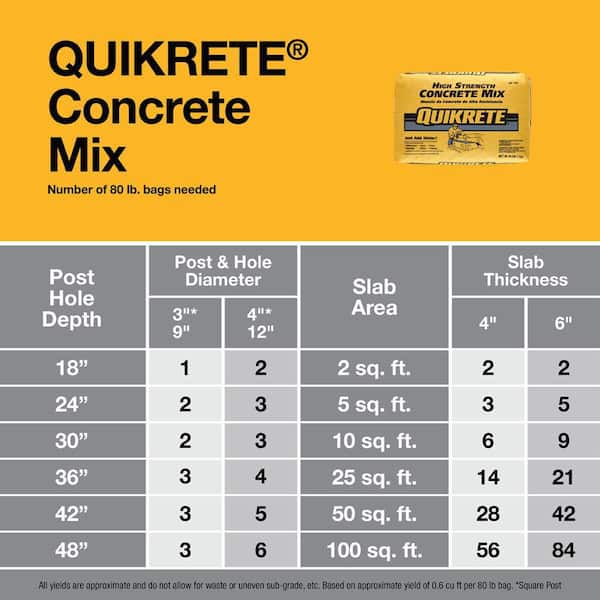
Image Source: images.thdstatic.com
Deciphering Concrete Volume: The Cubic Yard
Before we can answer how many bags of Quikrete are in a yard, we must first grasp what a cubic yard actually is. A cubic yard is a unit of volume. Imagine a cube that is 3 feet long, 3 feet wide, and 3 feet high. That entire cube would represent 1 cubic yard of space.
- Dimensions: 3 feet x 3 feet x 3 feet = 27 cubic feet
- Conversion: 1 cubic yard = 27 cubic feet
This measurement is the standard for ordering and estimating bulk concrete. When you see pricing for concrete, it’s almost always quoted per cubic yard.
Quikrete Bag Yield: The Key to Calculation
Quikrete, a popular brand of pre-mixed concrete, offers various bag sizes, each with a specific yield. The yield is the amount of finished concrete you can expect from one bag. This is the most crucial piece of information for determining how many bags of Quikrete are in a yard.
The most common Quikrete bag sizes and their approximate yields are:
- 80-pound bag: Typically yields about 0.6 cubic feet of concrete.
- 60-pound bag: Typically yields about 0.45 cubic feet of concrete.
- 50-pound bag: Typically yields about 0.38 cubic feet of concrete.
It’s important to note that these are approximate yields. Factors like the exact amount of water added and the degree of mixing can slightly influence the final volume. Always check the specific product packaging for the most accurate yield information.
Calculating Quikrete Needed: From Cubic Feet to Cubic Yards
Now, let’s put it all together to answer the central question: how many bags of Quikrete are in a yard?
We know that 1 cubic yard is equal to 27 cubic feet. We also know the yield of a Quikrete bag. To find out how many bags are needed for a cubic yard, we divide the total cubic feet in a yard by the cubic feet yielded by one bag.
For 80-pound Bags:
- Calculation: 27 cubic feet (per cubic yard) / 0.6 cubic feet (per 80lb bag) = 45 bags
- Result: Approximately 4.5 to 5 80-pound bags of Quikrete are needed to make 1 cubic yard of concrete.
For 60-pound Bags:
- Calculation: 27 cubic feet (per cubic yard) / 0.45 cubic feet (per 60lb bag) = 60 bags
- Result: Approximately 6 to 7 60-pound bags of Quikrete are needed to make 1 cubic yard of concrete.
For 50-pound Bags:
- Calculation: 27 cubic feet (per cubic yard) / 0.38 cubic feet (per 50lb bag) = 71.05 bags
- Result: Approximately 7 to 8 50-pound bags of Quikrete are needed to make 1 cubic yard of concrete.
This gives us a clear answer to how much Quikrete for yard projects.
The Quikrete Calculator: Simplifying Your Estimates
To make this process even easier, many manufacturers, including Quikrete, offer online Quikrete calculators or Quikrete volume calculators. These tools are invaluable for estimating the Quikrete per cubic yard needed for specific project dimensions.
You typically input the length, width, and depth of your desired concrete pour (in feet or inches), and the calculator automatically converts these dimensions into cubic feet and then into the number of bags required, based on the bag size you select. This eliminates the need for manual calculations and reduces the chance of errors.
Factors Affecting Your Concrete Needs
While the calculations above provide a solid baseline, several factors can influence the actual amount of Quikrete you’ll need:
1. Project Dimensions and Depth
This is the most significant factor. A larger area or a deeper pour will naturally require more concrete. Always measure your project dimensions accurately.
Example: If you need to pour a 4-foot by 8-foot slab that is 4 inches deep:
- Convert depth to feet: 4 inches / 12 inches/foot = 0.33 feet
- Calculate volume in cubic feet: 4 ft x 8 ft x 0.33 ft = 10.56 cubic feet
- Convert cubic feet to cubic yards: 10.56 cubic feet / 27 cubic feet/cubic yard = 0.39 cubic yards
Now, using our earlier figures, you can estimate the bags needed for this 0.39 cubic yard project:
- 80-pound bags: 0.39 cubic yards * 4.5 bags/cubic yard = 1.75 bags (round up to 2 bags)
- 60-pound bags: 0.39 cubic yards * 6.5 bags/cubic yard = 2.53 bags (round up to 3 bags)
2. Waste and Spillage
It’s a good practice to add a small buffer to your estimate to account for potential waste, spillage, or slight variations in the sub-base. A common recommendation is to add 5-10% extra.
Calculation with a 10% buffer:
- For 4.5 bags: 4.5 bags * 1.10 = 4.95 bags (round up to 5 bags)
- For 6.5 bags: 6.5 bags * 1.10 = 7.15 bags (round up to 8 bags)
Always err on the side of having slightly too much rather than too little. Running out of concrete mid-pour is a significant problem that can lead to weak joints and an uneven finish.
3. Sub-Base Irregularities
If your prepared sub-base isn’t perfectly level, you might need more concrete than calculated to fill low spots and achieve the desired final depth. Compact the sub-base thoroughly to minimize these irregularities.
4. Compaction and Mixing Variations
The Quikrete bag yield can be slightly affected by how well the material is mixed and compacted. Overwatering can lead to segregation and reduced strength, while too little water makes the mix difficult to work with. Follow the manufacturer’s instructions for water addition precisely.
The Concrete Mix Ratio Per Yard: A Deeper Dive
While Quikrete is a pre-mixed product, understanding the fundamental concrete mix ratio per yard is still beneficial for context. Traditional concrete is made from Portland cement, aggregate (sand and gravel), and water. The typical mix ratio for a strong, durable concrete might be around 1:2:3 (cement:sand:gravel) by volume, with water added to achieve the desired workability.
Quikrete essentially combines these ingredients in a carefully controlled ratio within their bags. When you add water, you’re activating this pre-measured mix to create concrete. This pre-mixed convenience is why Quikrete is so popular for DIY projects.
Quikrete Coverage Per Bag: Beyond Volume
While volume is key for how many bags of Quikrete are in a yard, sometimes you might encounter information about Quikrete coverage per bag. This is usually expressed in terms of surface area and thickness.
For example, a 60-pound bag of Quikrete might cover approximately 0.5 square feet at a 2-inch thickness. This type of information is useful for very shallow pours, like patching or thin overlays, where precise volume calculations might be less critical than surface coverage. However, for most foundational or structural work, relying on cubic yard estimates is more accurate.
Converting Cubic Yards to Quikrete Bags: Your Go-To Table
To quickly reference cubic yard to Quikrete bags conversions for common bag sizes, use this handy table:
| Bag Size | Approximate Yield (cu ft) | Bags per Cubic Yard (approx.) | Estimated Extra Bags (10% buffer) |
|---|---|---|---|
| 80-pound | 0.6 | 4.5 – 5 | 5 – 6 |
| 60-pound | 0.45 | 6 – 7 | 7 – 8 |
| 50-pound | 0.38 | 7 – 8 | 8 – 9 |
Important Note: Always double-check the specific product packaging for the most accurate yield information.
Practical Tips for Estimating and Buying Quikrete
- Measure Twice, Buy Once: Accurate measurements are paramount. Use a tape measure and sketch out your project area.
- Sketch Your Project: Draw a simple diagram of your pour area and label the dimensions. This helps visualize the volume needed.
- Use a Quikrete Calculator: Leverage online tools to cross-reference your manual calculations.
- Consider Bag Size: 80-pound bags are generally more economical per cubic foot of concrete, but they are heavier and harder to handle. 60-pound bags are easier to manage for smaller projects or if you have physical limitations.
- Factor in Storage: If you have a large project, consider how you will store the bags. They need to be kept dry and protected from the elements.
- Don’t Forget Additives: For certain applications, you might need Quikrete additives like plasticizers or accelerators. Factor these into your purchase if necessary.
- When in Doubt, Buy Extra: It is far better to have a few extra bags than to be short. Unused Quikrete can often be returned if it’s in good condition and within the store’s return policy.
Frequently Asked Questions (FAQ)
Q1: How many bags of Quikrete do I need for a 4-inch thick slab?
A1: This depends on the surface area of the slab. First, calculate the volume in cubic feet. For example, a 4ft x 4ft slab that is 4 inches (0.33 ft) thick has a volume of 4ft * 4ft * 0.33ft = 5.28 cubic feet. To convert this to cubic yards: 5.28 cu ft / 27 cu ft/cu yd = 0.196 cubic yards. Using our table, you’d need approximately 0.196 * 4.5 bags/cu yd = 0.88 bags of 80lb Quikrete. So, you would need at least 1 bag, but likely 2 bags to account for waste and ensure a good pour.
Q2: Can I mix Quikrete by hand?
A2: Yes, for small projects, Quikrete can be mixed by hand in a wheelbarrow or mixing tub. Ensure thorough mixing to achieve a consistent color and strength. For larger projects, a mechanical mixer is highly recommended.
Q3: How much water should I add to a bag of Quikrete?
A3: Always refer to the specific product packaging for the recommended water amount. Generally, an 80-pound bag requires about 3.5 to 4 quarts of water, and a 60-pound bag requires about 2.5 to 3 quarts. Adding too much water will weaken the concrete.
Q4: What is the difference between Quikrete and regular concrete?
A4: Quikrete is a pre-packaged, dry concrete mix that contains Portland cement, sand, and gravel. Regular concrete is typically mixed on-site from its individual components (cement, sand, gravel, and water). Quikrete offers convenience and consistency for DIY projects.
Q5: What is the best way to calculate how much Quikrete for a specific project?
A5: The most effective way is to first calculate the volume of your project in cubic feet (Length x Width x Depth) and then convert that to cubic yards (divide by 27). Once you have your cubic yardage, use the Quikrete bag yield for your chosen bag size to determine the number of bags needed. Using an online Quikrete calculator is also an excellent method.
Q6: How can I ensure the correct concrete mix ratio per yard when using Quikrete?
A6: By following the water instructions on the Quikrete bag precisely. The manufacturer has already pre-mixed the cement, sand, and aggregate in the correct proportions. Your role is to add the specified amount of water for optimal strength and workability.
By carefully considering these calculations and practical tips, you can confidently determine how many bags of Quikrete are in a yard and ensure you have the right amount of material for a successful concrete project. Happy building!