
Image Source: i.ytimg.com
How Many Bags Of Concrete Are In 1 Yard? A Guide
How many bags of concrete are in 1 cubic yard? Typically, there are about 5 to 6 bags of concrete in 1 cubic yard, depending on the bag size. This guide will help you navigate the world of concrete bags and cubic yards, making your next project a breeze.
Deciphering Concrete Bag Sizes and Yield
When you’re planning a concrete project, knowing exactly how much concrete you need is crucial. This often leads to a common question: “How many bags of concrete are in 1 cubic yard?” The answer isn’t a single, simple number because concrete bags come in various sizes. However, by understanding the basics of concrete yield and bag volumes, you can accurately estimate your needs.
The Cubic Yard: A Standard Measure
A cubic yard is a unit of volume. It represents a cube that is 3 feet wide, 3 feet long, and 3 feet high (3ft x 3ft x 3ft = 27 cubic feet). This is the standard way concrete is sold in bulk. When you order ready-mix concrete, you’ll specify how many cubic yards you require.
Standard Concrete Bag Weight and Volume
Concrete bags are commonly found in two primary weights: 40-pound bags and 60-pound bags. Some areas may also offer 80-pound bags. The volume each bag yields is what truly matters when converting to cubic yards.
- 40-pound bag: Typically yields about 0.30 cubic feet of concrete.
- 60-pound bag: Typically yields about 0.45 cubic feet of concrete.
- 80-pound bag: Typically yields about 0.60 cubic feet of concrete.
It’s important to note that these are approximate yields. The actual yield can vary slightly based on the specific mix, water added, and compaction. Always check the packaging for the manufacturer’s stated yield.
Calculating Bags of Concrete Per Cubic Yard
To figure out how many bags of concrete are in 1 cubic yard, we need to convert the cubic yard volume to cubic feet, as bag yields are usually given in cubic feet.
- 1 cubic yard = 27 cubic feet
Now, we can calculate the number of bags for each common size:
- For 40-pound bags:
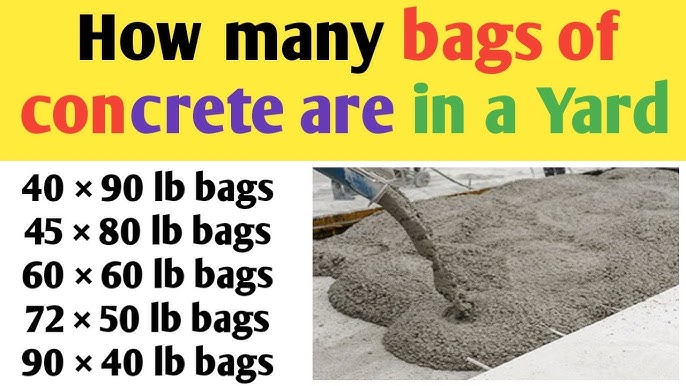
- 27 cubic feet / 0.30 cubic feet per bag = 90 bags
- For 60-pound bags:
- 27 cubic feet / 0.45 cubic feet per bag = 60 bags
- For 80-pound bags:
- 27 cubic feet / 0.60 cubic feet per bag = 45 bags
This gives us a clearer picture. So, to directly answer the question, 1 cubic yard of concrete bags is approximately 90 bags of 40 lbs, 60 bags of 60 lbs, or 45 bags of 80 lbs.
The Concrete Bag Calculator in Action
This is where a concrete bag calculator becomes incredibly useful. These tools simplify the process of estimating. You input the dimensions of your project (length, width, and depth) in feet or inches, and the calculator automatically computes the total cubic feet or cubic yards needed. It then uses standard bag yields to tell you how many bags of a specific weight you’ll require. Many online calculators are available for free.
Estimating Concrete Bags for Your Project
Beyond just knowing the conversion, estimating concrete bags involves a bit more thought to ensure you don’t end up short or with excessive waste.
Measuring Your Project Accurately
Before you reach for a concrete calculator, you must accurately measure the area you need to cover.
- For slabs or rectangular areas: Measure the length and width in feet. For depth, consider the required thickness in inches. Convert the depth to feet by dividing by 12 (e.g., 4 inches / 12 inches/foot = 0.33 feet).
- Volume (cubic feet) = Length (ft) × Width (ft) × Depth (ft)
- For circular areas: Measure the diameter in feet. The radius is half the diameter.
- Volume (cubic feet) = π × Radius (ft)² × Depth (ft) (where π is approximately 3.14159)
- For irregular shapes: Break down the area into simpler geometric shapes (rectangles, triangles, circles), calculate the volume of each, and add them together.
Accounting for Waste and Spillage
It’s always wise to add a buffer of 5-10% to your concrete estimate. This accounts for:
- Uneven subgrade: Low spots will require more concrete to fill.
- Spillage: Some concrete will inevitably be lost during mixing, transport, and pouring.
- Compaction: Concrete can settle slightly after placement.
So, if your calculation shows you need 1 cubic yard, it’s safer to purchase enough for 1.05 or 1.10 cubic yards.
Converting Cubic Yards to Bags: A Practical Approach
Let’s put the conversion into practice with an example. Suppose you need to pour a concrete patio that is 10 feet long, 8 feet wide, and 4 inches thick.
- Convert thickness to feet: 4 inches / 12 inches/foot = 0.33 feet.
- Calculate volume in cubic feet: 10 ft × 8 ft × 0.33 ft = 26.4 cubic feet.
- Convert volume to cubic yards: 26.4 cubic feet / 27 cubic feet/cubic yard = 0.98 cubic yards.
Now, using our previous calculations:
- If you are using 40-pound bags (0.30 cubic feet yield):
- 0.98 cubic yards × 90 bags/cubic yard = 88.2 bags.
- Add 10% for waste: 88.2 × 1.10 = 97.02 bags. You would round up and buy 98 bags.
- If you are using 60-pound bags (0.45 cubic feet yield):
- 0.98 cubic yards × 60 bags/cubic yard = 58.8 bags.
- Add 10% for waste: 58.8 × 1.10 = 64.68 bags. You would round up and buy 65 bags.
- If you are using 80-pound bags (0.60 cubic feet yield):
- 0.98 cubic yards × 45 bags/cubic yard = 44.1 bags.
- Add 10% for waste: 44.1 × 1.10 = 48.51 bags. You would round up and buy 49 bags.
This shows why converting cubic yards to bags requires careful calculation and a buffer.
The Role of Concrete Mix Ratio Per Yard
The concrete mix ratio per yard refers to the proportions of cement, sand, aggregate (gravel), and water used to create the concrete. While pre-bagged concrete has a set ratio, understanding this can be helpful if you’re mixing your own from scratch or for specialized applications.
A common mix ratio for general-purpose concrete (often referred to as 3000 psi concrete) might be:
- 1 part cement
- 2 parts sand
- 3 parts gravel
The amount of water is critical and usually determined by the desired slump (consistency) and the moisture content of the aggregates. A typical water-to-cement ratio for durable concrete is between 0.40 and 0.50.
When you buy bagged concrete, the manufacturer has already determined the optimal concrete mix ratio per yard to achieve specific strength and workability characteristics. This saves you the complexity of measuring out individual components.
What is a Yard of Concrete?
As established, how much concrete is a yard refers to a cubic yard, a standard unit of volume equal to 27 cubic feet. It’s the measure used for bulk concrete deliveries. Understanding this basic definition is the first step in any concrete project calculation.
Fathoming the Nuances of Concrete Projects
When to Use Bagged Concrete vs. Ready-Mix
Bagged concrete is generally suitable for smaller projects where precise volume is not a major concern, or when access for a ready-mix truck is difficult. These include:
- Setting fence posts
- Repairing small cracks or holes
- Small patio slabs or walkways
- Repairing steps
Ready-mix concrete is the preferred choice for larger projects like driveways, large patios, foundations, and structural elements. It offers:
- Consistent quality and strength
- Precise mix ratios
- Less labor for mixing on-site
- Bulk ordering convenience
The Importance of Water Content
Adding the correct amount of water to bagged concrete is paramount. Too little water makes the mix difficult to work with and can lead to a weaker final product. Too much water weakens the concrete significantly and can cause shrinkage cracks.
- Follow the manufacturer’s instructions on the bag precisely.
- Use measuring containers for accuracy.
- The goal is a workable mix that holds its shape when squeezed in your hand but isn’t soupy.
Tools for Your Concrete Project
Beyond the bags of concrete, you’ll need various tools:
- Wheelbarrow: For mixing and transporting concrete.
- Shovel: For mixing and moving dry and wet concrete.
- Hoe: For mixing concrete.
- Buckets: For measuring water.
- Level: To ensure your pour is flat.
- Screed board: A long, straight board to level the concrete surface.
- Float (Bull Float or Hand Float): To smooth the surface after screeding.
- Edger and Groover: For finishing the edges and control joints.
- Trowel: For final smoothing.
- Gloves, eye protection, and a dust mask: For safety.
Site Preparation
Proper site preparation is critical for a successful concrete pour:
- Excavation: Dig out the area to the required depth, accounting for the concrete thickness and any base material (like gravel).
- Base Material: Install a compacted layer of gravel (typically 4-6 inches) for drainage and support.
- Formwork: Build sturdy forms around the perimeter of the pour area using lumber. Ensure they are level and well-braced to withstand the pressure of wet concrete.
- Vapor Barrier (for slabs): For slabs on grade that will have finished flooring, lay down a plastic vapor barrier to prevent moisture from migrating upwards.
Frequently Asked Questions (FAQ)
Q1: How many 50 lb bags of concrete are in a cubic yard?
A1: A 50 lb bag typically yields about 0.375 cubic feet. To convert a cubic yard (27 cubic feet) to bags: 27 / 0.375 = 72 bags. So, there are approximately 72 bags of 50 lb concrete in 1 cubic yard.
Q2: Can I mix concrete in a wheelbarrow?
A2: Yes, for small projects, mixing concrete in a wheelbarrow is common. Ensure the wheelbarrow is clean and has a solid base. For larger projects, a cement mixer is more efficient.
Q3: How much concrete do I need for a 4×8 foot patio 4 inches thick?
A3: This project requires approximately 0.98 cubic yards of concrete. Using 60 lb bags (0.45 cu ft yield), you’d need about 65 bags after accounting for waste.
Q4: What is the difference between cement and concrete?
A4: Cement is a binder, a powder that, when mixed with water, hardens and binds other materials together. Concrete is a composite material made from cement, water, sand (fine aggregate), and gravel (coarse aggregate).
Q5: How long does concrete take to cure?
A5: Concrete begins to harden within hours, but it takes about 28 days to reach its full designed strength (cure). It’s crucial to keep newly poured concrete moist for the first several days to promote proper curing.
Q6: What does “psi” mean for concrete?
A6: PSI stands for pounds per square inch, a measure of compressive strength. For example, 3000 psi concrete means the concrete can withstand 3000 pounds of force per square inch before failing.
By now, you should have a solid grasp of how to determine how many bags of concrete are in 1 yard. Always use a reliable concrete calculator and remember to add a buffer for waste. Happy concreting!